 cord
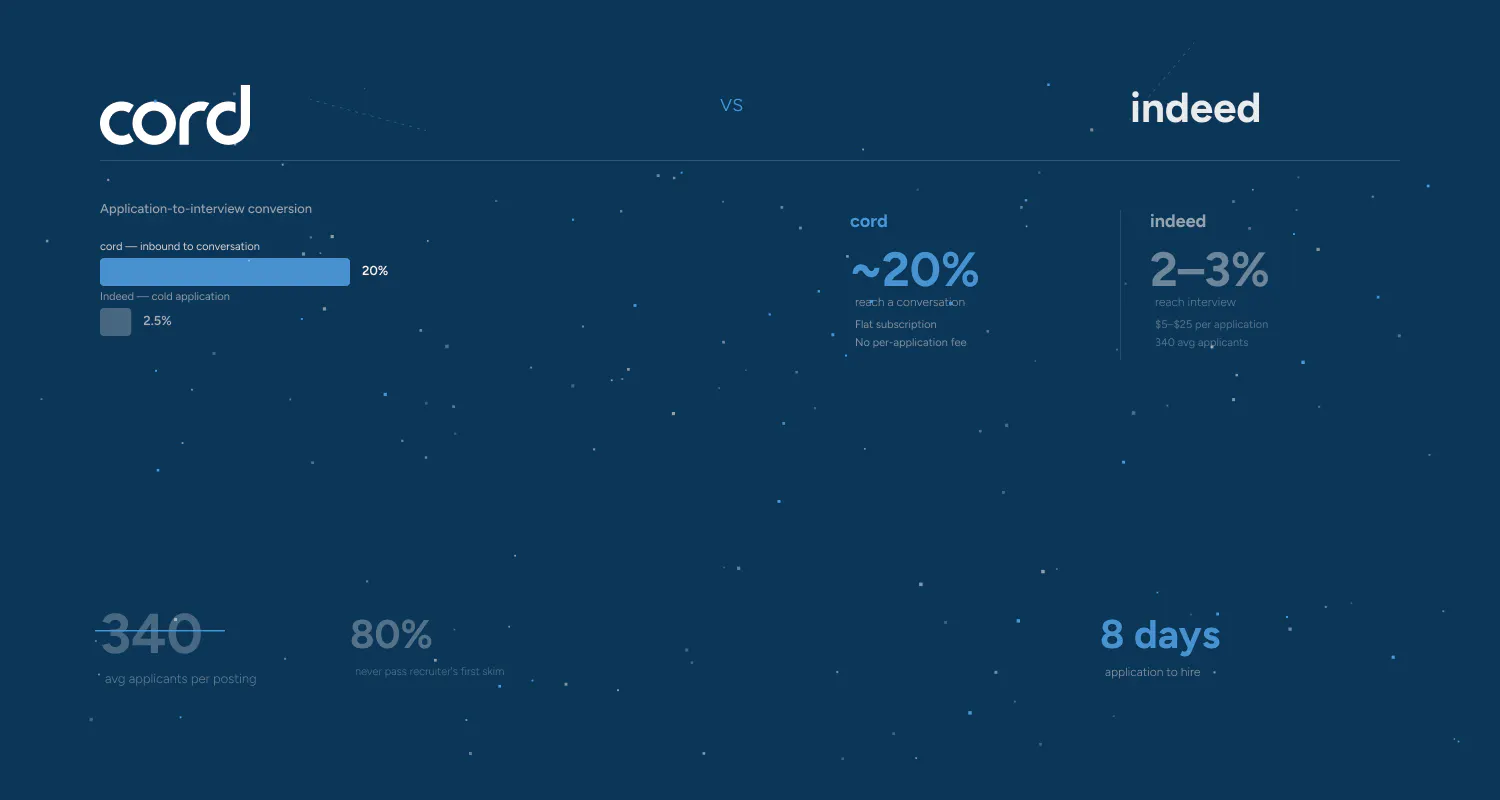
cordApplications to interviews ratio: cord vs Indeed
September 4, 2026
On most job boards, between 2 and 3% of applications turn into an interview. Referrals and direct-sourced candidates convert far higher. So the question isn't how many applications a posting pulls, it's how many of them were ever going to become a hire, and that depends almost entirely on where they came from.
What is a good application-to-interview conversion rate?
The application-to-interview conversion rate is the percentage of applications that lead to a scheduled interview, calculated as interviews divided by applications times 100. Cold applications through general job boards convert at about 2 to 3%. Optimised corporate funnels average 8 to 12% (Jobvite reports around 8.4%), and referrals or well-matched, targeted applications convert higher still, often 20 to 40%.
Application-to-interview rate by source:
- Cold job-board application, for example Indeed: 2 to 3%.
- General or optimised corporate funnel: 8 to 12%.
- Referral: 30 to 40%.
- Direct-sourced, already-engaged engineer: highest of all.
Why do so few Indeed applications convert?
The problem is volume without fit. A single job advertisement now draws an average of 340 applicants (Ashby, 2025), and around 80% never get past a recruiter's first skim, who spends roughly 30 seconds per CV (StandOut CV). A general board is built to maximise reach, so it fills the top of the funnel with applications, most of which were never a match. Indeed's sponsored jobs bill per application or per click, commonly $5 to $25 each, so you pay to attract that pile and pay again in the hours it takes to sort it.
How direct sourcing changes the number
The way to lift conversion is to start with people who fit, rather than filter a crowd who mostly don't. That's the shift developer hiring has already made: with cold response rates on general platforms dropping below 3%, recruiters are moving to places where engaged engineers already are (daily.dev). cord works the same way from the employer's side. Because the people applying and being messaged are engineers who use the platform, inbound applications on cord reach a live conversation with the company about 20% of the time, and a full-stack engineer who applied to a London company this way was hired eight days later. Fewer applications, far more of them real.
One caveat on comparing those figures: cord's 20% is application to conversation, while the job-board benchmarks are application to interview. They are adjacent funnel stages, not the same one.
Indeed vs cord
They are built for different jobs, and it's worth being clear about which does what.
- Best at. Indeed: reach and volume across every role type. cord: fit, for engineering roles specifically.
- Conversion. Indeed: around 2 to 3% of cold applications reach interview. cord: inbound reaches a conversation around 20% of the time.
- Cost. Indeed: $5 to $25 per application, plus the hours spent sorting. cord: flat subscription, no per-application fee.
- Where it wins. Indeed: high-volume, generalist or non-technical hiring. cord: technical hiring, where a filtered pool matters more than reach.
Indeed genuinely wins when you want maximum reach across many role types, or you're hiring at volume for generalist roles. For hiring engineers, where a smaller pool of people who actually fit beats a large pile that mostly doesn't, the maths runs the other way.
Frequently asked questions
What is a good application-to-interview conversion rate?
Cold job-board applications convert at about 2 to 3%; optimised funnels average 8 to 12% (Jobvite around 8.4%); referrals and targeted applications reach 20 to 40%.
Why do most job-board applicants get rejected?
A single posting averages 340 applicants and around 80% are filtered on a 30-second skim, because general boards optimise for reach, which fills the funnel with people who don't fit the role.
What are the alternatives to Indeed for hiring developers?
Specialised platforms that reach engaged engineers rather than the whole market: developer communities and job boards (Dice, Wellfound, We Work Remotely, daily.dev), vetted networks (Toptal, Hired), and direct-sourcing platforms like cord, where you message engineers who fit instead of waiting on inbound volume.
Application count tells you how visible a posting was. Conversion tells you whether you're about to hire someone. On a general board the first number is easy and the second is low, and for engineering roles that trade is rarely worth making.