 cord
cord10 Types of Employment Contracts for International Teams
And Why Getting This Wrong Can Cost You Millions
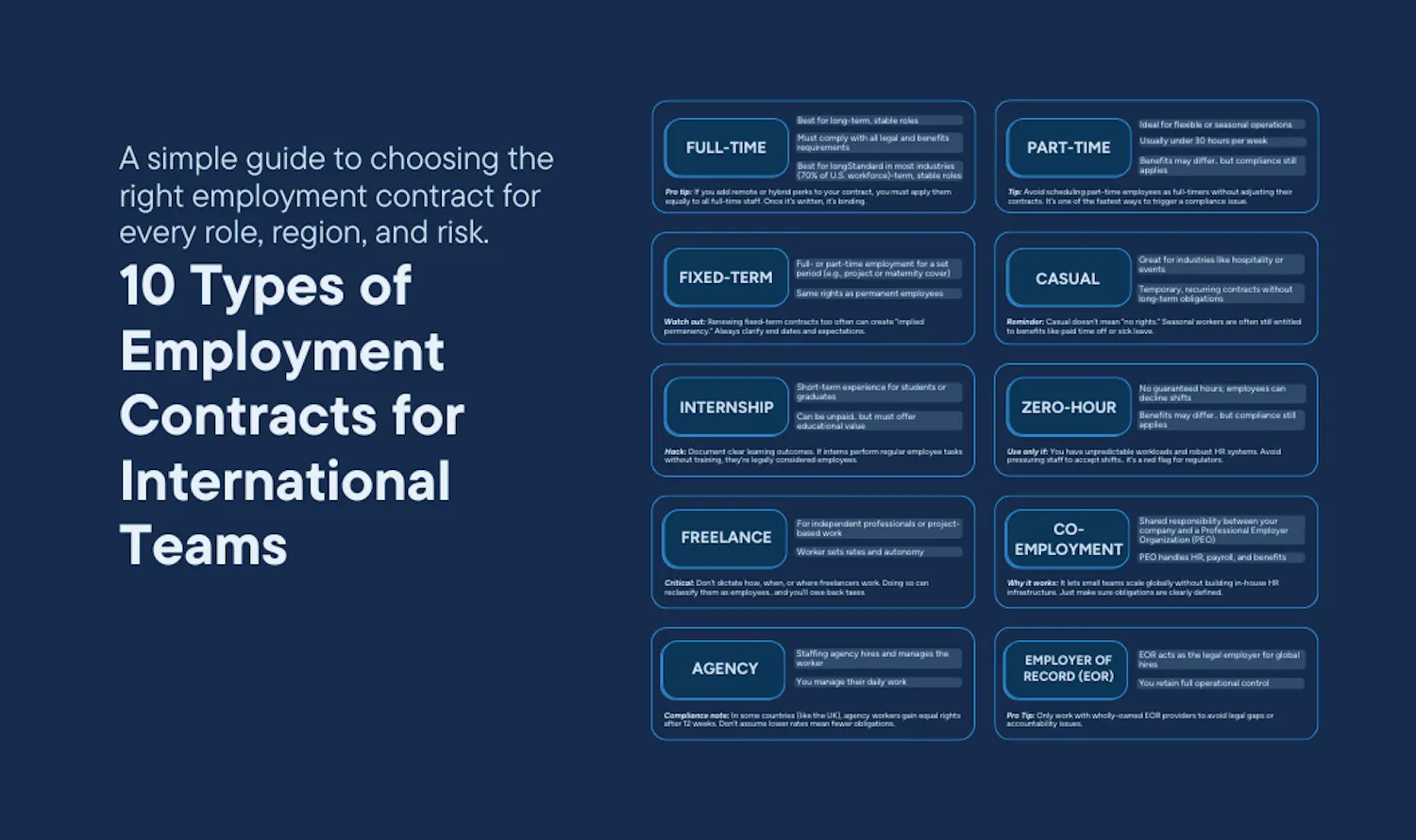
Building a global team isn't just about finding great talent—it's about structuring how you work together legally and compliantly.
We've seen companies lose millions not from bad hires, but from misclassified contracts. And in today's borderless workforce, that mistake can happen faster than ever.
If you're scaling internationally, understanding the different types of employment contracts isn't just about compliance. It's strategy. The right contract shapes how your people grow, collaborate, and do their best work.
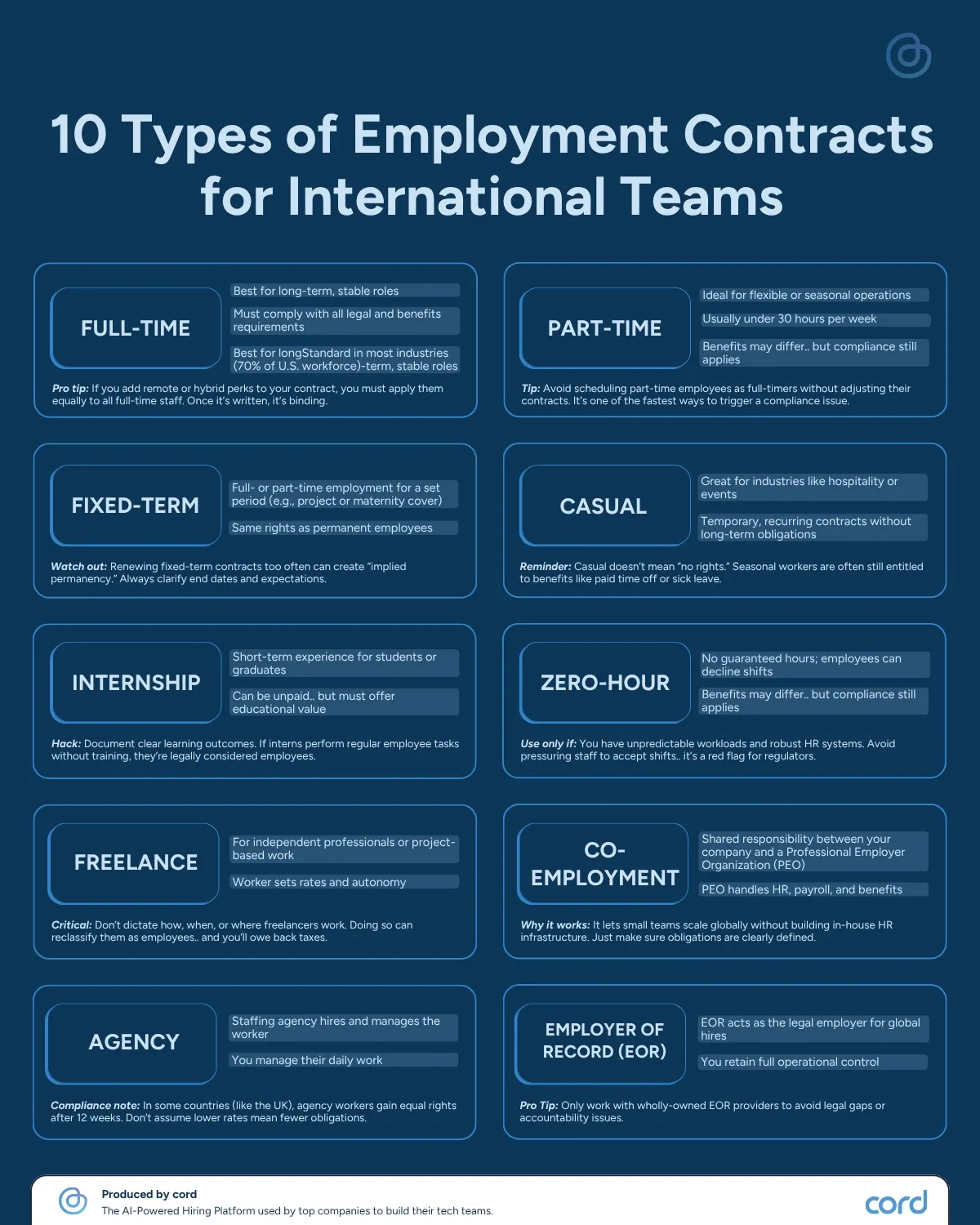
Here's your breakdown of the 10 employment contract types you need to know:
1. Full-Time
Best for: Long-term, stable roles
Full-time contracts are standard in most industries (covering about 70% of the U.S. workforce) and require compliance with all legal and benefits requirements in the employee's country.
Pro tip: If you add remote or hybrid perks to your contract, you must apply them equally to all full-time staff. Once it's written, it's binding.
2. Part-Time
Ideal for: Flexible or seasonal operations
Part-time employees usually work under 30 hours per week. Benefits may differ from full-time staff, but compliance still applies.
Tip: Avoid scheduling part-time employees as full-timers without adjusting their contracts. It's one of the fastest ways to trigger a compliance issue.
3. Fixed-Term
Best for: Project-based work or temporary coverage (like maternity leave)
Fixed-term employees have the same rights as permanent employees, but the contract clearly defines the start and end dates.
Watch out: Renewing fixed-term contracts too often can create "implied permanency." Always clarify end dates and expectations upfront.
4. Casual
Great for: Industries like hospitality or events
Casual contracts are temporary and recurring, with no long-term obligations. They're flexible by design.
Reminder: Casual doesn't mean "no rights." Seasonal workers are often still entitled to benefits like paid time off or sick leave depending on the jurisdiction.
5. Internship
Best for: Short-term experience for students or graduates
Internships can be unpaid, but they must offer educational value and clear learning outcomes.
Hack: Document clear learning outcomes. If interns perform regular employee tasks without training, they're legally considered employees in many regions.
6. Zero-Hour
Best for: Unpredictable workloads
Zero-hour contracts offer no guaranteed hours. Employees can decline shifts, and benefits may differ—but compliance still applies.
Use only if: You have unpredictable workloads and robust HR systems. Avoid pressuring staff to accept shifts. It's a red flag for regulators.
7. Freelance
Best for: Independent professionals or project-based work
Freelancers set their own rates and work with autonomy. They're not employees, so they handle their own taxes and benefits.
Critical: Don't dictate how, when, or where freelancers work. Doing so can reclassify them as employees, and you'll owe back taxes.
8. Co-Employment
Best for: Small teams scaling globally without in-house HR
Co-employment involves shared responsibility between your company and a Professional Employer Organization (PEO). The PEO handles HR, payroll, and benefits.
Why it works: It lets small teams scale globally without building full HR infrastructure. Just make sure obligations are clearly defined.
9. Agency
Best for: Filling short-term staffing needs
A staffing agency hires and manages the worker. You manage their daily work and tasks.
Compliance note: In some countries (like the UK), agency workers gain equal rights after 12 weeks. Don't assume lower rates mean fewer obligations.
10. Employer of Record (EOR)
Best for: Hiring globally without setting up a legal entity
An EOR acts as the legal employer for your global hires. You retain full operational control over the work.
Pro Tip: Only work with wholly-owned EOR providers to avoid legal gaps or accountability issues.
Why This Matters
The right employment contract isn't just a formality. It defines:
- How you manage risk
- How you scale operations
- How your team members are protected
- How you stay compliant across borders
Misclassification isn't a small mistake. It can lead to penalties, back taxes, lawsuits, and reputational damage that takes years to recover from.
As you build your international team, treat contract structure as seriously as you treat hiring itself. Because in a borderless workforce, getting this right is what separates companies that scale smoothly from those that scramble to survive audits.
Choose wisely. Structure smartly. Scale confidently.

Was this content useful?