 cord
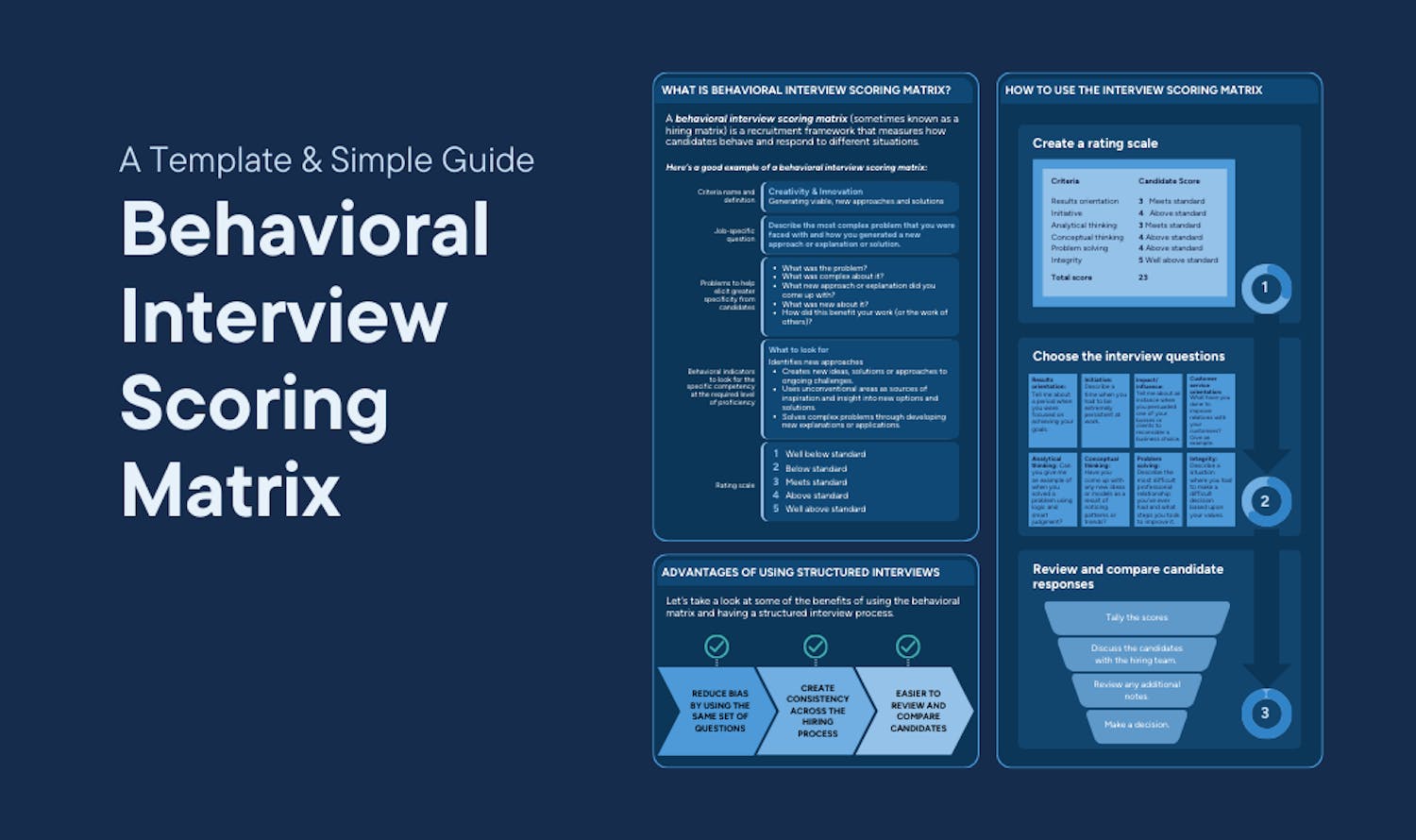
cordBehavioral Interview Scoring Matrix
A Template & Simple Guide
Great hiring isn't luck. It's having a structured way of finding people who will do their best work with you.
Hiring gets harder every year, not because talent is scarce, but because fit is harder to measure.
Skills matter. Experience matters.
But the real differentiator is behavior: how someone thinks, communicates, and solves problems inside your environment.
That's why the Behavioral Interview Scoring Matrix is one of the simplest ways to make better hiring decisions, consistently.
It evaluates candidates using the same criteria, the same questions, and the same rating scale. No guesswork. No bias disguised as intuition.
A Quick Example
We recently interviewed three candidates for a Customer Success role.
Without structure, the most confident communicator would've felt like the "best" pick.
Using the matrix, each interviewer scored the same competencies: communication, ownership, problem-solving, collaboration, and values alignment.
One candidate had less direct experience, but her behavioral scores were highest.
She's now a top performer.
That's the power of structured evaluation.
What Is a Behavioral Interview Scoring Matrix?
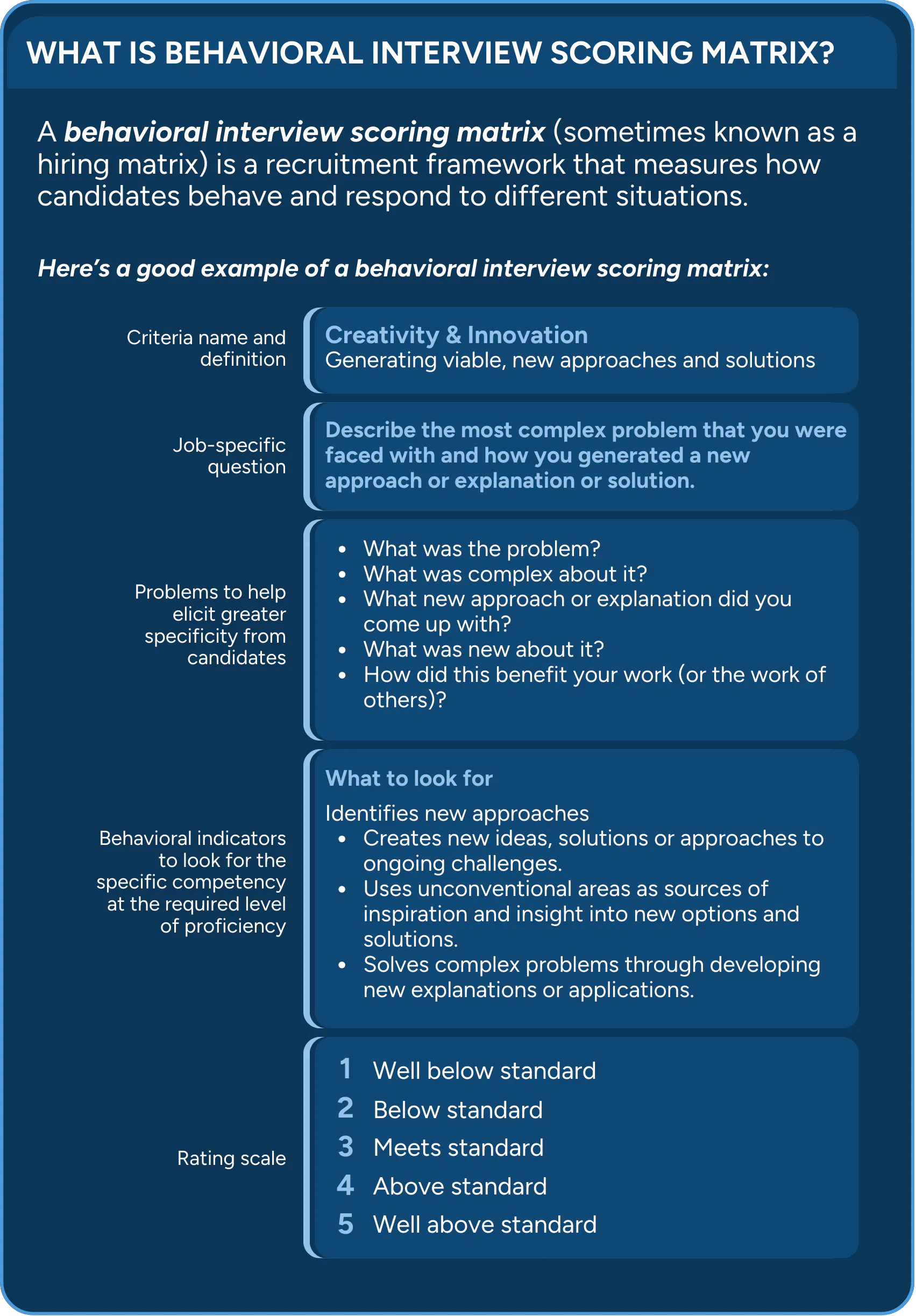
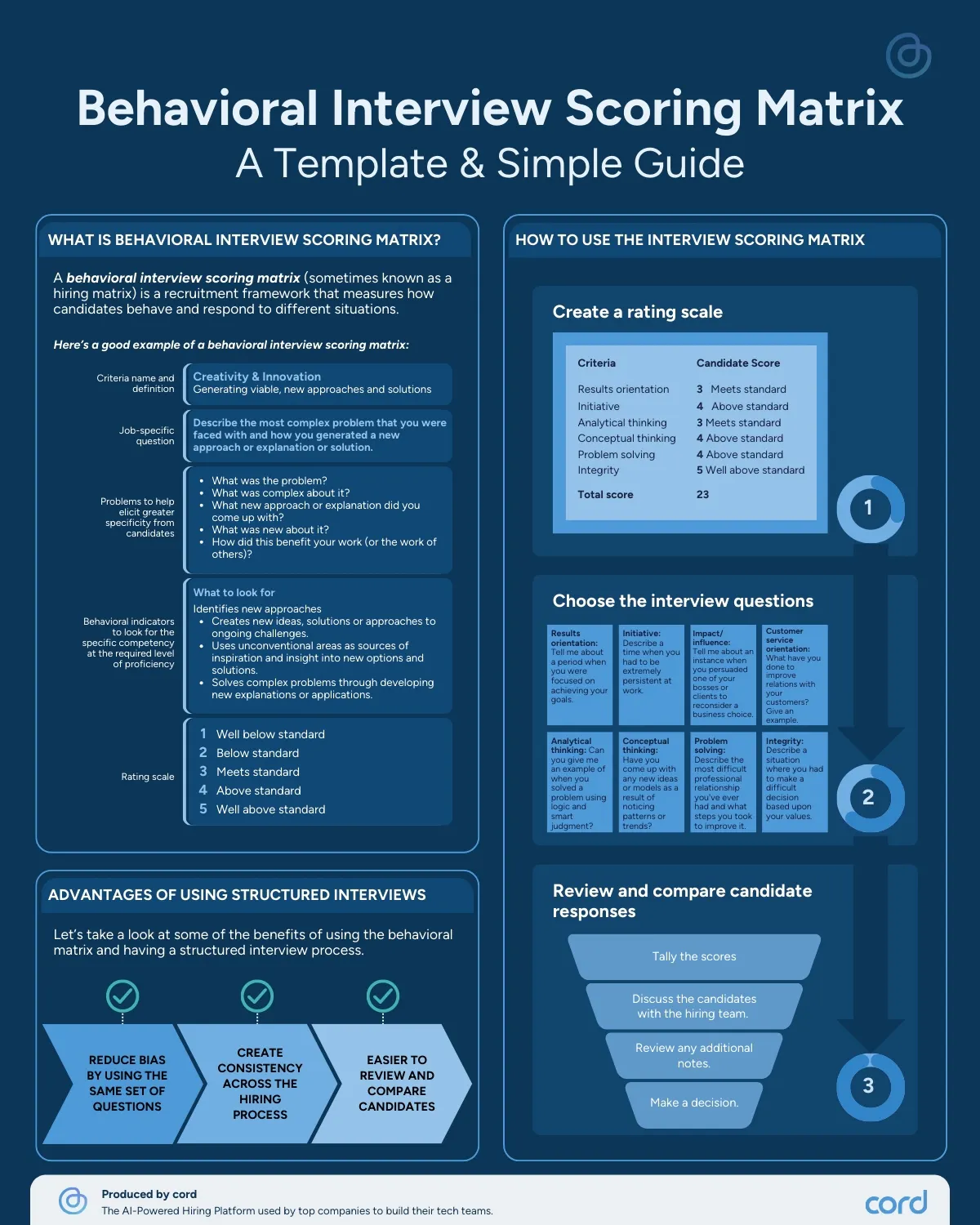
A behavioral interview scoring matrix (sometimes known as a hiring matrix) is a recruitment framework that measures how candidates behave and respond to different situations.
Instead of relying on gut feelings or vague impressions, you're evaluating specific competencies that matter for the role. Each competency gets a clear definition, targeted questions, behavioral indicators, and a consistent rating scale.
For example, if you're hiring for "Creativity & Innovation," you'd define it as "generating viable, new approaches and solutions." Then you'd ask questions like:
- Describe the most complex problem you were faced with and how you generated a new approach or explanation or solution.
From there, you look for behavioral indicators: Do they identify new approaches? Create new ideas or solutions? Use unconventional inspiration? Solve complex problems through new explanations?
Finally, you rate them on a 1-5 scale based on how well they demonstrated that competency.
Why Structured Interviews Work
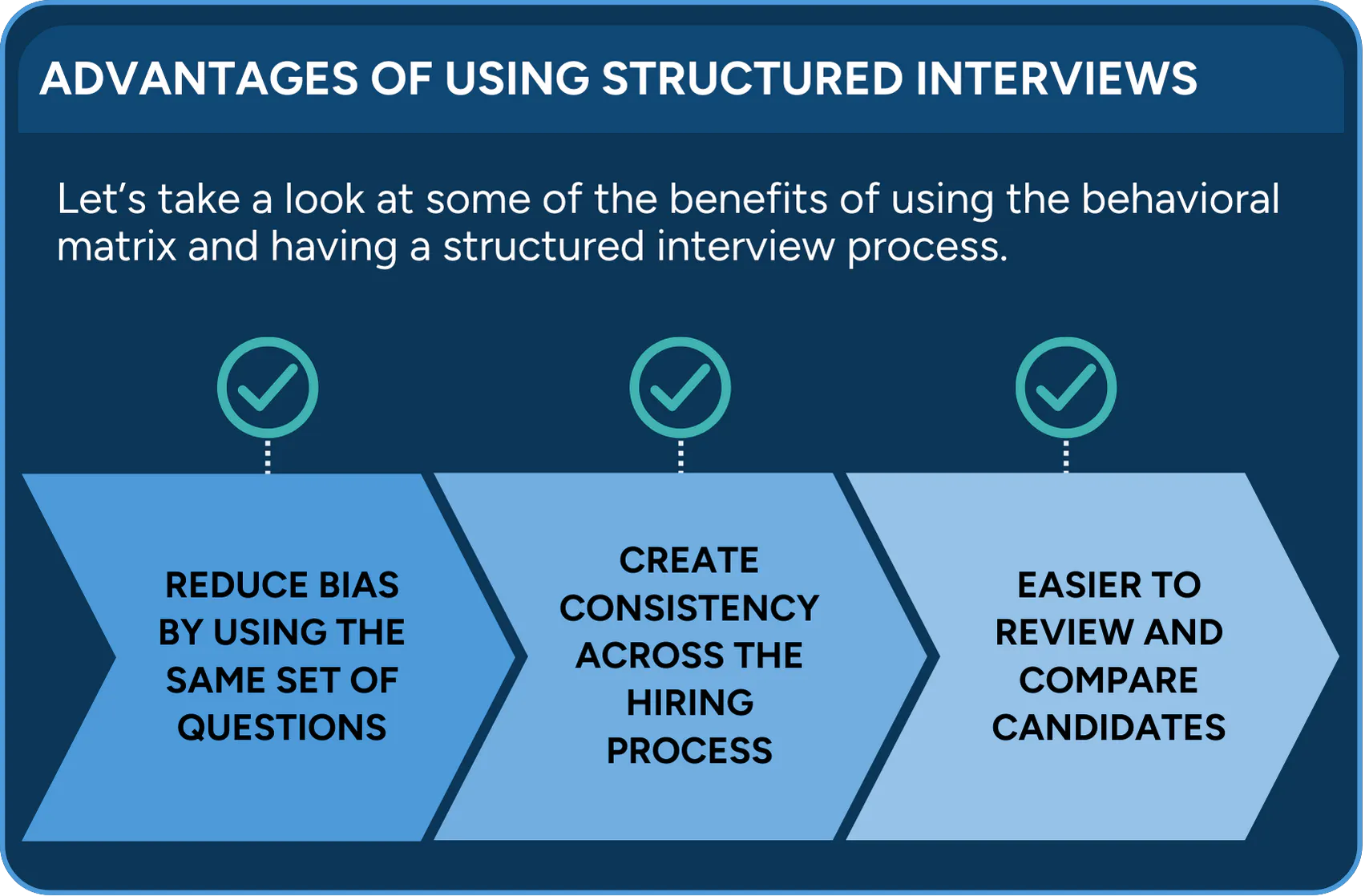
Let's look at some of the benefits of using the behavioral matrix and having a structured interview process:
Reduce first-impression bias – By using the same set of questions for every candidate, you're evaluating what actually matters instead of who makes the best first impression.
Create consistency across the hiring process – Everyone on your team is scoring the same competencies using the same scale. This makes it way easier to compare candidates objectively.
Make hiring decisions easier to review and compare – When you have clear scores tied to specific behaviors, you can defend your decisions with data instead of vibes.
Give candidates a calmer, clearer process – Structured interviews are more predictable and fair. Candidates know what to expect, which actually helps them show up better.
How to Use the Interview Scoring Matrix
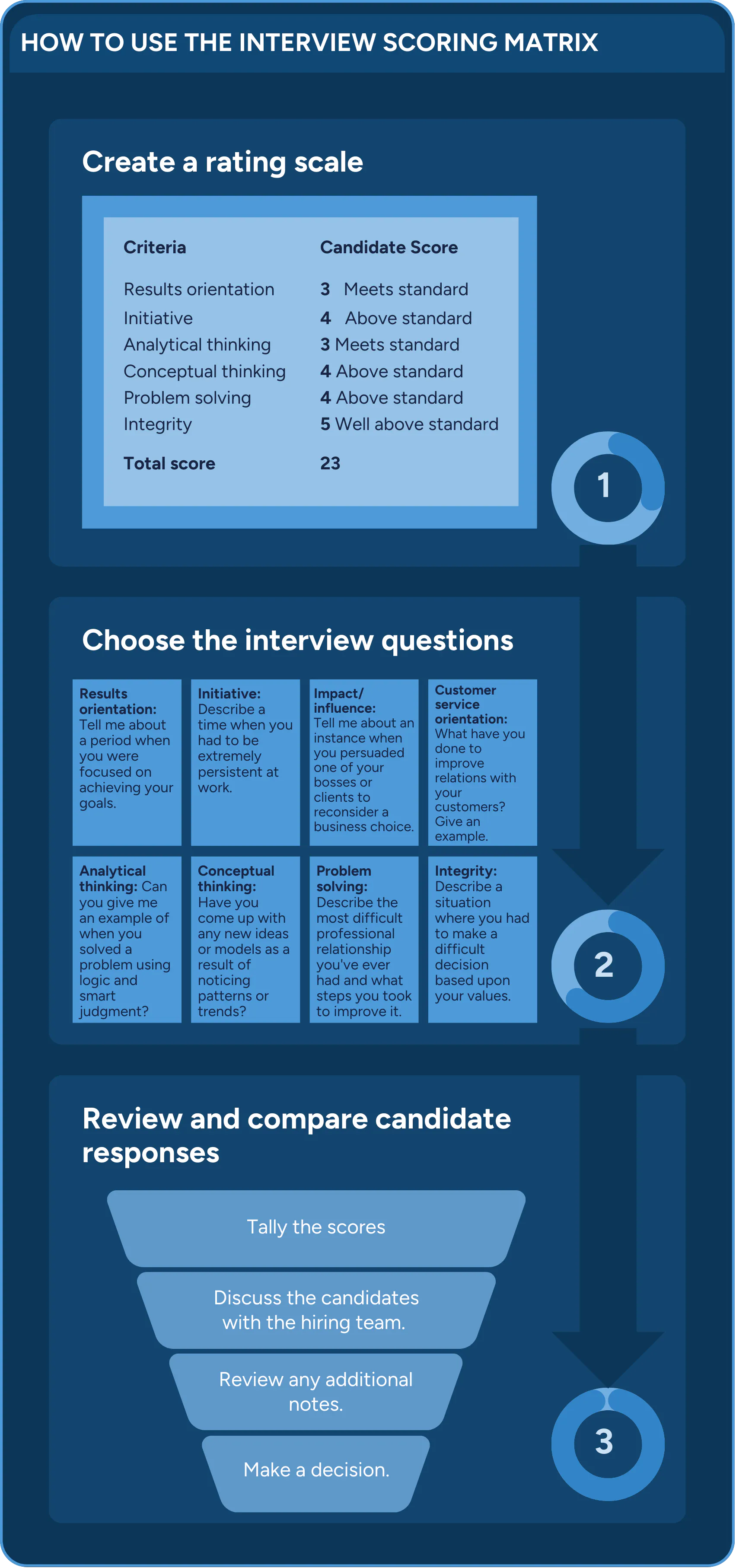
1. Create a Rating Scale
Start with a simple 5-point scale. It's enough range to compare candidates, but not so complex that scoring becomes subjective.
Here's what it looks like:
- 1 – Well below standard
- 2 – Below standard
- 3 – Meets standard
- 4 – Above standard
- 5 – Well above standard
For each competency you're evaluating, assign a score based on the candidate's response. At the end, tally up the total to see how they performed overall.
2. Choose the Interview Questions
Your questions should map directly to the competencies that define success in your company. Always prepare follow-ups because most candidates need prompts to give real depth.
Here are some solid behavioral questions to get you started:
Results orientation: Tell me about a period when you fell behind on achieving goals. What happened?
Initiative: Describe a time when you had to be persistent at work.
Impact/Influence: Tell me about an instance when one of your bosses or leaders had to reconsider a business choice.
Customer service orientation: What have you done to improve relations with customers? Give an example.
Analytical thinking: Can you give me an example of when you solved a problem using smart judgment?
Conceptual thinking: Have you come up with ideas, plans, or models as a result of observations, patterns or trends?
Problem solving: Describe the most difficult work relationship you've ever had. What specific steps you took to improve it.
Integrity: Describe a situation where you had to make a difficult decision. How did you stay true to your values?
3. Review and Compare Candidate Responses
After the interview, here's how to make the final call:
Tally the scores – Add up each candidate's ratings across all competencies.
Discuss the candidates with the hiring team – Score first, then discuss. This keeps bias from dominating the room.
Review any additional notes – Transferable skills are often what separate "good" from "great."
Make a decision – Use the data to guide you, but don't ignore your judgment. The matrix refines your intuition, it doesn't replace it.
The Bottom Line
Structured systems don't replace judgment. They refine it.
Great hiring isn't about finding the perfect CV. It's about finding people who will do their best work with you.
The Behavioral Interview Scoring Matrix gives you a consistent, unbiased way to evaluate what actually matters: how someone thinks, acts, and solves problems in your environment.
Use it, and you'll make better hiring decisions every time.

Was this content useful?