 cord
cordJob Interview DOs and DON'Ts for Hiring Managers
A Practical Checklist for Consistent, Bias-Free Hiring Decisions
The biggest challenge for hiring managers isn't knowing what to ask—it's staying consistent and objective during interviews. When you're juggling back-to-back interviews, it's easy to drift into unstructured conversations that favor talkative personalities, let gut feelings outweigh facts, or slip into off-script questions that introduce bias or legal risk.
This comprehensive guide will help you conduct better interviews and make stronger hiring decisions.
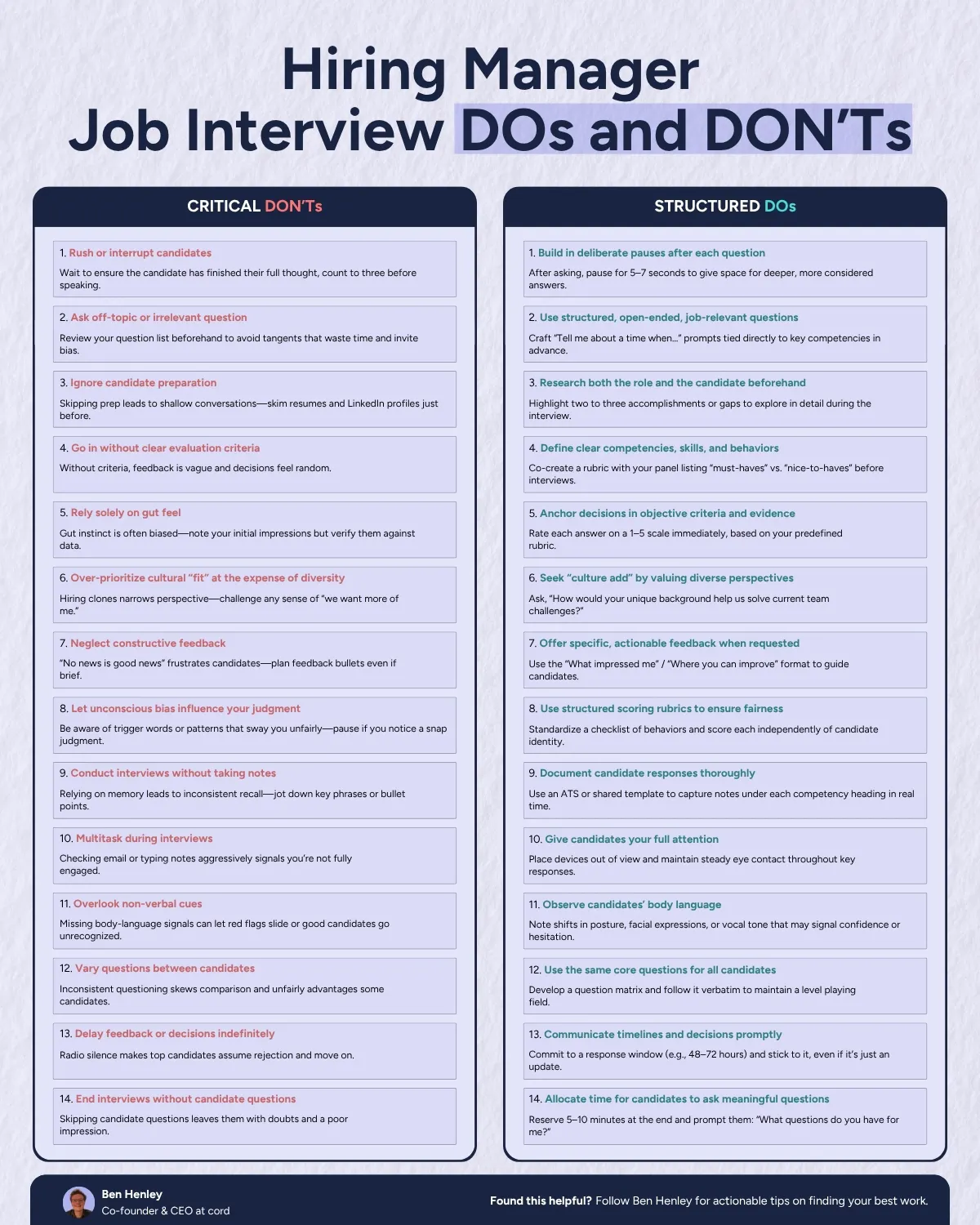
Critical DON'Ts
1. Rush or interrupt candidates
Wait for candidates to finish their full thought—count to three before speaking. Interrupting signals you're not listening and causes you to miss key evidence of their fit.
2. Ask off-topic or irrelevant questions
Review your question list beforehand to avoid tangents that waste time and invite bias. Every question should tie directly to job-relevant competencies.
3. Ignore candidate preparation
Skipping prep leads to shallow conversations. Review resumes and LinkedIn profiles before the interview, not during.
4. Go in without clear evaluation criteria
Without criteria, feedback becomes vague and decisions feel random. Define what you're measuring before you start.
5. Rely solely on gut feel
Gut instinct is often biased. Note your initial impressions but verify them against data and objective criteria.
6. Over-prioritize cultural "fit" at the expense of diversity
Hiring clones narrows perspective. Challenge any sense of "we want more of me" thinking.
7. Neglect constructive feedback
"No news" frustrates candidates. Plan feedback bullets even if brief, using a "What impressed me" / "Where you can improve" format to guide candidates.
8. Let unconscious bias influence your judgment
Be aware of trigger words or patterns that sway you unfairly. Pause if you notice a snap judgment forming.
9. Conduct interviews without taking notes
Relying on memory leads to inconsistent recall. Jot down key phrases or bullet points during the conversation.
10. Multitask during interviews
Checking email or typing notes aggressively signals you're not fully engaged and disrespects the candidate.
11. Overlook non-verbal cues
Missing body language signals can let red flags slide or good candidates go unrecognized.
12. Vary questions between candidates
Inconsistent questioning skews comparison and unfairly advantages some candidates over others.
13. Delay feedback or decisions indefinitely
Radio silence makes top candidates assume rejection and move on to other opportunities.
14. End interviews without candidate questions
Skipping candidate questions leaves them with doubts and creates a poor impression of your process.
Structured DOs
1. Build in deliberate pauses after each question
After asking, pause for 5-7 seconds to give space for deeper, more considered answers. Silence isn't awkward—it's essential for thoughtful responses.
2. Use structured, open-ended, job-relevant questions
Craft "Tell me about a time when..." prompts tied directly to key competencies in advance. This approach reveals real experience rather than rehearsed answers.
3. Research both the role and the candidate beforehand
Highlight two to three accomplishments or gaps to explore in detail during the interview. Come prepared with specific talking points.
4. Define clear competencies, skills, and behaviors
Co-create a rubric with your hiring panel listing "must-haves" vs. "nice-to-haves" before interviews begin.
5. Anchor decisions in objective criteria and evidence
Rate each answer on a 1-5 scale immediately, based on your predefined rubric. This creates consistency across all candidates.
6. Seek "culture add" by valuing diverse perspectives
Ask, "How would your unique background help us solve current team challenges?" This question reveals value beyond traditional fit.
7. Offer specific, actionable feedback when requested
Use the "What impressed me" / "Where you can improve" format to guide candidates constructively.
8. Use structured scoring rubrics to ensure fairness
Standardize a checklist of behaviors and score each independently of candidate identity.
9. Document candidate responses thoroughly
Use an ATS or shared template to capture notes under each competency heading in real time.
10. Give candidates your full attention
Place devices out of view and maintain steady eye contact throughout key responses.
11. Observe candidates' body language
Note shifts in posture, facial expressions, or vocal tone that may signal confidence or hesitation.
12. Use the same core questions for all candidates
Develop a question matrix and follow it verbatim to maintain a level playing field.
13. Communicate timelines and decisions promptly
Commit to a response window (e.g., 48-72 hours) and stick to it, even if it's just an update.
14. Allocate time for candidates to ask meaningful questions
Reserve 5-10 minutes at the end and prompt them: "What questions do you have for me?"
The Impact of Better Interviews
Following these guidelines will help you dodge bias, sharpen your judgment, and hire outstanding people. Average interviews produce average teams. Consistent, structured interviews aren't just nice-to-have—they're essential for building strong organizations.
Use this guide as your opening and closing checklist before every job interview. Your candidates will notice the difference, and your hiring decisions will improve dramatically.

Was this content useful?