 cord
cordThe Hiring Impact Pyramid
A Strategic Framework for Building Effective Hiring Systems
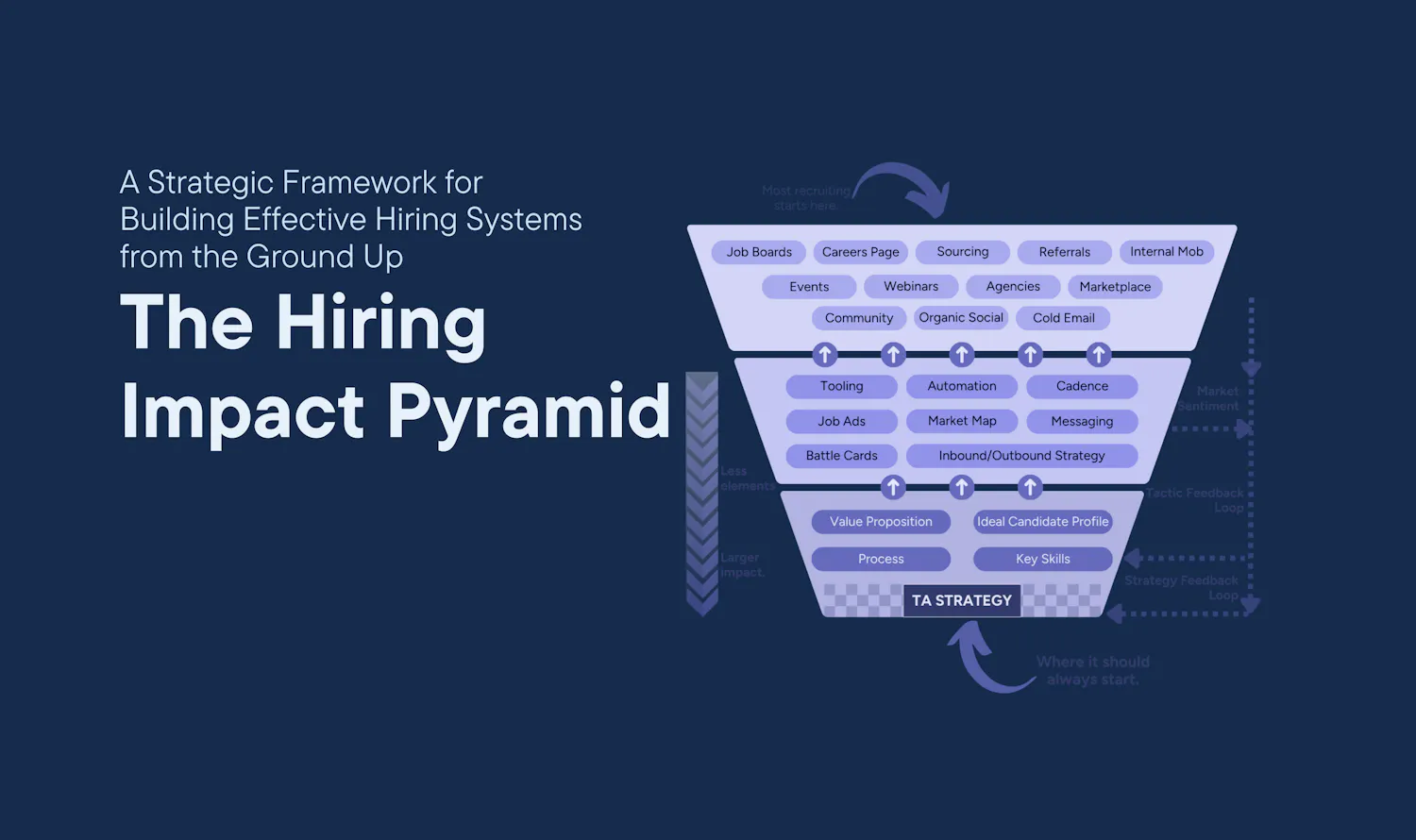
Many businesses are building their talent acquisition strategy upside down. They start by posting jobs on multiple platforms, reaching out to recruiting agencies, and launching referral programs without establishing the foundation that makes these tactics effective.
This approach results in longer time-to-hire, higher costs, and candidates who don't stick around. The problem usually isn't the tactic itself—it's more likely to be a gap in your process, unclear candidate requirements, or weak value propositions.
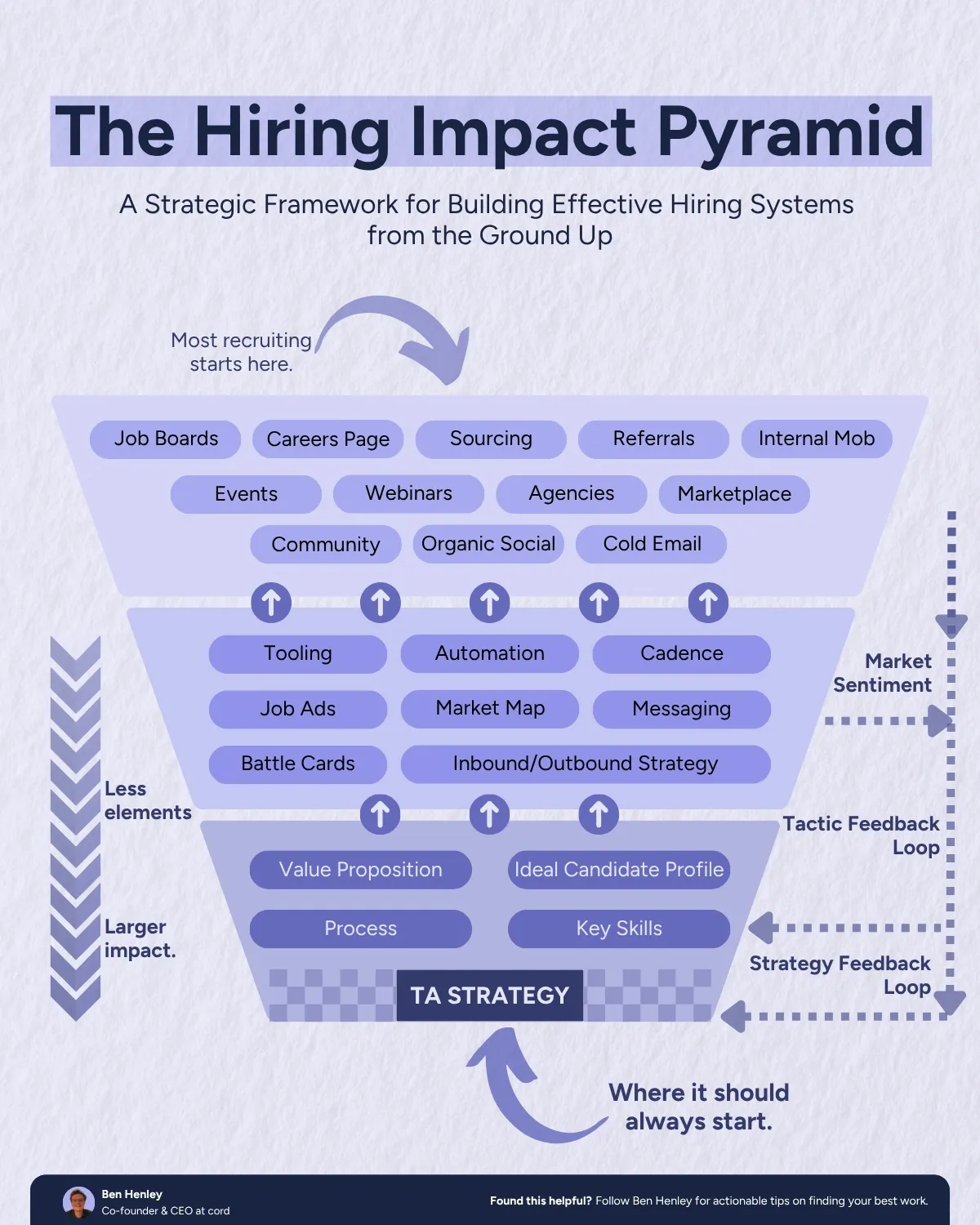
The Hiring Impact Pyramid provides a strategic framework for building effective hiring systems from the ground up. This model shows that sustainable hiring success comes from building a strong foundation before deploying tactics.
The Three Layers of the Hiring Impact Pyramid
Layer 1: TA Strategy (Foundation)
Where it should always start
The bottom layer forms your strategic foundation. This is where you define the core elements that will guide all your hiring decisions:
- Process: Establish clear, consistent hiring workflows that every stakeholder understands
- Key Skills: Identify must-have versus nice-to-have competencies for each role
- Ideal Candidate Profile: Create detailed profiles that go beyond job requirements to include cultural fit and growth potential
- Value Proposition: Craft compelling reasons why top talent should choose your company over competitors
Layer 2: Tactical Foundation (Middle)
Building your execution capabilities
The middle layer translates your strategy into operational elements:
- Tooling: Select recruitment platforms and systems that support your defined process
- Automation: Implement systems that streamline repetitive tasks while maintaining personal touch
- Cadence: Establish consistent timing and frequency for candidate communications
- Job Ads: Write descriptions that accurately reflect your strategy and attract the right candidates
- Market Map: Understand where your ideal candidates spend their time and how to reach them
- Messaging: Develop consistent communication that reinforces your value proposition
- Battle Cards: Create resources that help hiring managers make informed decisions
- Inbound/Outbound Strategy: Plan how you'll attract candidates and when you'll actively source them
Layer 3: Sourcing Tactics (Top)
Most recruiting starts here
Only after building your foundation should you deploy sourcing tactics:
- Job Boards: Post strategically on platforms where your ideal candidates are active
- Careers Page: Optimize your company's career site to convert visitors into applicants
- Sourcing: Proactively reach out to passive candidates using your defined messaging
- Referrals: Leverage employee networks with clear guidelines about ideal candidates
- Internal Mobility: Promote from within using the same strategic framework
- Events: Attend or host recruiting events that align with your candidate profiles
- Webinars: Share expertise to attract candidates who value your company's knowledge
- Agencies: Partner with recruiters who understand your strategy and requirements
- Marketplace: Use talent platforms that connect with your target candidate segments
- Community: Engage in professional communities where your ideal candidates participate
- Organic Social: Share authentic content that showcases your company culture
- Cold Email: Reach out to specific candidates with personalized, value-driven messages
The Critical Feedback Loops
The pyramid includes two essential feedback mechanisms:
Tactic Feedback Loop: Market signals inform adjustments to your sourcing tactics. If certain job boards aren't producing quality candidates, you adjust your posting strategy.
Strategy Feedback Loop: Broader market trends and hiring outcomes influence your foundational strategy. If you're consistently losing candidates to competitors, you may need to revisit your value proposition.
These loops only work effectively when you have a strong foundation. Without clear strategy and process, feedback becomes noise rather than actionable insight.
Benefits of the Pyramid Approach
For hiring managers, building from the bottom up means:
- Less time spent on ineffective sourcing activities
- Better candidate quality and cultural fit
- Reduced hiring costs through more targeted efforts
- Faster decision-making with clear evaluation criteria
- More consistent hiring outcomes across different roles and teams
Why Most Companies Get This Wrong
The temptation to start with tactics is understandable. Job boards and recruiting agencies promise immediate access to candidates. Social media and networking events feel productive and visible.
But without strategic foundation, these activities become expensive experiments. You end up with high activity but low impact—lots of candidates but few quality hires.
Getting Started
If you're currently operating tactics-first, don't abandon everything overnight. Instead, begin building your foundation while maintaining current sourcing efforts:
- Audit your current process: Document how hiring decisions actually get made in your organization
- Define ideal candidate profiles: Start with your most critical roles and work backward from your best performers
- Clarify your value proposition: Identify what genuinely differentiates your company as an employer
- Align your messaging: Ensure job descriptions and candidate communications reflect your strategy
The goal isn't to use fewer tactics—it's to use them more strategically. When your foundation is solid, every sourcing activity becomes more effective because it's guided by clear purpose and consistent execution.
Less noise. More impact. Start from the bottom where the real leverage is.

Was this content useful?