 cord
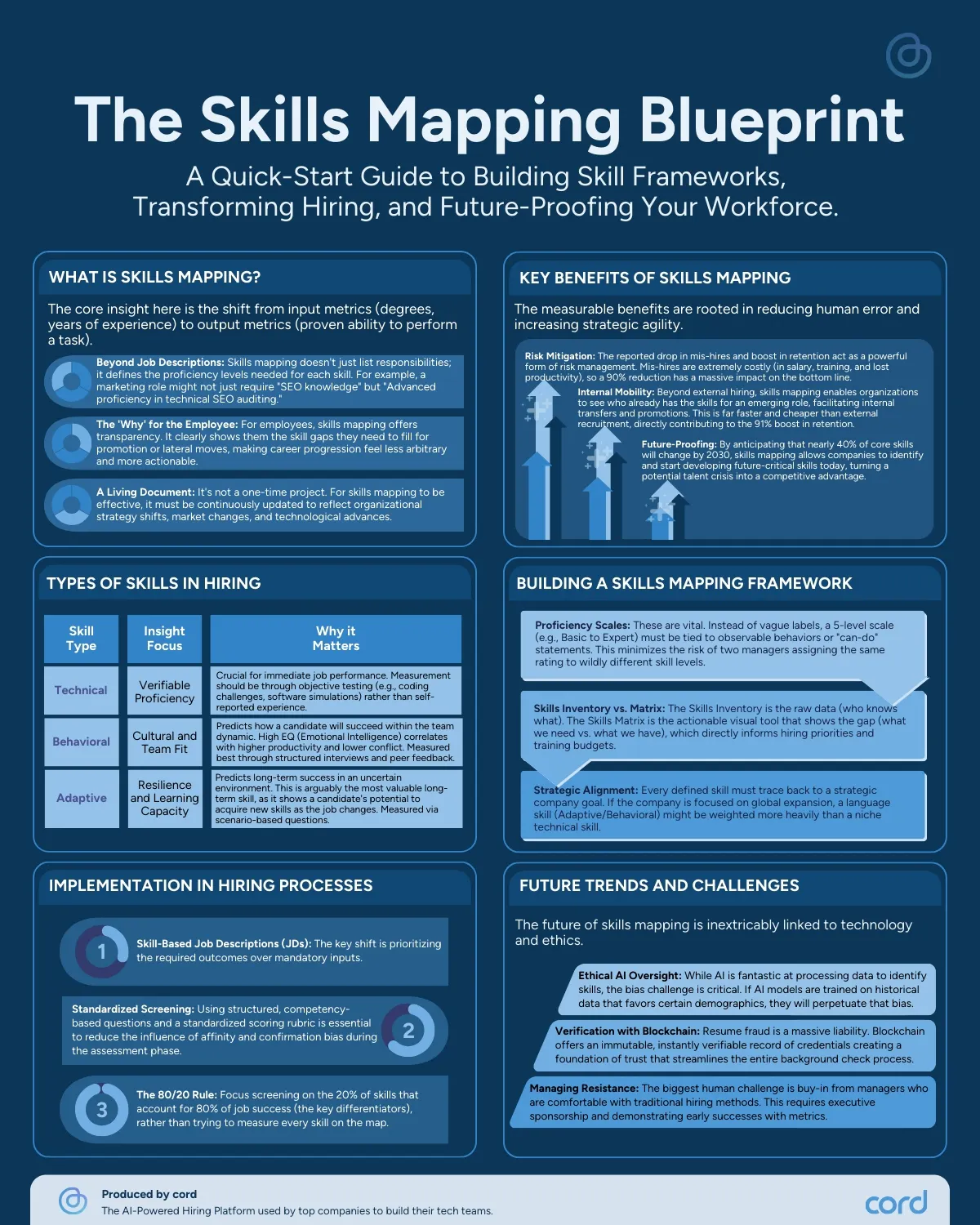
cordThe Skills Mapping Blueprint
A Quick-Start Guide to Building Skill Frameworks, Transforming Hiring, and Future-Proofing Your Workforce.

We all claim we want the best people. But most of us are still filtering for the best résumé.
Those two things rarely overlap.
Degrees don't prove capability. Job titles don't prove relevance. Years of experience don't prove readiness for the role you're actually hiring for.
So what actually predicts success? Skills. Today's skills, tomorrow's skills, and the ability to grow into both.
That's why skills mapping is quickly becoming the backbone of modern hiring. This isn't a trendy HR buzzword. It's a needed correction to a broken system.
The Data Speaks for Itself
A skills-based approach to hiring delivers measurable results. Organizations using this method report 90% fewer mis-hires, 91% higher retention rates, 34% faster time-to-hire, and save an average of 600 hours per senior hire, according to TestGorilla's 2024 research.
With nearly 40% of core skills expected to change by 2030, the companies that win will be the ones hiring for what actually matters, not what looks good on paper.
What Is Skills Mapping?
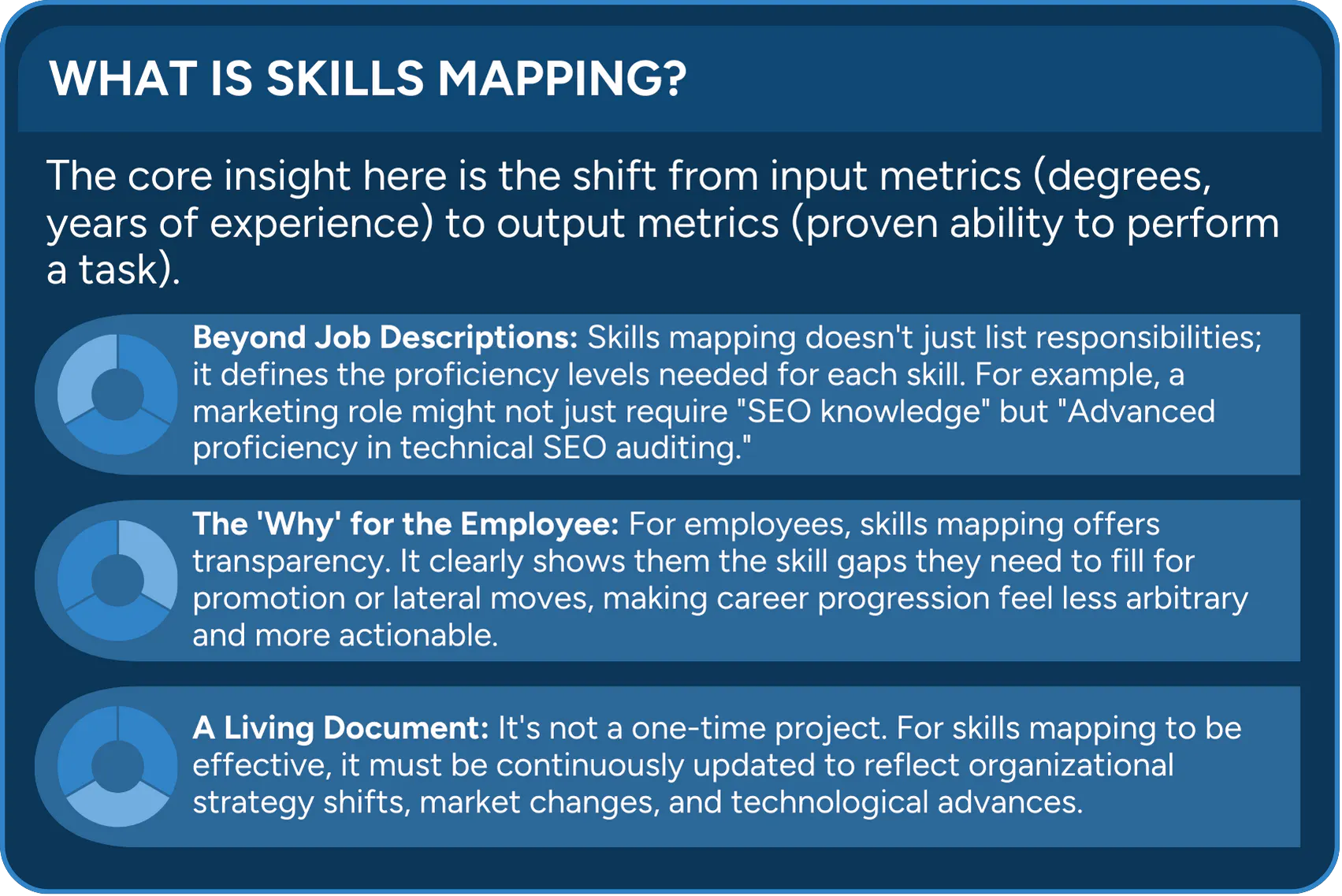
Skills mapping is the shift from input metrics like degrees, years of experience, and previous job titles to output metrics that measure proven ability to perform a task.
Instead of asking "Does this candidate have the right background?" you're asking "Can this person actually do the work?"
Here's what makes it work:
Beyond Job Descriptions: Skills mapping defines the proficiency levels needed for each skill in a role. A marketing role might require "Intermediate knowledge in technical SEO auditing" rather than just listing "SEO" as a nice-to-have.
The 'Why' for Employees: For candidates, skills mapping offers transparency. It clearly shows them the skills they need to fill the role or advance internally, making career progression less arbitrary and more achievable.
A Living Document: This isn't a one-time project. For skills mapping to stay effective, it must be continuously updated to reflect organizational strategy shifts, market changes, and technological advances.
Key Benefits of Skills Mapping
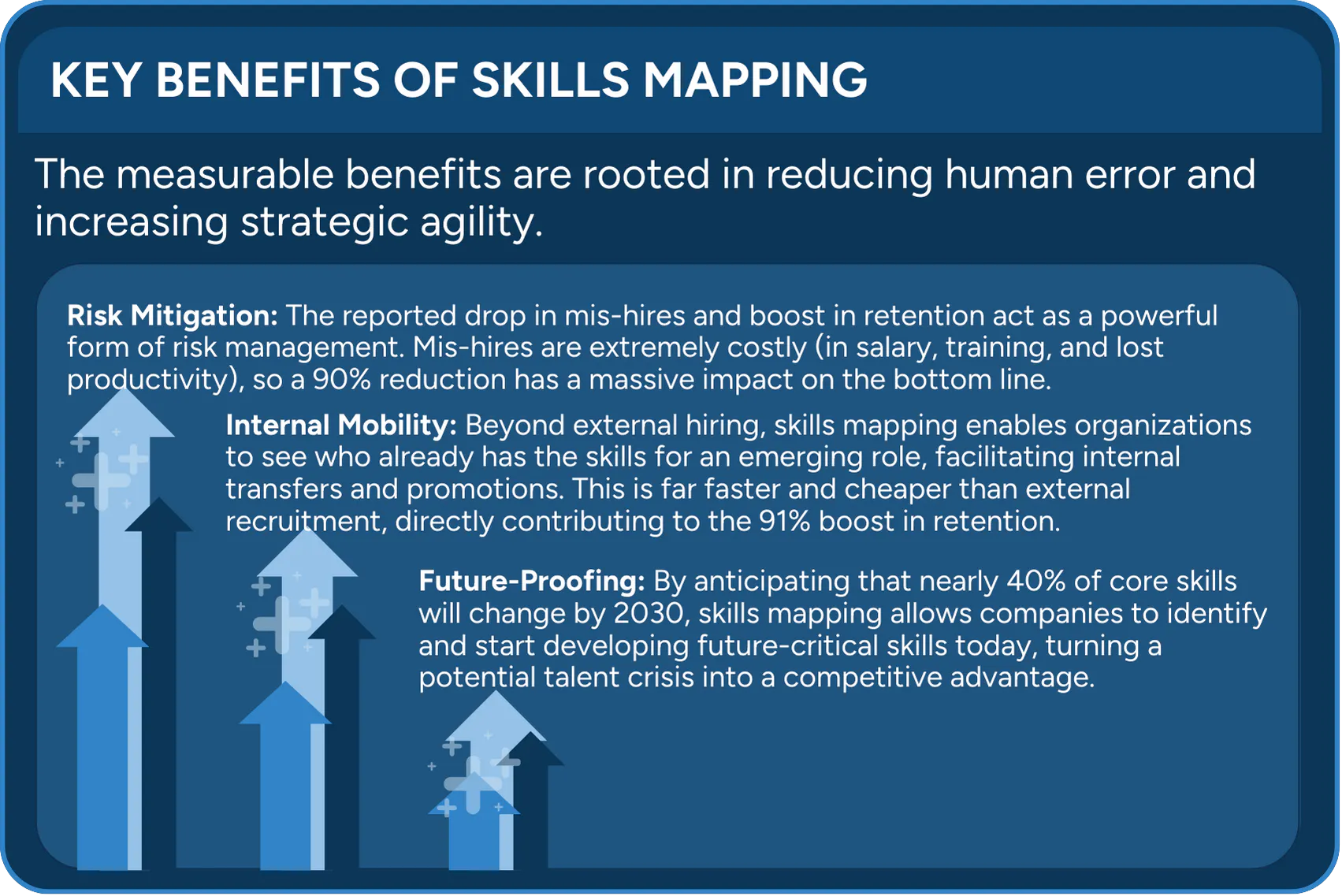
The measurable benefits come from reducing human error and increasing precision in hiring decisions.
Risk Mitigation: The reported drop in mis-hires and boost in retention act as a powerful form of risk management. Mis-hires are expensive in salary, training, and lost productivity, and a 50% reduction has a massive impact on the bottom line.
Internal Mobility: Beyond external hiring, skills mapping enables organizations to see who already has the skills for an emerging role, drastically reducing external recruitment and directly contributing to the 91% boost in retention.
Future-Proofing: By anticipating which 40% of core skills will change by 2030, skills mapping allows companies to identify and start developing future-critical skills now, turning a potential talent crisis into a competitive advantage.
Types of Skills in Hiring
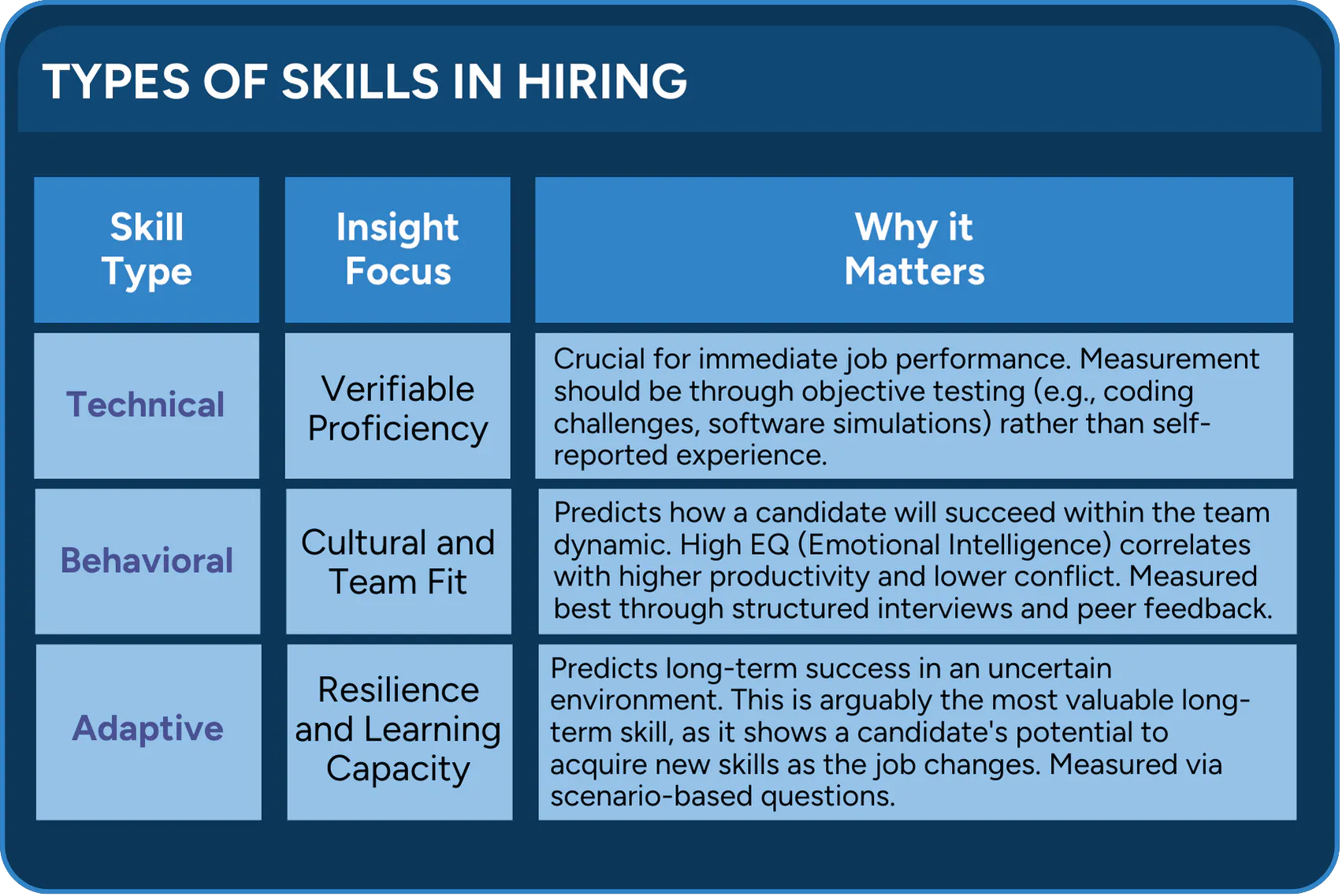
Understanding different skill types helps you build a complete picture of what each role actually needs.
Technical Skills
Focus: Verifiable Proficiency
Why it Matters: These are crucial for immediate job performance. Measurement should be direct and quantifiable through testing, like coding challenges or portfolio reviews, rather than self-reported experience.
Behavioral Skills
Focus: Cultural and Team Fit
Why it Matters: Soft skills consistently show up within the top 10 most dynamic, high-EQ skills like emotional intelligence that correlate with higher productivity and lower conflict. These are best measured through structured interviews and peer feedback.
Adaptive Skills
Focus: Resilience and Learning Capacity
Why it Matters: These predict long-term success in an uncertain environment. This is arguably the most valuable long-term skill, as they help people continuously acquire new skills as the job changes. Measured via scenario-based questions.
Building a Skills Mapping Framework
Here's how to actually implement this in your organization.
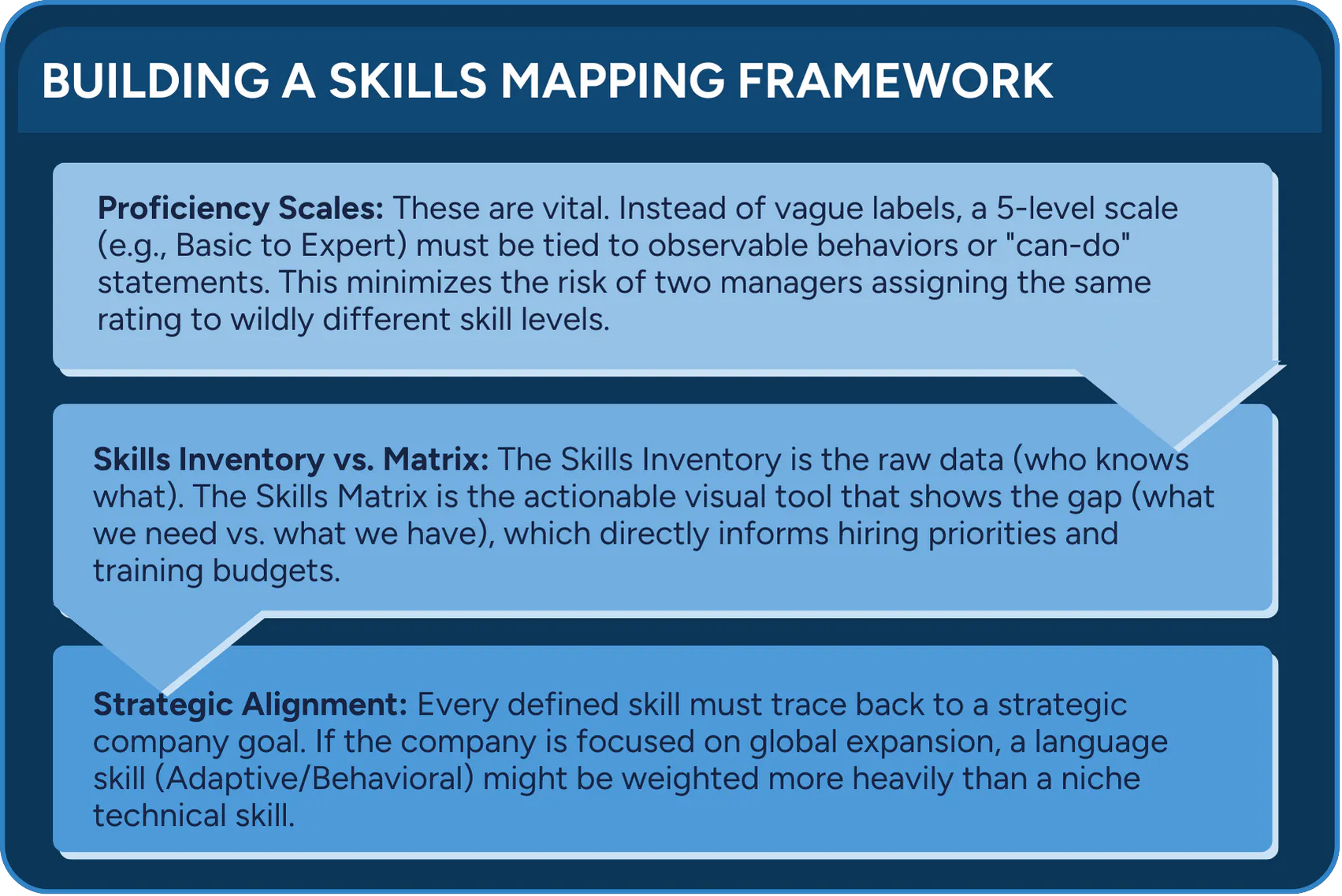
Proficiency Scales
Use a clear 5-level scale: Basic, Apprentice, Intermediate, Advanced, Expert. Each level must tie to observable behaviors and "can-do" statements. This minimizes the risk of two managers assigning the same rating to wildly different skill levels.
Skills Inventory vs. Matrix
The Skills Inventory is the raw data showing who knows what. The Skills Matrix is the actionable visual tool that shows what we need versus what we have, which directly informs hiring priorities and training budgets.
Strategic Alignment
Every defined skill must trace back to a strategic company goal. If the company is focused on global expansion, a language skill for adaptive/behavioral roles might be weighted more heavily than a niche technical skill.
How to Start: A 5-Step Framework
1. Define what success really looks like for each role
Skip the tasks and credentials. List the 10-15 skills your top performers actually rely on. Talk to the people already excelling in the role and map what they do, not what the job description says they should do.
2. Build a consistent proficiency scale
Create clear criteria for each level: Basic, Apprentice, Intermediate, Advanced, Expert. This removes guesswork and reduces bias in evaluation. When everyone evaluates skills using the same rubric, hiring decisions become more objective.
3. Rewrite job descriptions with skills at the top
Job posts under 300 words with skill-first framing get 8.4% more applicants. Prioritize the required outcomes over mandatory inputs like degree requirements or years of experience.
4. Screen for proof, not keywords
Use structured interviews, skill tests, and scoring rubrics to evaluate real capability. Standardized, competency-based questions and scoring systems are essential to reduce affinity bias and confirmation bias during assessment.
5. Keep your skills map alive
Core skills now expire every five years on average. Review your skills framework quarterly and update it annually to reflect organizational strategy shifts, market changes, and technological advances.
Implementation in Hiring Processes
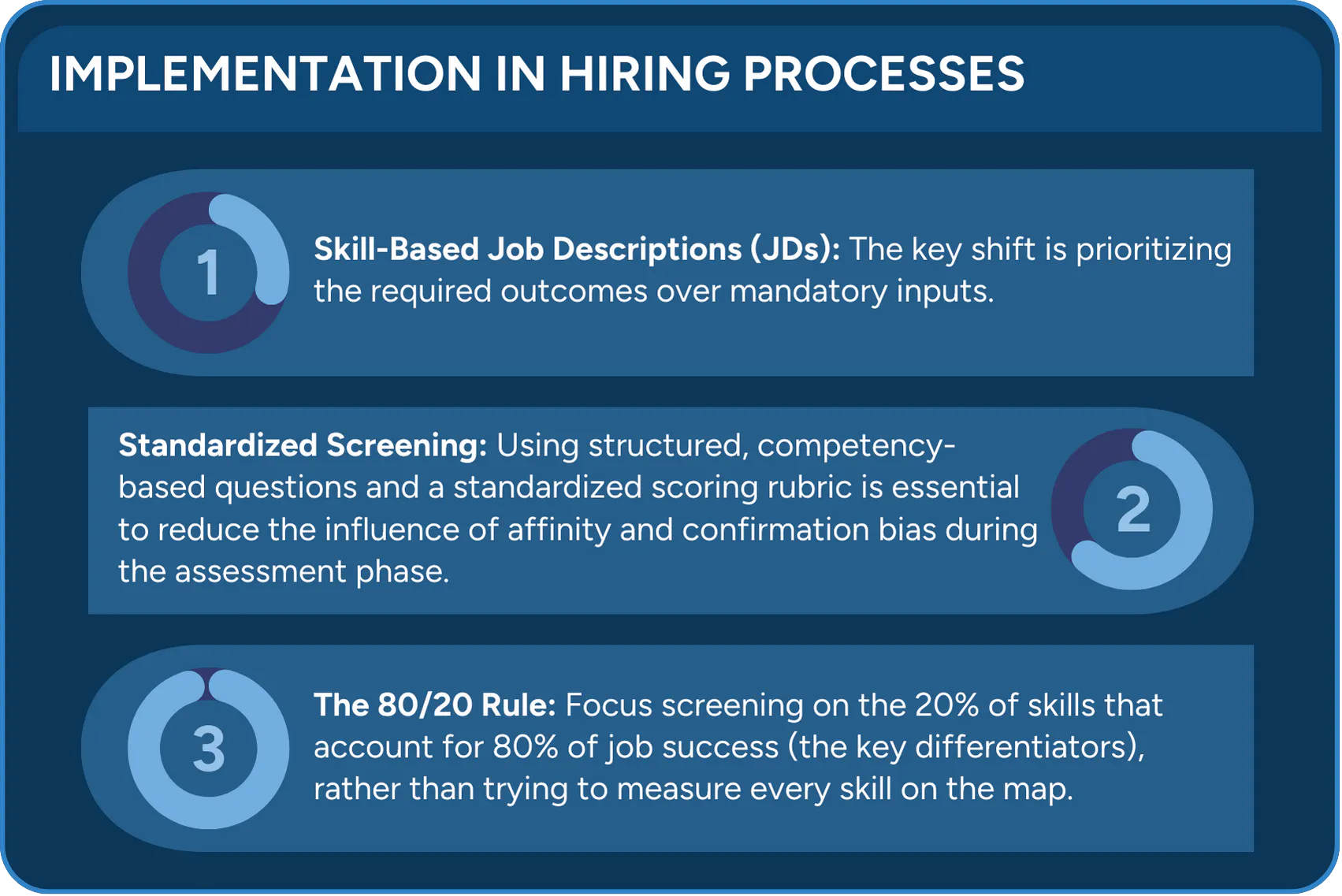
Skill-Based Job Descriptions: The key shift is prioritizing the required outcomes over mandatory inputs. Focus on what candidates need to accomplish, not what credentials they need to have.
Standardized Screening: Using structured, competency-based questions and a standardized scoring rubric is essential to reduce the influence of affinity and confirmation bias during the assessment phase.
The 80/20 Rule: Focus screening on the 20% of skills that account for 80% of job success, the key differentiators. Don't try to measure every skill on the map during initial screening.
Future Trends and Challenges
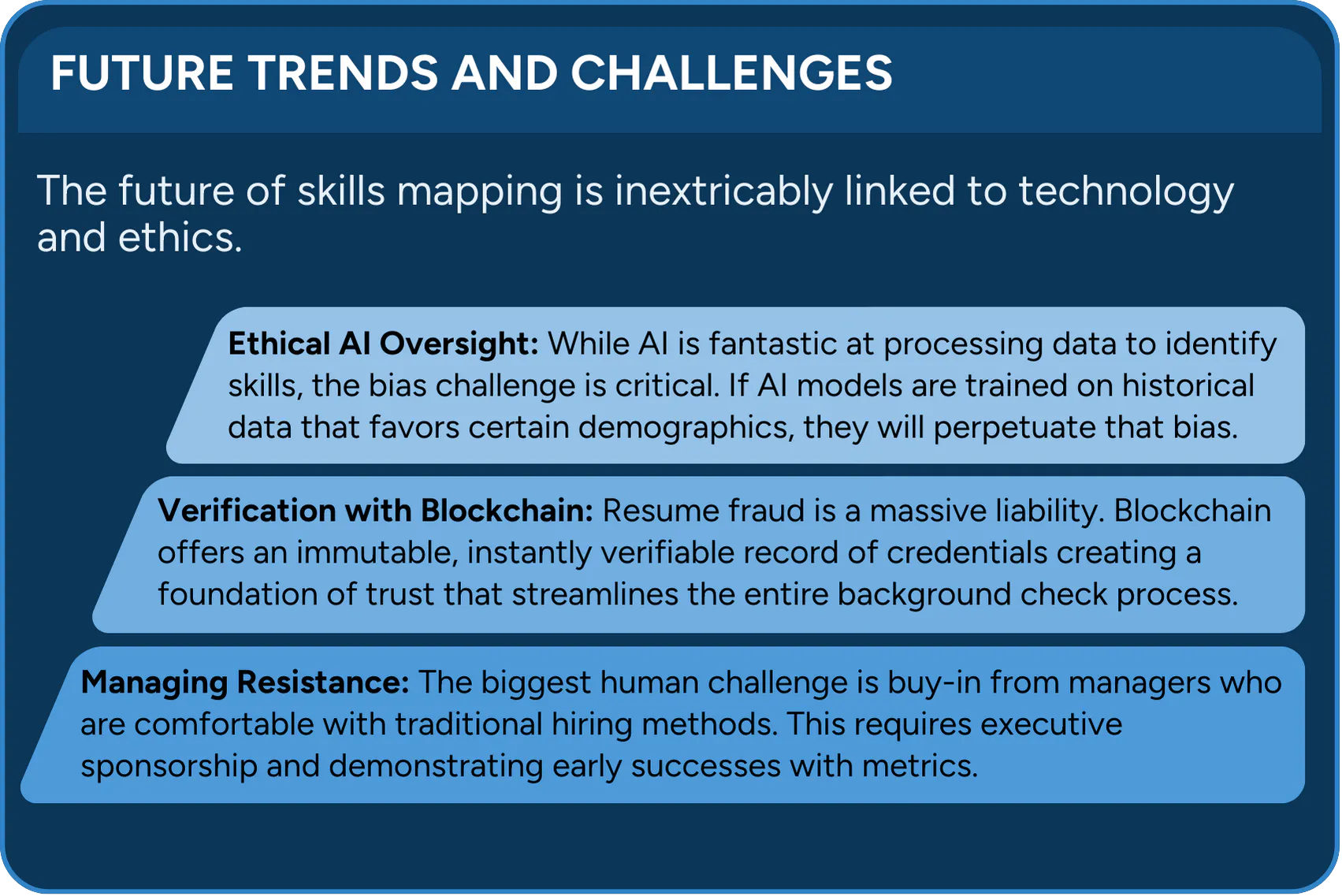
The future of skills mapping is inextricably linked to technology and ethics.
Ethical AI Oversight: While AI is effective at processing data to identify skills, the bias challenge is critical. If AI models are trained on historical data that favors certain demographics, they will reproduce that bias.
Verification with Blockchain: Résumé fraud is a massive liability. Blockchain offers an immutable, instantly verifiable record of credentials, creating a foundation of trust that streamlines the entire background check process.
Managing Resistance: The biggest human challenge is buy-in from managers who are comfortable with traditional hiring methods. This requires executive sponsorship and demonstrating early successes with metrics.
The Bottom Line
Skills mapping isn't just better hiring. It's better team building, better development, and better alignment between people and the work that lets them perform at their highest level.
This isn't a "future of work" concept. It's the system companies need right now, especially as roles evolve faster than most organizational structures can keep up.
Organizations that adopt skills-based hiring are 98% more likely to retain top talent and 57% better at adapting to change, according to Deloitte.
If your team wants fewer mis-hires, faster hiring cycles, and more people doing the work they're actually great at, this is the shift that matters.
The truth is simple: we need to stop hiring for credentials that look good on paper and start hiring for skills that deliver real results.

Was this content useful?