 cord
cordTop 5 Insights From Spring ‘26 Hiring Rankings
Key trends shaping the UK tech job market: growth, popularity, AI adoption, and diversity insights from the Spring 2026 hiring rankings.
Top 5 Insights From Spring ‘26 Hiring Rankings
The Spring 2026 Hiring Rankings reveal a UK tech landscape defined by AI adoption, mid-sized company growth, and a growing focus on diversity. While large enterprises continue to attract talent due to their stability, smaller organizations are driving innovation, accelerating growth, and leading more inclusive hiring practices.
Here are the top insights from Spring ‘26 hiring rankings:
- AI is becoming a foundational layer across every industry
- Mid-sized companies are experiencing the fastest growth
- Large enterprises continue to dominate in popularity
- There is minimal overlap between the fastest-growing and most popular companies
- Small and mid-sized companies are leading in gender diversity
AI is becoming the core layer of every industry
One of the clearest takeaways from the Spring Hiring Rankings is that AI is no longer confined to “AI startups.” Instead, it has become a foundational layer driving growth across industries - from finance and healthcare to real estate and consulting.
Across the fastest-growing companies in every industry, the same trend emerges: AI-powered organizations are scaling their teams faster than nearly any other sector. AI startups are scaling the fastest. In the AI category itself, growth rates are striking.
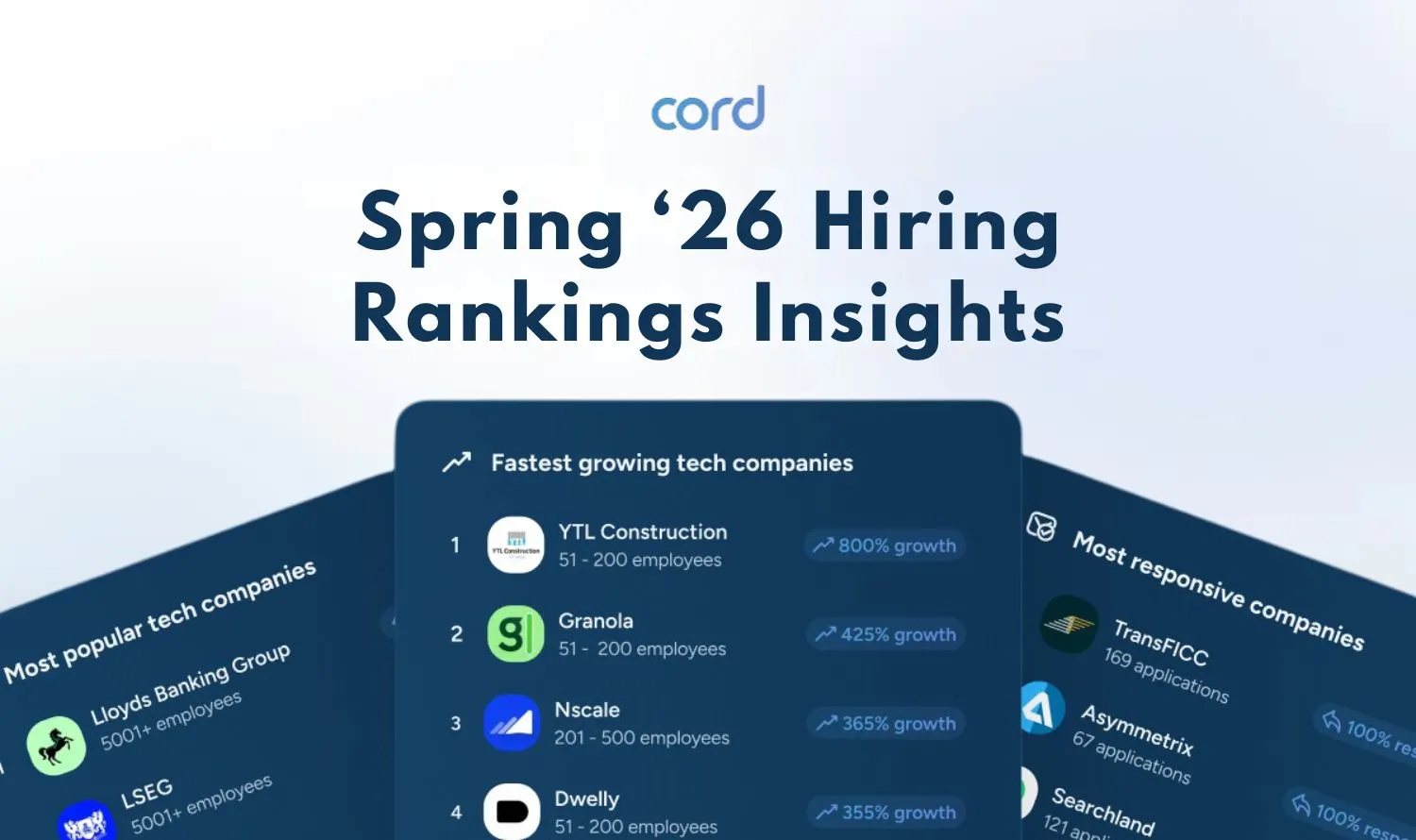
- Granola leads with 425% headcount growth.
- Dwelly follows with 355% growth.
- Solve Intelligence grew 192%.
Most of these companies are still in the 11–50 employee stage, which shows how quickly teams expand once AI products reach early traction.
AI is transforming fintech
The same trend appears in fintech, where AI is increasingly embedded into financial workflows. For example:
- Finster AI recorded 155% growth, building enterprise AI tools for finance teams.
- Capi Money grew 182%, modernising international payments infrastructure.
Rather than building traditional fintech apps, many companies are now layering AI directly into financial decision-making and analysis.
AI is accelerating healthtech innovation
Healthcare is another industry where AI is driving major growth. Companies applying machine learning to drug discovery and biotech are scaling rapidly:
- Ignota Labs — 120% growth
- Relation Therapeutics — 59% growth
Meanwhile, computational modeling platforms like PolyModels Hub recorded 200% growth, highlighting how AI and simulation tools are reshaping pharmaceutical research.
Data infrastructure is growing alongside AI
As AI adoption increases, the need for large-scale data infrastructure grows as well. Companies building data platforms are expanding quickly:
- Snap Analytics — 120% growth
- Encord — 66% growth
These platforms provide the data pipelines, annotation systems, and analytics needed to train machine learning models at scale.
AI is no longer a niche industry
Taken together, the data suggests something bigger than just a boom in AI startups. AI is increasingly becoming the foundational technology layer across industries, powering innovation in financial infrastructure, healthcare research, enterprise software, data platforms, etc.
The fastest-growing companies in multiple sectors are not simply “AI companies” — they are industry platforms built with AI at their core. And if hiring growth is any indication, this shift is only accelerating.
Mid-sized companies are experiencing the fastest growth
The latest Spring 2026 hiring and growth data reveal a clear pattern: the fastest-growing companies are small and mid-sized tech firms with 11–200 employees. From AI startups to biotech innovators and industrial tech pioneers, these companies are scaling at speeds that leave even large enterprises behind.
Among the top 50 fastest-growing companies, over 60% fall within this mid-sized range, achieving growth rates from 138% to over 425%.
Notable Examples
- Granola – AI-powered notepad for back-to-back meetings, growing 425%, team of 51–200.
- Dwelly – AI-first property management, growing 355%, team of 11–50.
- Isembard – Industrial acceleration services, growing 350%, team of 11–50.
- PolyModels Hub – Accelerating drug development with modeling and simulations, growing 200%, team of 11–50.
- Fractile – AI chip developer for large language models, growing 137%, team of 51–200.
Why Mid-Sized Companies Are Scaling So Fast
- Agility and Focus - With fewer management layers, mid-sized companies pivot quickly, adopt emerging technologies, and capitalize on new market opportunities. Their structure allows rapid year-over-year growth.
- High-Impact Roles for Employees - At small and mid-sized companies, your work has a tangible impact. Employees take on cross-functional roles, influencing the company’s direction in ways rarely possible at large enterprises, where roles are often narrowly defined.
- Innovation at the Core - Many of these high-growth companies operate in AI, biotech, industrial tech, and other cutting-edge sectors. Employees aren’t just witnessing growth, they’re powering it.
- Hiring Activity Mirrors Growth - Mid-sized companies are growing their teams fast — 18 (11–50 employees) and 12 (51–200 employees) companies are adding key roles, turning rapid growth into real opportunities.
💡 Takeaway
For professionals seeking real growth and meaningful impact, mid-sized companies are a great place to look this spring. They combine the agility of startups with the stability of more established businesses. Many are actively hiring and expanding, making them some of the most exciting places to build your career in 2026.
Why Large Enterprises Dominate Popularity
As we review the most popular companies from Spring 2026 Hiring Rankings, it's clear that job seekers are showing a strong preference for large enterprises, especially in finance and consulting, reflecting the appeal of well-established organizations with extensive resources and global reach.
Among the top 50 most sought-after employers, a significant number are organizations with 5,000+ employees, including well-known names such as Lloyds Banking Group, BT, Capgemini, Barclays, and Handelsbanken.
These companies consistently rank in the “Top 1%” of popularity, attracting talent with their scale, stability, and global reach.
Finance Leads in Popularity
Large financial institutions account for a significant portion of the most popular companies:
- Lloyds Banking Group – Top 1% popularity, 5000+ employees.
- Barclays – Top 1% popularity, 5000+ employees.
- Handelsbanken – Top 1%, 5000+ employees.
- LSEG – Top 1%, 5000+ employees.
These organizations offer not just prestige but also career stability, structured development programs, and global opportunities, making them magnets for talent.
Tech & Consulting Firms Attract Talent at Scale
Beyond finance, tech and consulting firms like Capgemini, PA Consulting, and Triad Group Plc are consistently in the top 1% of popularity. These firms combine innovation-driven projects with global client reach, offering professionals the chance to work on high-impact technology transformations across industries.
Popularity vs. Growth
While large enterprises dominate popularity, they often grow at a slower pace compared to mid-sized startups. For example:
- Capgemini has 55 open jobs and 5000+ employees, but its growth rate is moderate compared to smaller AI or industrial startups.
- Lloyds Banking Group attracts talent at scale but is not in the top fastest-growing list.
This illustrates an important insight for job seekers: brand recognition, stability, and visibility often outweigh explosive growth when it comes to popularity.
💡 Takeaway
The most popular companies are overwhelmingly those with 5,000+ employees, highlighting that job seekers are drawn to the resources, global reach, and structured career paths these organizations offer. In contrast, mid-sized companies often lack the same level of brand visibility.
Popularity often follows visibility. Large enterprises benefit from strong brand recognition, scale, and established career frameworks, which naturally attract the most attention from talent.
However, for professionals considering their next move, the key question isn’t just which companies are most popular, it’s which ones provide the opportunities that align best with your ambitions and career goals.
Growth vs Popularity – Why Few Companies Do Both
Spring 2026 hiring data shows that the fastest-growing companies and the most popular ones rarely overlap, with only one company appearing in the top 50 of both lists, illustrating that rapid growth and widespread popularity don’t often go hand in hand.
The Rare Overlap
Blink, a mobile platform for frontline workers experiencing 98% growth and ranked in the top 3% for popularity, exemplifies the sweet spot where rapid scaling meets rising visibility. With 51–200 employees, it is mid-sized enough to grow nimbly while being established enough to attract attention from job seekers, making it a rare and exciting opportunity for those looking to join a company that is both dynamic and recognized.
Why So Few Companies Appear on Both Lists
Brand Recognition vs. Growth Stage – The most popular companies, such as Lloyds Banking Group, Capgemini, and BT Group, draw talent through stability, reputation, and global reach, not rapid expansion. Conversely, the fastest-growing companies, like Granola, Nscale, and Dwelly, scale quickly but often remain relatively unknown outside their niche.
Growth Doesn’t Guarantee Visibility – A company can nearly double or triple in size in a year yet remain invisible to the broader talent market. Meanwhile, well-known enterprises may grow slowly but continue to attract candidates purely through their brand.
Size Matters – Mid-sized companies, with roughly 50–500 employees, tend to strike the right balance, being visible enough to attract talent while still agile enough to grow quickly. Very small startups (fewer than 50 employees) can scale fast but lack recognition, while very large enterprises (over 5,000 employees) are widely known but rarely experience rapid growth.
Key Takeaways
Fast growth and widespread popularity don’t often coincide, but when they do, the opportunities can be exceptional. Most high-growth companies are small, innovative startups, while the most popular employers are large, established organizations.
Mid-sized tech and AI companies like Blink show that it’s possible to combine rapid scaling with rising visibility. For job seekers, this rare overlap represents a chance to join a company that is both dynamic and recognized, offering the best of both worlds.
Small and Mid-Sized Companies Lead the Way in Gender Diversity
Gender diversity continues to be an important focus in hiring for 2026, and recent data shows that small and mid-sized companies are exceeding large enterprises in attracting female talent above industry averages.
Across the top companies leading in gender-diverse hiring, most have 11–200 employees, highlighting that impactful diversity programs are often easier to implement in agile, focused teams.
Top Performers in Gender Diversity
Some of the standout companies sourcing female candidates well above the industry average include:
- Syntasso – 310% over industry average, 11–50 employees
- Engine by Starling – 219% over average, 51–200 employees
- Asymmetrix – 178% over average, 1–10 employees
- Quantum – 159% over average, 51–200 employees
- Diesta – 152% over average, 11–50 employees
- Dunelm – 144% over average, 5001+ employees
Even tiny startups can dramatically outperform industry benchmarks. For instance, Asymmetrix, with fewer than 10 employees, sourced 178% more female candidates than the industry average.
Why Small and Mid-Sized Companies Excel
- Agility in Hiring - Smaller firms can implement focused diversity initiatives quickly, ensuring that sourcing female candidates is a core part of the hiring process.
- Impactful Roles - With fewer employees, each hire has a proportionally larger impact on overall gender balance, which can quickly move metrics above the industry average.
- Innovation and Culture - Many of the top performers are in tech, fintech, healthcare, and digital services. These industries often prioritize inclusive cultures and forward-thinking HR practices, helping them attract diverse talent.
Large Enterprises Are Improving, But Lag Behind
While some large companies like Dunelm and Redgate Software appear in the top rankings, most leaders in gender diversity are smaller firms. This indicates that size alone doesn’t guarantee diversity — structured programs, cultural focus, and active sourcing strategies matter more.
💡 Key Takeaways
- Mid-sized firms (11–200 employees) are leading gender-diverse hiring.
- Small startups can outperform larger firms, showing that strategic sourcing is more important than size.
- Tech, fintech, and healthcare are the sectors most actively sourcing female talent above industry benchmarks.
- Diversity programs are an opportunity for mid-sized companies to attract top talent, as candidates increasingly value inclusive workplaces.
Conclusion
Spring 2026 shows that UK tech is being defined by AI, rapid growth, and diversity. Large enterprises draw talent with scale and stability, but mid-sized and smaller companies are where innovation, speed, and inclusive cultures thrive.
For job seekers and professionals, the takeaway is clear: consider both growth potential and company culture, weigh the appeal of brand recognition against the excitement of rapid scaling, and recognize that some of the best opportunities lie in mid-sized, innovative companies that combine impact, visibility, and inclusivity. The companies shaping 2026 aren’t just growing -they’re redefining what it means to be an employer of choice.
Was this content useful?