 cord
cordIntersectional representation in software engineering
cord data on representation of different genders and ethnic minorities in the Tech industry
Gender and ethnicity of all engineers on cord
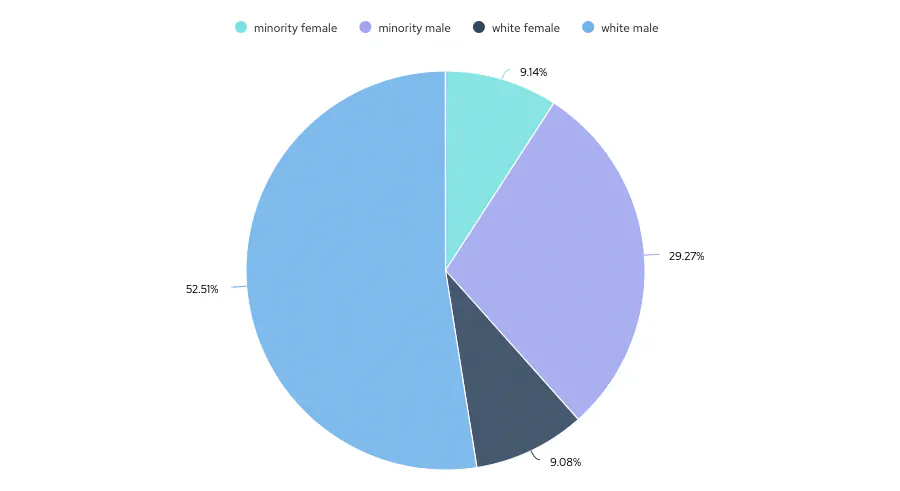
52.51% of people in tech and product roles are white males. 29.27% are minority (i.e., non-white) males, 9.14% are minority females, and 9.08% are white females.
This data is based on people looking for work on cord. In order to do so, engineers are required to have experience working a technical or product role in a technology company in the UK, EU or US, with the majority being software engineers. This means this data is highly reliable and relevant for other people who match this criteria, as opposed to other sources that often cover the “Technology industry” as a whole. It is therefore felt that the data discussed here gives a unique insight into intersectional gender and ethnic minority representation among people working in tech and product-specific positions.
Engineers on cord by function
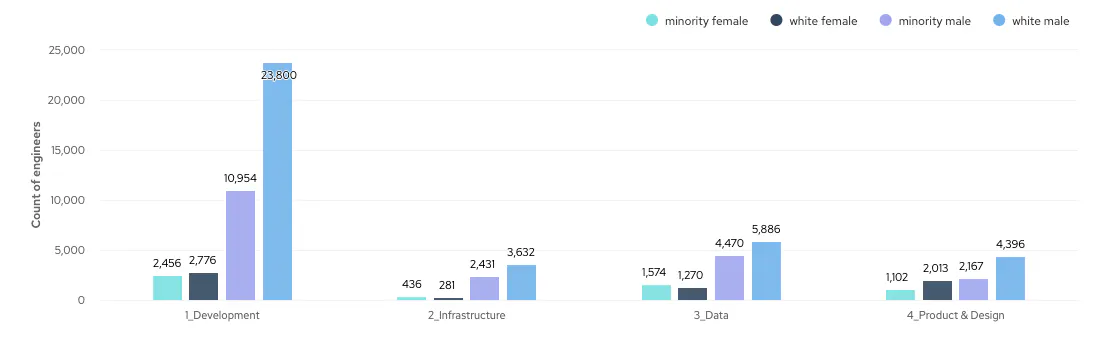
Minority female representation is highest in Data at 11.92%, followed closely by Product & Design at 11.39%. Infrastructure (6.43%) and Development (6.14%) see the lowest levels of minority female representation. Both see little more than half as much minority female representation as Product & Design or Data.
White female representation is highest in Product & Design at 20.80%. Conversely, Infrastructure engineers are just 4.14% white female - less than a fifth the equivalent figure for Product & Design.
Overall Data is the most diverse function (with 44.59% being white male) while Development is the least with 59.92% of developers being white males.
Engineers on cord by seniority
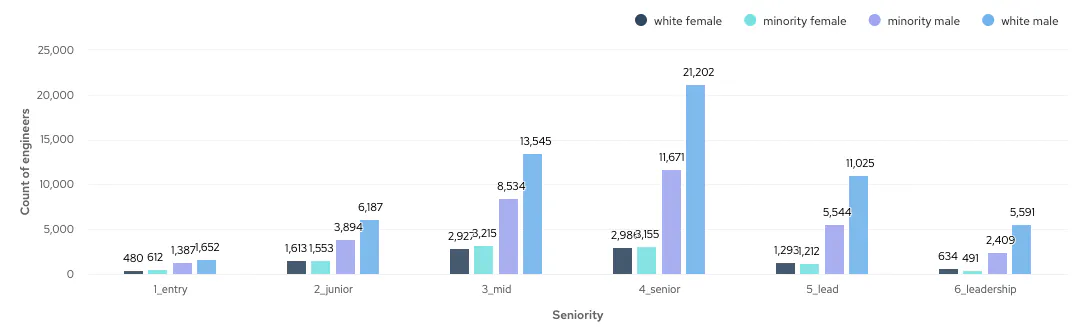
Minority female representation is inversely correlated with seniority.
14.81% of entry-level engineers and 11.72% of junior engineers are females from ethnic minority backgrounds. However, just 6.35% of lead (managerial) and 5.38% of leadership-level (senior managerial) engineers are women from ethnic minority backgrounds. White female representation broadly follows the same pattern, although it is greater at junior (12.18%) than entry (11.62%) level.
White male representation follows the opposite trend: it is highest in leadership (61.27%) and lead (57.80%) engineers, and lowest in entry level (39.99%) and junior (46.70%) engineers.
Demand
Note that, in this article, "message requests" counts approaches received by engineers on cord from companies, regardless of whether or not the engineer accepted the request. The average number of message requests received per engineer is used as a proxy for how sought-after (by hiring companies) engineers in any given category are.
Engineer demand by function
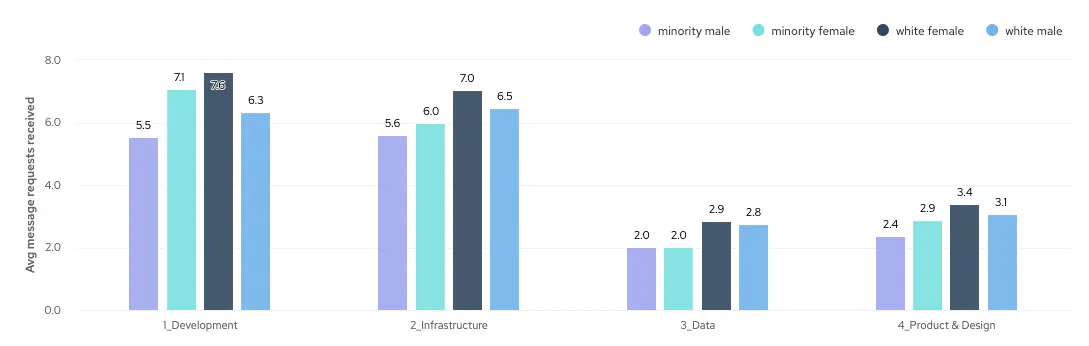
In all functions, white females are the most in-demand group. The average female engineer working in Development receives 7.6 message requests.
Minority males experience negative sourcing bias in all functions. In Data, they are joint-least in demand (with minority females), receiving an average of 2.0 approaches per engineer, and are the least-approached group in all other functions.
Outside of Data, minority females are a relatively in-demand group. They are the second most-approached in Development, where the average minority female engineer receives 7.1 message requests.
Engineer demand by skillset
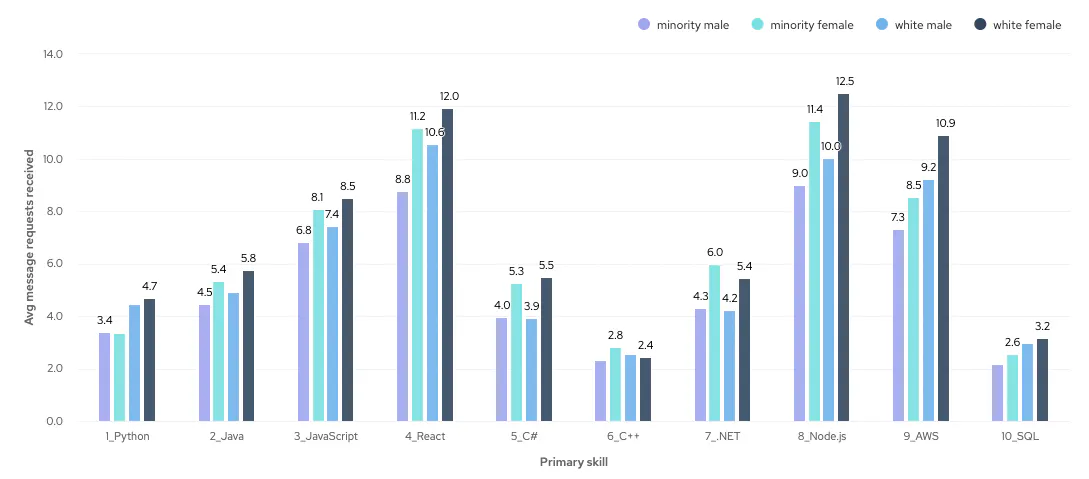
In general, though with several exceptions, females are more in-demand than males with equivalent skills. For 8 out of the 10 most popular primary skills on cord, white females receive the largest number of approaches, on average, per engineer, and for five of these skills minority females receive the second-largest number of approaches. Minority females are the most in-demand group for the remaining two skills (C++ and .NET), with white females the second-most-messaged group among .NET developers.
However, minority males are the least-messaged group for all but three primary skills (Python, C# and .NET).
Note: primary skills are selected by engineers who create cord profiles. Each engineer can select more than one primary skill.
Engineer demand by seniority
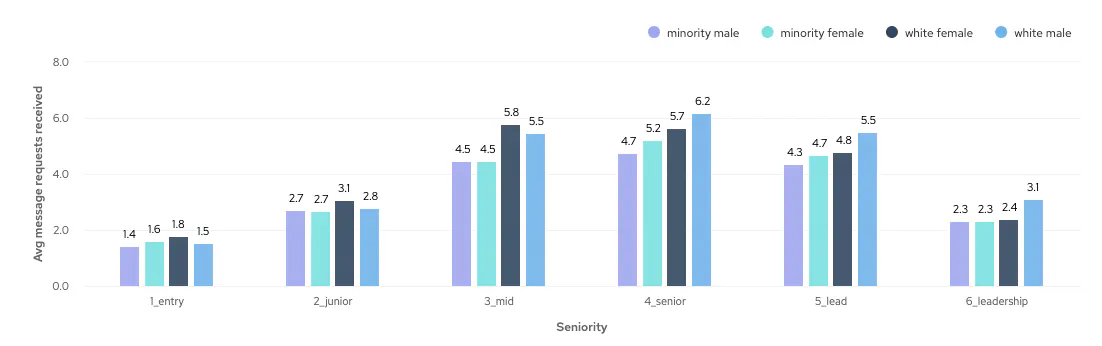
This apparent sourcing bias against minority males persists at equivalent seniority levels too. Minority male engineers at all levels the fewest, or joint-fewest, number of message requests of all groups.
White females receive the most message requests at entry- to mid-level. At higher seniority levels, white males receive the most message requests.
Key Insights
- White males are the most numerous group in tech and product, making up 52.51% of the industry. However, women from minority backgrounds slightly outnumber white women in tech
- Women from ethnic minority backgrounds make up just 5.38% of engineers in senior leadership roles
- Males from minority backgrounds tend to experience a negative sourcing bias
Data Disclaimer
Data refers to 79,462 engineers across all locations (primarily London, Europe/Remote, and New York) on cord.
Gender is determined by one of two methods. All engineers are given the opportunity to self-ID. Roughly one quarter of engineers do so. The remainder have been assigned a gender (male or female) by a third-party predictive API (https://namsor.app/) based on their name. The API makes mistakes, but is accurate in 90-95% of cases. The same API is used to predict the ethnic background of all engineers.
Messages received data refers to the lifetime message count for these engineers - i.e. the total number of message requests each engineer has received from creating their cord profile.

Was this content useful?
Table of contents
Highlights
- White males are the most numerous group in tech and product, making up 52.51% of the industry. However, women from minority backgrounds slightly outnumber white women in tech
- Women from ethnic minority backgrounds make up just 5.38% of engineers in senior leadership roles
- Males from minority backgrounds tend to experience a negative sourcing bias
Discussions you may like
Improving my mental health
Discussion started over 6 months ago.



Working through adversity
Discussion started over 6 months ago.







You might also like

Working culture
How ethnically diverse is the tech workforce?
cord data on representation of, and sourcing biases affecting, different ethnic minorities in the technology industry

Working culture
Gender representation among engineers
cord data examined to reveal how well-represented different genders are in the Tech industry

Working culture
Is there an ethnicity pay gap in tech?
cord data from tens of thousands of engineers analysed to understand the pay gap between different ethnic minorities