 cord
cord20 Most Common Skill-Based Interview Answers
Proven Answers That Demonstrate Real Impact
Telling a great story in an interview isn't enough. Without clear proof of your skills, even the best stories fail. Too often, candidates recount experiences—"I led a team," "I fixed a process"—but fail to translate those moments into real, measurable impact. This is where skill-based answers make the difference.
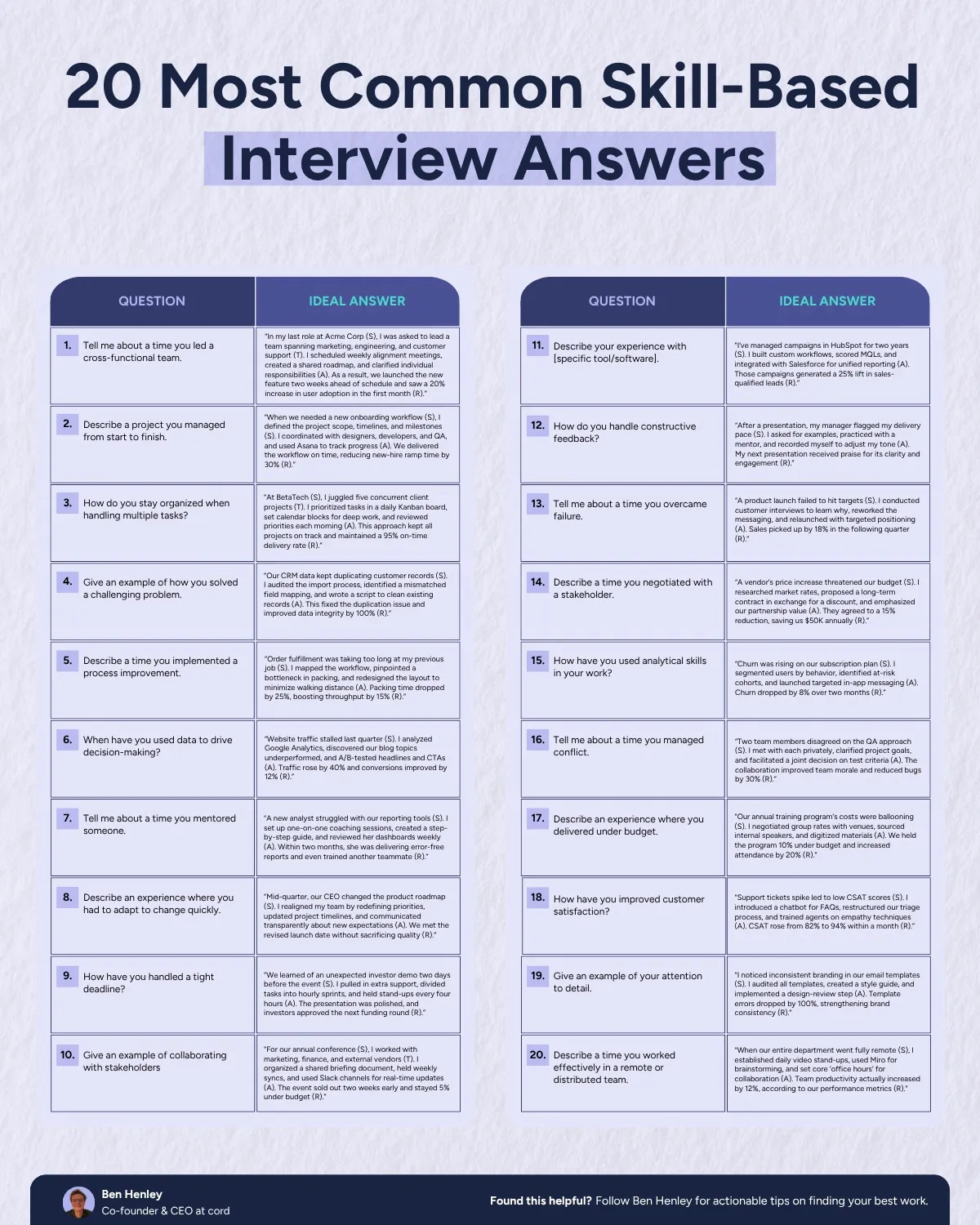
Here are 20 essential skill-based interview questions, paired with strong sample answers. Each one shows how to use the STAR method the right way—anchored in impact, not fluff.
Tell me about a time you led a cross-functional team.
Answer: "In my last role at Acme Corp, I was asked to lead a team spanning marketing, engineering, and customer support. I scheduled weekly alignment meetings, created a shared roadmap, and clarified individual responsibilities. As a result, we launched the new feature two weeks ahead of schedule and saw a 20% increase in user adoption in the first month."
Describe a project you managed from start to finish.
Answer: "When we needed a new onboarding workflow, I defined the project scope, timelines, and milestones. I coordinated with designers, developers, and QA, and used Asana to track progress. We delivered the workflow on time, reducing new-hire ramp time by 30%."
How do you stay organized when handling multiple tasks?
Answer: "At BatchTech, I juggled five concurrent client projects. I prioritized tasks in a daily Kanban board, set calendar blocks for deep work, and reviewed priorities each morning. This approach kept all projects on track and maintained a 95% on-time delivery rate."
Give an example of how you solved a challenging problem.
Answer: "Our CRM data kept duplicating customer records. I audited the import process, identified a mismatched field mapping, and wrote a script to clean existing records. This fixed the duplication issue and improved data integrity by 100%."
Describe a time you implemented a process improvement.
Answer: "Order fulfillment was taking too long at my previous job. I mapped the workflow, pinpointed a bottleneck in packing, and redesigned the layout to minimize walking distance. Packing time dropped by 25%, boosting throughput by 15%."
When have you used data to drive decision-making?
Answer: "Website traffic stalled last quarter. I analyzed Google Analytics, discovered we blog posts underperformed, and A/B-tested headlines and CTAs. Traffic rose by 40% and conversions improved by 15%."
Tell me about a time you mentored someone.
Answer: "A new analyst struggled with our reporting tools. I set up one-on-one training sessions, created a step-by-step guide, and reviewed her work for two weeks. Within two months, she was delivering error-free reports and even trained another teammate."
Describe an experience where you had to adapt to change quickly.
Answer: "Our client shifted their campaign strategy mid-launch. I realigned my team by redefining priorities, updated creative briefs, and coordinated directly with stakeholders about new expectations. We met the revised launch date without sacrificing quality."
How have you handled a tight deadline?
Answer: "We learned of an unexpected investor demo two days before the event. I pulled in extra support, divided tasks into 4-hour blocks, and held brief check-ins every four hours. We delivered the demo on time, and investors approved the next funding round."
Give an example of collaborating with stakeholders.
Answer: "For our annual conference, I worked with marketing, finance, and external vendors. I organized a shared briefing document, held weekly sync-ups, and used Slack channels for real-time updates. The event came in 10% under budget and exceeded our attendance target by 15%."
Describe your experience with [specific tool/software].
Answer: "I've managed campaigns in HubSpot for two years. I built custom workflows, scored 1,500+ leads per quarter, and created reports for unified reporting. Those campaigns generated a 25% lift in sales-qualified leads."
How do you handle constructive feedback?
Answer: "After a presentation, my manager flagged my delivery pace. I practiced with teammates, switched to a shorter format, and rehearsed timing more carefully. My next presentation received praise for its clarity and engagement."
Tell me about a time you overcame failure.
Answer: "A product launch failed to hit targets. I conducted customer interviews to learn why, revisited the messaging strategy, and A/B-tested positioning options. The updated product up by 30% in the following quarter."
Describe a time you negotiated with a stakeholder.
Answer: "A vendor's price increase threatened our budget. I researched market rates, proposed a long-term contract in exchange for a discount, and emphasized our partnership value. We negotiated a 15% cost reduction, saving us $50K annually."
How have you used analytical skills in your work?
Answer: "Churn was rising on our subscription plan. I segmented users by behavior, identified at-risk cohorts, and launched targeted in-app messaging. Churn dropped by 8% over two months."
Tell me about a time you managed conflict.
Answer: "Two team members disagreed on the QA approach. I met with each individually, clarified project goals, and facilitated a joint decision on test criteria. The collaboration improved team morale and reduced bugs by 20%."
Describe an experience where you delivered under budget.
Answer: "Our annual training program's costs were ballooning. I negotiated group rates for online venues, secured sponsorships for materials, and streamlined logistics. We ran the program 15% under budget and increased attendance by 20%."
How have you improved customer satisfaction?
Answer: "Support tickets took too long to resolve. I introduced a triage system, cross-trained our team on different products, and created self-service resources. CSAT rose from 82% to 94% within a month."
Give an example of your attention to detail.
Answer: "I noticed inconsistent branding in our email templates. I audited all templates, created a style guide, and implemented a design review steps. Template consistency improved, and our email engagement increased by 12%."
Describe a time you worked effectively in a remote or distributed team.
Answer: "When our entire department went fully remote, I established daily video stand-ups, used Miro for brainstorming, and set core office hours for collaboration. Team productivity actually increased by 15%, according to our performance metrics."
The Key to Success
The next time someone says, "Tell me about a time…", you won't just share a story—you'll deliver real proof. Each answer should follow the STAR method (Situation, Task, Action, Result) and focus on specific, measurable outcomes that demonstrate your skills in action.
Remember: concrete results beat vague descriptions every time. Use numbers, percentages, and clear metrics to show the impact of your work.

Was this content useful?