 cord
cordThe Hidden Meaning Behind the Toughest Questions
What Interviewers are really looking for

Job interviews can feel like walking through a minefield. You prepare for the obvious questions about your experience and qualifications, but then the interviewer hits you with something that makes you pause: "Tell me about a time you failed" or "Why are you leaving your current job?"
These questions might catch you off guard, but they're not designed to trip you up. They have a deeper purpose that goes beyond the surface-level answer you might give.
What Interviewers Are Really Looking For
The toughest interview questions aren't trick questions—they're windows into who you are as a person and professional. When an interviewer asks about your biggest weakness or a time you had conflict with a coworker, they're not trying to eliminate you from consideration. They're trying to understand three key things about you:
How you handle pressure. Can you stay composed when discussing difficult topics? Do you become defensive, or do you approach challenging questions with grace?
Whether you take responsibility. When things go wrong, do you blame others or circumstances beyond your control? Or do you own your part in what happened?
If you really understand your own value. Can you articulate what you bring to the table, even when discussing areas for improvement? Do you know your worth without being arrogant?
The Three-Step Framework for Tough Questions
Top candidates don't deflect or give generic answers to these challenging questions. Instead, they follow a clear framework that demonstrates self-awareness, accountability, and growth.
1. Understand What They're Really Asking
Every tough interview question has a hidden meaning. When someone asks about your biggest weakness, they want to see self-awareness. When they ask about team conflict, they're checking your emotional intelligence. When they bring up a missed deadline, they're watching to see if you take accountability.
Before you answer, take a moment to think about what the interviewer is trying to learn about you. This pause shows thoughtfulness and helps you give a more targeted response.
2. Take Responsibility Without Flinching
You don't need to be perfect to be hireable. In fact, trying to present yourself as flawless often backfires because it suggests a lack of self-awareness or honesty.
Instead, be clear about what happened, what you learned, and how you've grown from the experience. When you can turn a failure into a lesson, you demonstrate maturity and leadership potential. This approach shows that you're someone who learns from mistakes rather than repeating them.
3. Connect It Back to What Matters
Your answers shouldn't exist in a vacuum. The best responses connect your experiences back to what the company values and what the role requires.
Show how your experience—even the challenging parts—makes you a stronger fit for the position. Demonstrate that you stay focused and solution-oriented under pressure. This connection helps the interviewer see how your past experiences will translate into future success in their organization.
Real Examples of How to Answer
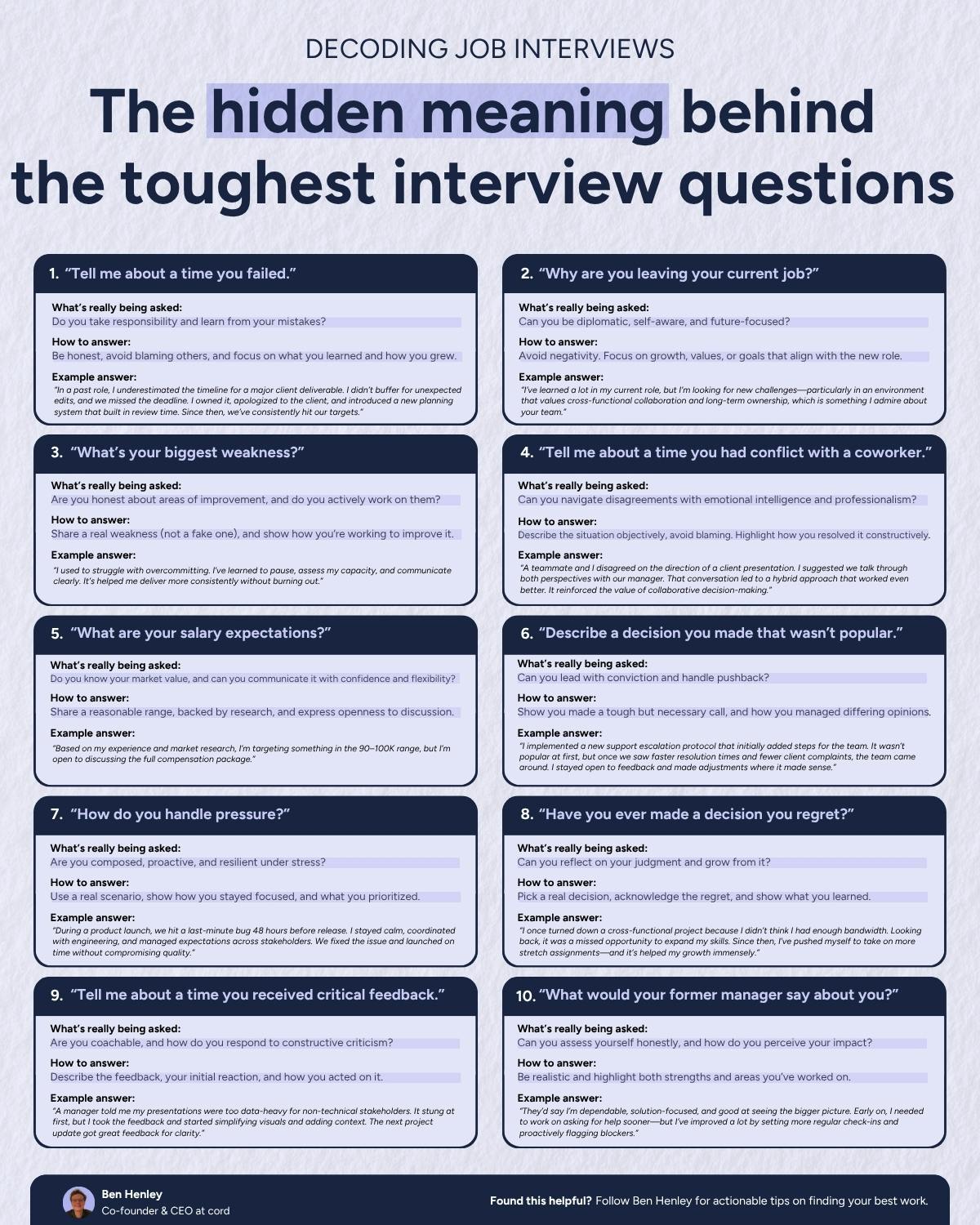
Let's look at how this framework applies to the ten most challenging interview questions:
1. "Tell me about a time you failed."
What they're really asking: Do you take responsibility and learn from your mistakes?
How to answer: Be honest, avoid blaming others, and focus on what you learned and how you grew. Pick a real example where you can demonstrate accountability and growth.
2. "Why are you leaving your current job?" What they're really asking: Can you be diplomatic, self-aware, and future-focused? How to answer: Avoid negativity. Focus on growth, values, or goals that align with the new role rather than what's wrong with your current situation.
3. "What's your biggest weakness?" What they're really asking: Are you honest about areas of improvement, and do you actively work on them? How to answer: Share a real weakness (not a fake one), and show how you're working to improve it. Demonstrate self-awareness and commitment to growth.
4. "Tell me about a time you had conflict with a coworker." What they're really asking: Can you navigate disagreements with emotional intelligence and professionalism? How to answer: Describe the situation objectively, avoid blaming. Highlight how you resolved it constructively and what you learned about collaboration.
5. "What are your salary expectations?" What they're really asking: Do you know your market value, and can you communicate it with confidence and flexibility? How to answer: Share a reasonable range, backed by research, and express openness to discussion. Show you understand your worth without being inflexible.
6. "Describe a decision you made that wasn't popular." What they're really asking: Can you lead with conviction and handle pushback? How to answer: Show you made a tough but necessary call, and how you managed differing opinions. Demonstrate leadership and the ability to stand by sound decisions.
7. "How do you handle pressure?" What they're really asking: Are you composed, proactive, and resilient under stress? How to answer: Use a real scenario, show how you stayed focused, and what you prioritized. Demonstrate your ability to maintain quality work under pressure.
8. "Have you ever made a decision you regret?" What they're really asking: Can you reflect on your judgment and grow from it? How to answer: Pick a real decision, acknowledge the regret, and show what you learned. Focus on how the experience improved your decision-making process.
9. "Tell me about a time you received critical feedback." What they're really asking: Are you coachable, and how do you respond to constructive criticism? How to answer: Describe the feedback, your initial reaction, and how you acted on it. Show that you can receive criticism professionally and use it for improvement.
10. "What would your former manager say about you?" What they're really asking: Can you assess yourself honestly, and how do you perceive your impact? How to answer: Be realistic and highlight both strengths and areas you've worked on. Show self-awareness and understanding of how others perceive your contributions.
The Key to Success
The secret to answering tough interview questions isn't about memorizing perfect responses or trying to outsmart the interviewer. It's about understanding what's really being asked, being present in the moment, and then tailoring your response to show your best qualities.
Remember, these questions are an opportunity, not a trap. They're your chance to demonstrate the kind of person you are when faced with challenges—someone who takes responsibility, learns from experiences, and approaches difficulties with maturity and grace.
When you can do that consistently, you'll stand out from other candidates who might have similar qualifications but lack the self-awareness and accountability that truly great employees possess.

Was this content useful?