 cord
cordJob Interview Dos & Dont’s
Master Every Stage of the Interview Process with Proven Strategies That Actually Work
Interviewing is a skill you can master. After thousands of interviews, one pattern emerges: the best candidates don't always have perfect answers, but the worst almost always make the same avoidable mistakes.
Here's your complete guide to interview success, broken down by each stage of the process.
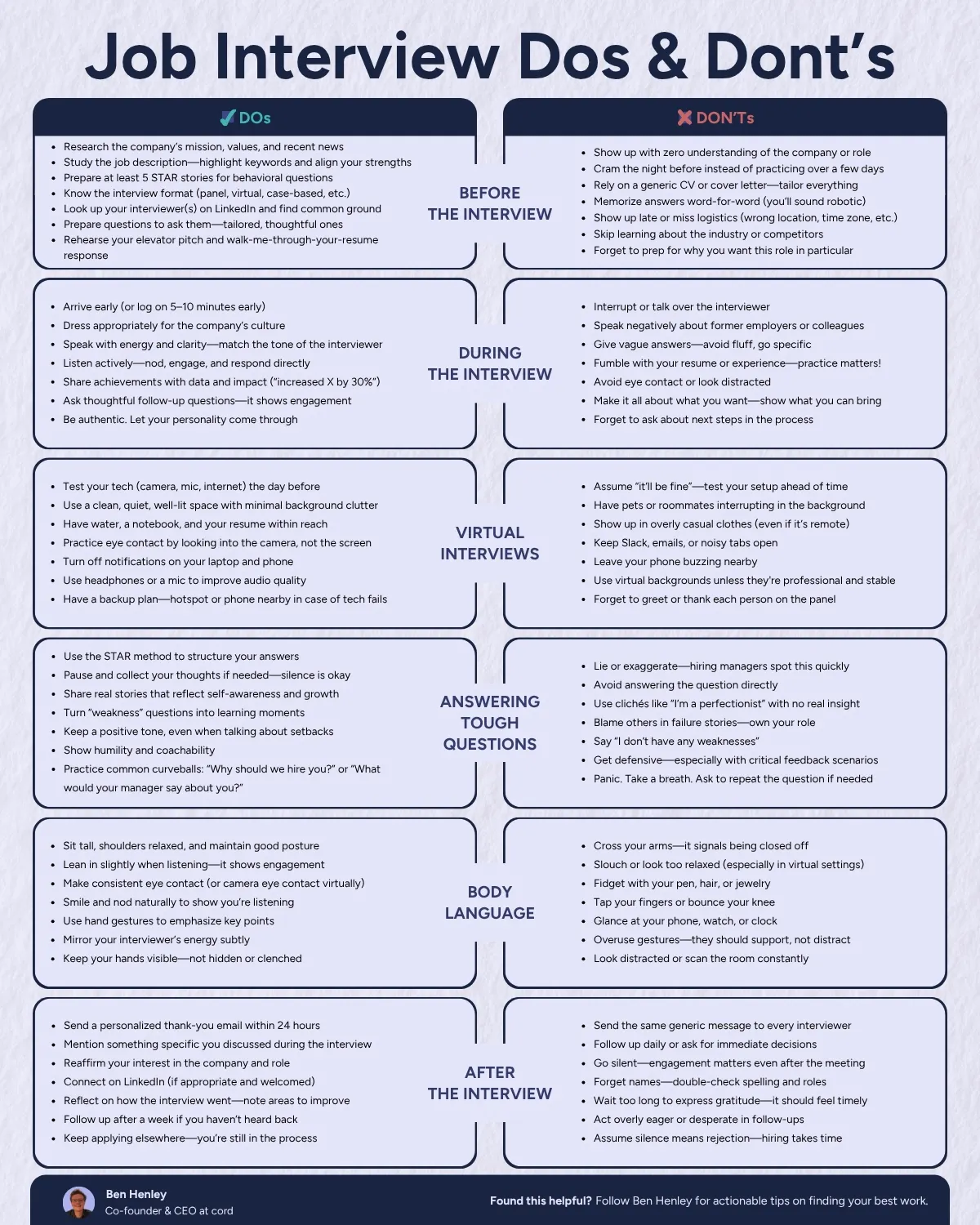
Before the Interview
What You Should Do
- Research the company's mission, values, and recent news
- Study the job description and highlight keywords that align with your strengths
- Prepare at least 5 STAR stories for behavioral questions
- Know the interview format (panel, virtual, case-based, etc.)
- Look up your interviewer(s) on LinkedIn and find common ground
- Prepare questions to ask them—tailored, thoughtful ones
- Rehearse your elevator pitch and walk-me-through-your-resume response
What You Should Never Do
- Show up with zero understanding of the company or role
- Cram the night before instead of practicing over a few days
- Rely on a generic CV or cover letter—tailor everything
- Memorize answers word-for-word (you'll sound robotic)
- Show up late or miss logistics (wrong location, time zone, etc.)
- Skip learning about the industry or competitors
- Forget to prep for why you want this role in particular
During the Interview
What You Should Do
- Arrive early (or log on 5-10 minutes early)
- Dress appropriately for the company culture
- Speak with energy and clarity—match the tone of the interviewer
- Listen actively—nod, engage, and respond directly
- Share achievements with stats and impact ("increased X by 30%")
- Ask thoughtful follow-up questions—it shows engagement
- Be authentic. Let your personality come through
What You Should Never Do
- Interrupt or talk over the interviewer
- Speak negatively about former employers or colleagues
- Give vague answers—avoid fluff, be specific
- Fumble with your resume or experience—practice matters
- Avoid eye contact or look distracted
- Make it all about what you want—show what you can bring
- Forget to ask about next steps in the process
Virtual Interviews
What You Should Do
- Test your tech (camera, mic, internet) the day before
- Use a clean, quiet, well-lit space with minimal background clutter
- Have water, a notebook, and your resume within reach
- Practice eye contact by looking into the camera, not the screen
- Turn off notifications on your laptop and phone
- Use headphones or a mic to improve audio quality
- Have a backup plan—hotspot or phone nearby in case of tech fails
What You Should Never Do
- Assume "it'll be fine"—test your setup ahead of time
- Have pets or roommates interrupting in the background
- Show up in overly casual clothes (even if it's remote)
- Keep Slack, emails, or noisy tabs open
- Leave your phone buzzing nearby
- Use virtual backgrounds unless they're professional and stable
- Forget to greet or thank each person on the panel
Answering Tough Questions
What You Should Do
- Use the STAR method to structure your answers
- Pause and collect your thoughts if needed—silence is okay
- Share real stories that reflect self-awareness and growth
- Turn "weakness" questions into learning moments
- Keep a positive tone, even when talking about setbacks
- Show humility and coachability
- Practice common curveballs: "Why should we hire you?" or "What would your manager say about you?"
What You Should Never Do
- Lie or exaggerate—hiring managers spot this quickly
- Avoid answering the question directly
- Use clichés like "I'm a perfectionist" with no real insight
- Blame others in failure stories—own your role
- Say "I don't have any weaknesses"
- Get defensive—especially with critical feedback scenarios
- Panic. Take a breath. Ask to repeat the question if needed
Body Language
What You Should Do
- Sit tall, shoulders relaxed, and maintain good posture
- Lean in slightly when listening—it shows engagement
- Make consistent eye contact (or camera eye contact virtually)
- Smile and nod naturally to show you're listening
- Use hand gestures to emphasize key points
- Mirror your interviewer's energy subtly
- Keep your hands visible—not hidden or clenched
What You Should Never Do
- Cross your arms—it signals being closed off
- Slouch or look too relaxed (even in virtual settings)
- Fidget with your pen, hair, or jewelry
- Tap your fingers or bounce your knee
- Glance at your phone, watch, or clock
- Overuse gestures—they should support, not distract
- Look distracted or scan the room constantly
After the Interview
What You Should Do
- Send a personalized thank-you email within 24 hours
- Mention something specific you discussed during the interview
- Reaffirm your interest in the company and role
- Connect on LinkedIn (if appropriate and welcomed)
- Reflect on how the interview went—note areas to improve
- Follow up after a week if you haven't heard back
- Keep applying elsewhere—you're still in the process
What You Should Never Do
- Send the same generic message to every interviewer
- Follow up daily or ask for immediate decisions
- Go silent—engagement matters even after the meeting
- Forget names—double-check spelling and titles
- Wait too long to express gratitude—it should feel timely
- Act overly eager or desperate in follow-ups
- Assume silence means rejection—hiring takes time
The Bottom Line
Most interviews are won before they start and lost because people didn't prepare with intention. You don't need to be perfect. You need to be present, prepared, and professional.
The candidates who succeed understand that interviewing is a two-way conversation. You're evaluating them as much as they're evaluating you. Approach each interview with curiosity, preparation, and authenticity.
Master these fundamentals, and you'll stand out from the majority of candidates who wing it and hope for the best.

Was this content useful?