 cord
cordStory-Telling Frameworks for Jobseekers
The 6 Essential Storytelling Frameworks for Interview Success

Talented people don't fail interviews because they're unqualified. They lose out because they don't know how to tell their story.
Here's what most job seekers miss: interviews aren't just about your experience. They're about how you present that experience. In today's competitive job market, you need more than bullet points on a resume. You need stories that connect with interviewers and make you memorable.
The difference between getting hired and getting passed over often comes down to one thing: can you turn your professional experiences into compelling narratives that demonstrate your value?
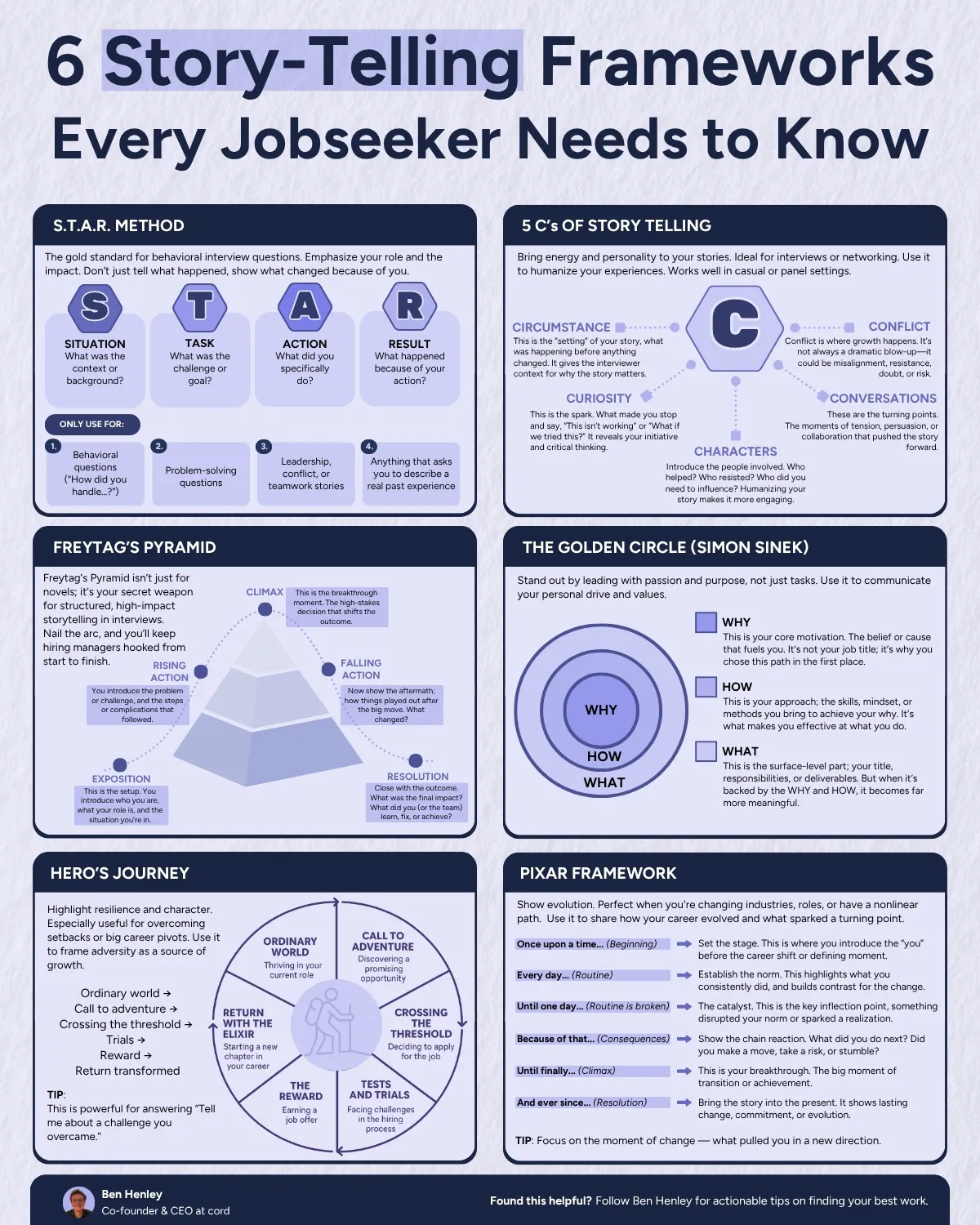
Here are six proven storytelling frameworks that will transform how you approach job interviews.
The 6 Essential Storytelling Frameworks for Interview Success
S.T.A.R. Method
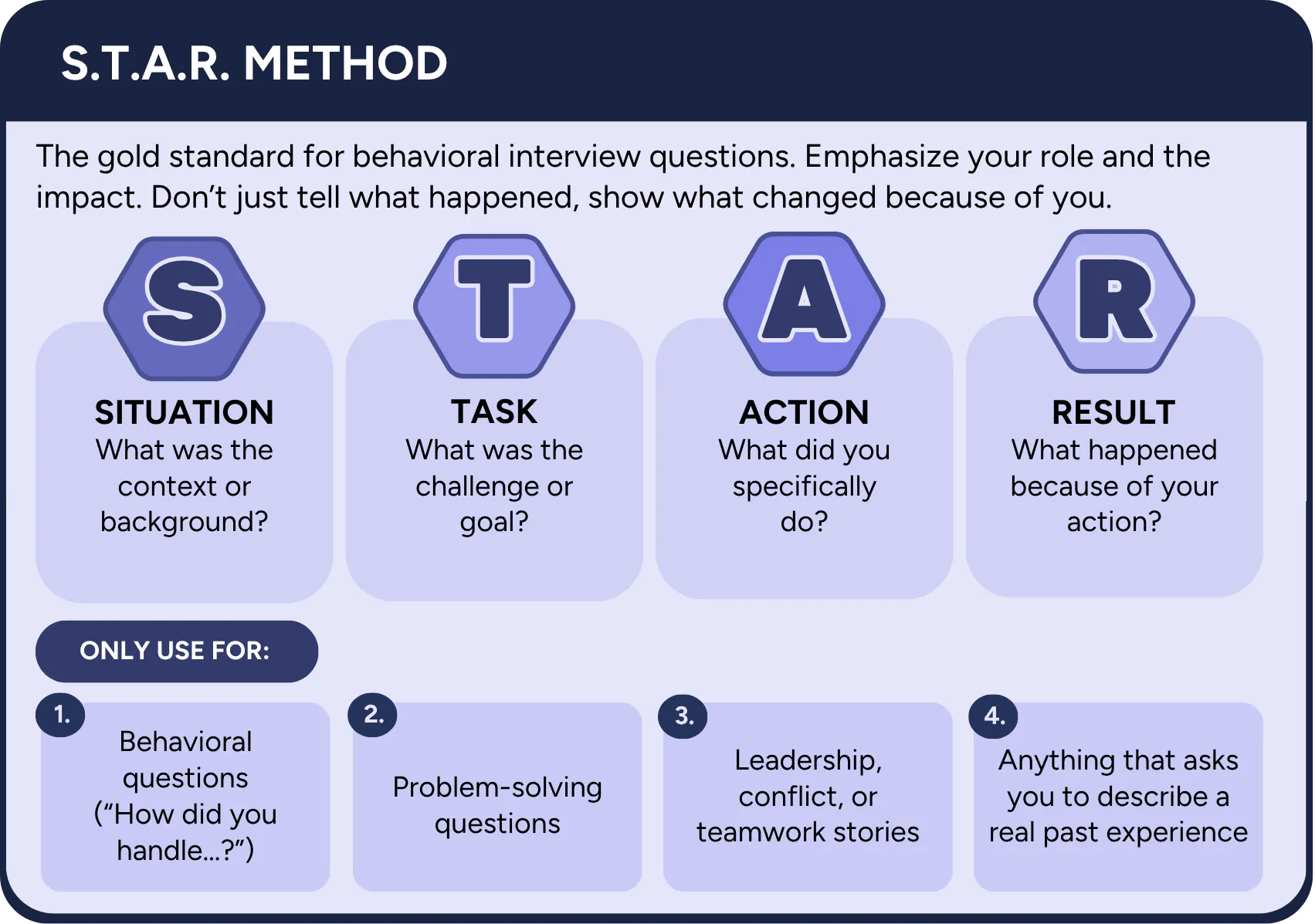
Structure: Situation → Task → Action → Result
The S.T.A.R. method is the gold standard for behavioral interview questions. It helps you provide structured, comprehensive answers that showcase both your experience and impact.
When to use:
- Behavioral questions ("Tell me about a time when...")
- Problem-solving questions
- Leadership, conflict, or teamwork stories
- Any question asking you to describe a real past experience
How it works:
- Situation: Set the context or background
- Task: Explain what challenge or goal you faced
- Action: Detail what you specifically did
- Result: Share what happened because of your actions
This framework keeps your answers focused and ensures you don't just tell what happened, but demonstrate the value you brought to the situation.
5 C's of Story Telling
Structure: Circumstance → Curiosity → Characters → Conversations → Conflict
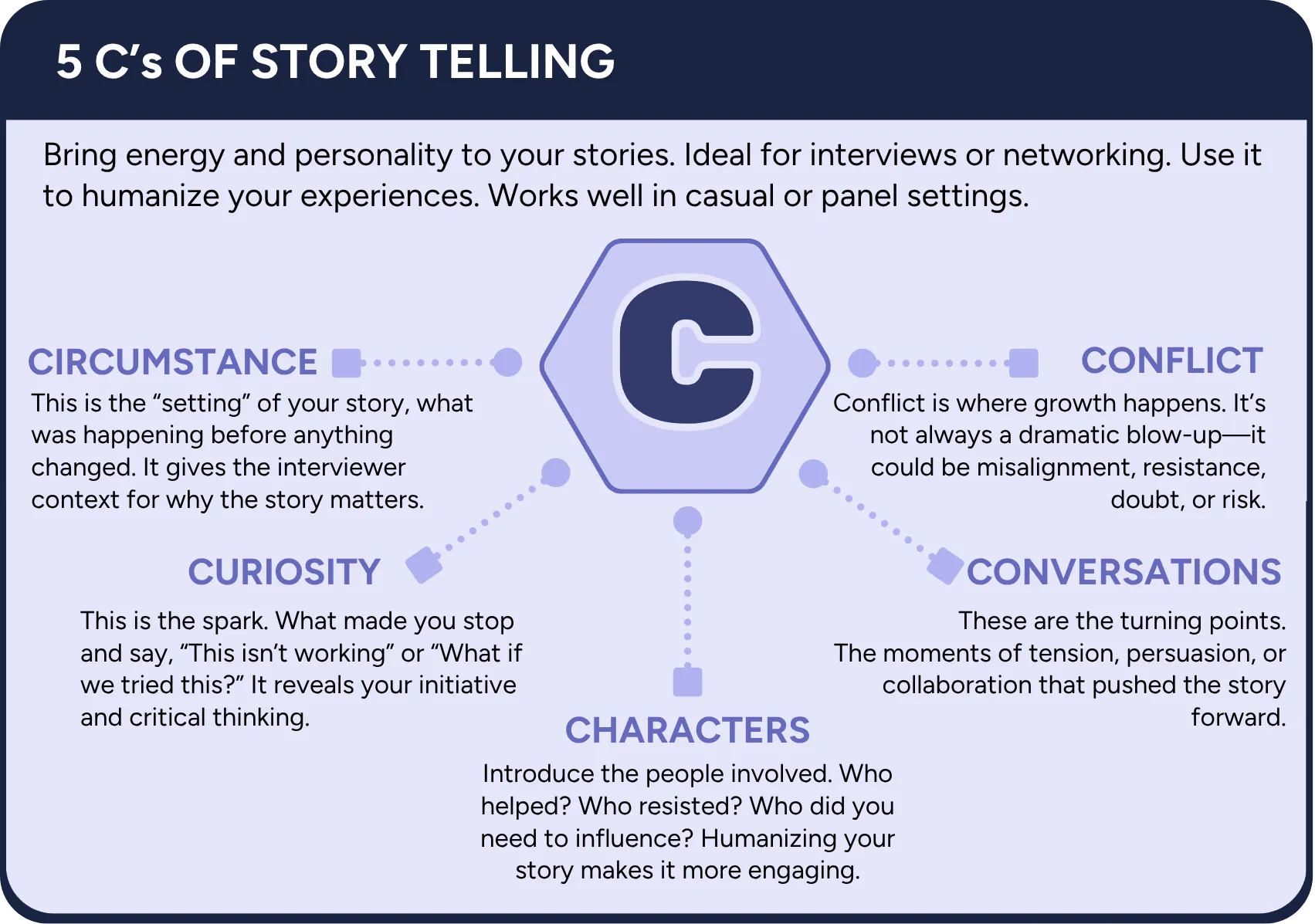
This framework brings energy and personality to your stories, making them more engaging and human. It works particularly well in casual or panel interview settings where you want to build rapport.
The five components:
- Circumstance: The "setting" of your story - what was happening before anything changed
- Curiosity: The hook that made you stop and think - "This isn't working" or "What if we tried this?"
- Characters: The people involved - who helped, resisted, or influenced the story
- Conversations: Moments of tension, persuasion, or collaboration that moved the story forward
- Conflict: Where growth happened - the challenge that created opportunity for change
Use this framework to humanize your experiences and show how you navigate workplace relationships and challenges.
The Golden Circle (Simon Sinek)
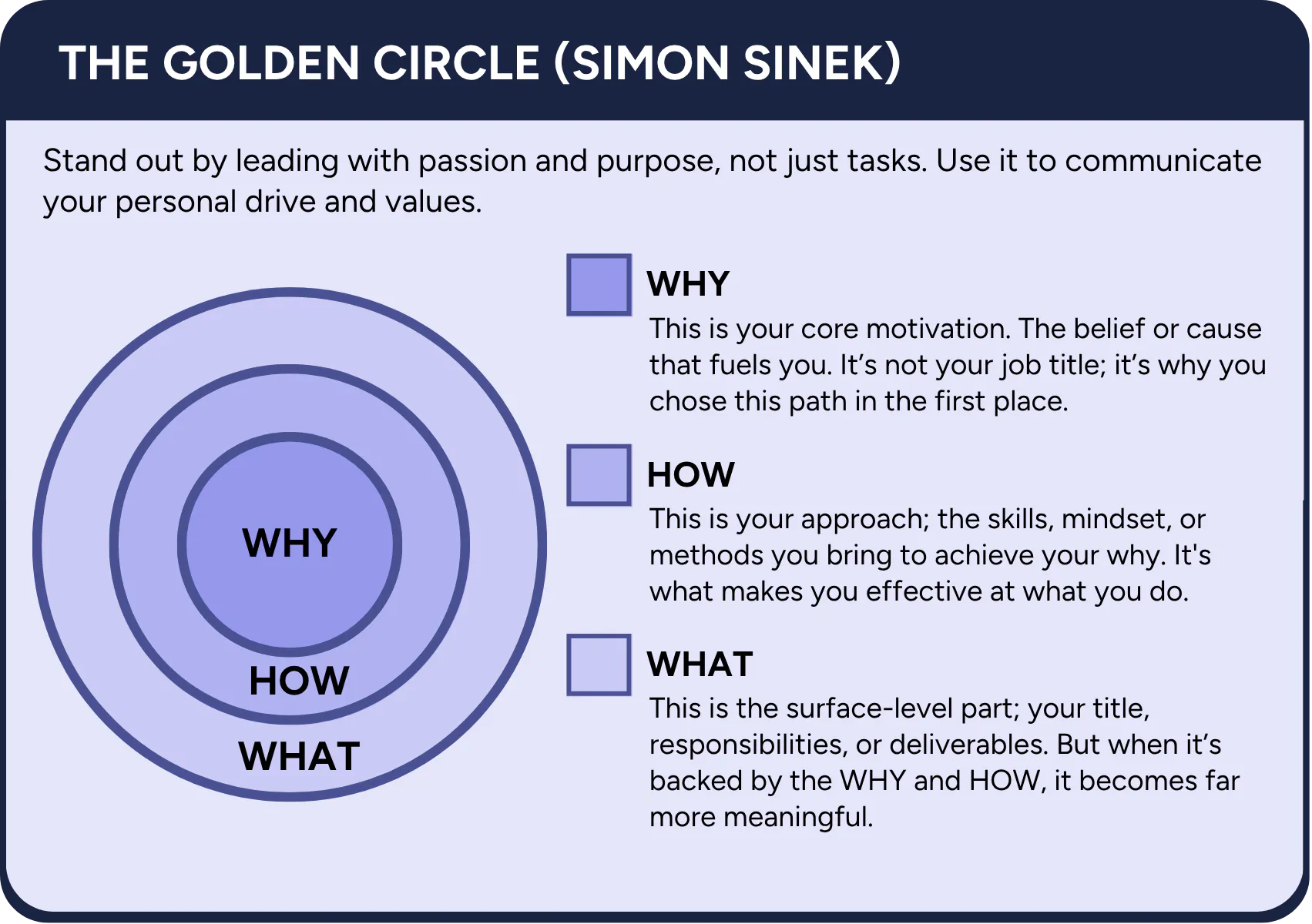
Structure: Why → How → What
Stand out by leading with passion and purpose, not just tasks. This framework helps you communicate your personal drive and values.
How to apply it:
- Why: Your core motivation - the belief or cause that drives you
- How: Your approach, skills, mindset, or methods for achieving your why
- What: The surface-level part - your title, responsibilities, or deliverables
Instead of starting with "I'm a marketing manager," try "I believe great products deserve to find their audience. I use data-driven storytelling and customer research to build meaningful connections between brands and people. That's why I chose marketing."
When backed by the WHY and HOW, your WHAT becomes far more meaningful.
Freytag's Pyramid
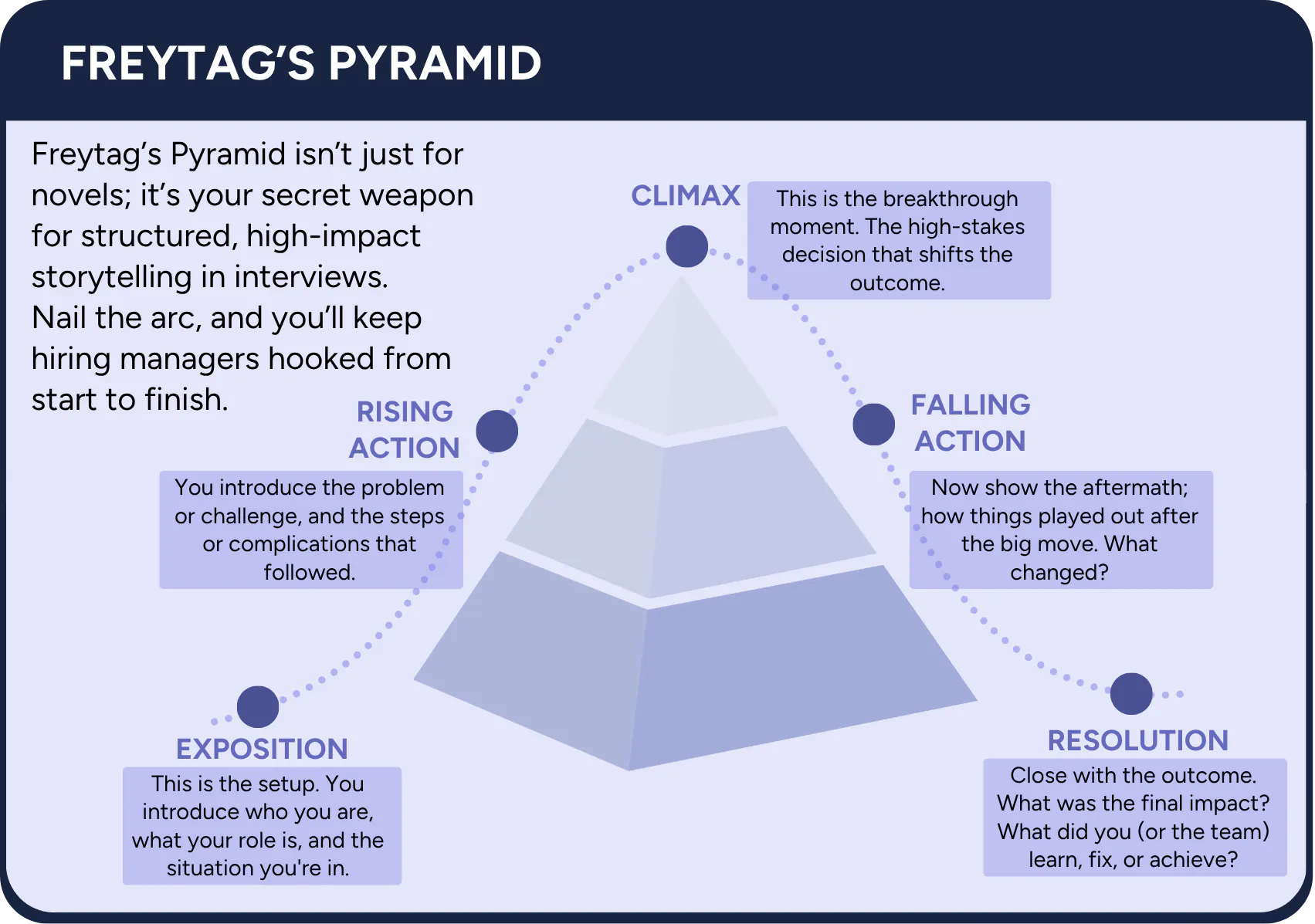
Structure: Exposition → Rising Action → Climax → Falling Action → Resolution
Structure your achievements like a compelling narrative. This framework is particularly effective for project-based stories and major accomplishments.
The components:
- Exposition: Set the stage - introduce who you are, what your role was, the situation you were in
- Rising Action: Build tension - introduce the problem or challenge, show complications that arose
- Climax: The breakthrough moment - the pivotal decision, action, or realization
- Falling Action: Show the aftermath - how things played out after the big moment
- Resolution: Close with the outcome - what was the final impact, what did you learn, fix, or achieve
This isn't just for novels. Use it to make your professional achievements feel like mini-narratives that keep interviewers engaged from start to finish.
Hero's Journey
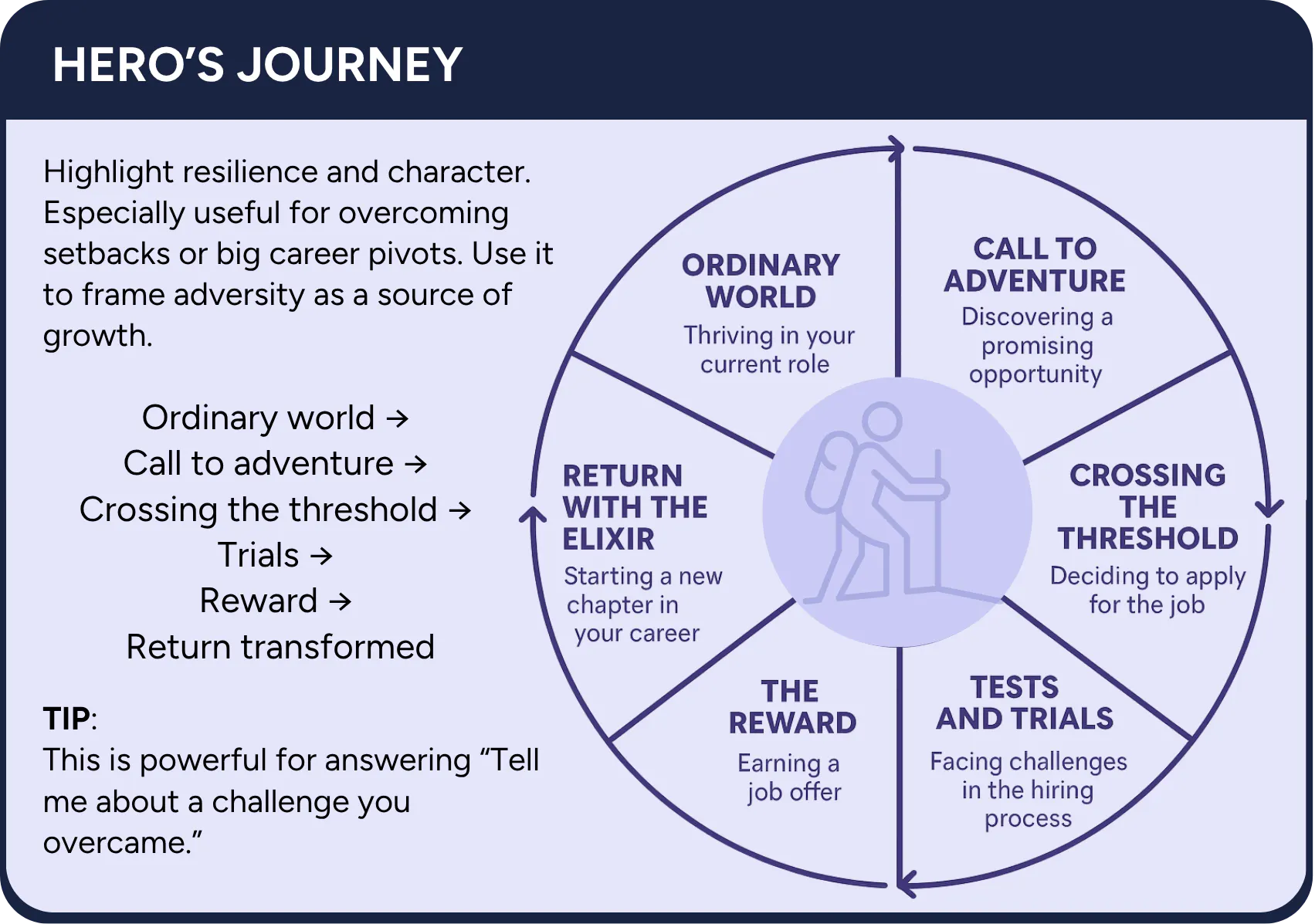
Structure: Ordinary World → Call to Adventure → Crossing the Threshold → Trials → Reward → Return Transformed
Highlight resilience and character development. This framework is especially useful for overcoming setbacks or pivoting in your career path.
The journey:
- Ordinary World: Your starting point - thriving in your comfort zone or previous role
- Call to Adventure: The moment you discovered a problem or opportunity
- Crossing the Threshold: Your decision to step into the unknown and tackle the challenge
- Trials and Tests: The obstacles you faced and lessons learned in the process
- The Reward: The success you achieved - earning a promotion, completing a difficult project, gaining new skills
- Return Transformed: How the experience changed you and prepared you for future challenges
This framework is powerful for answering "Tell me about a challenge you overcame" or explaining career transitions and growth.
Pixar Framework
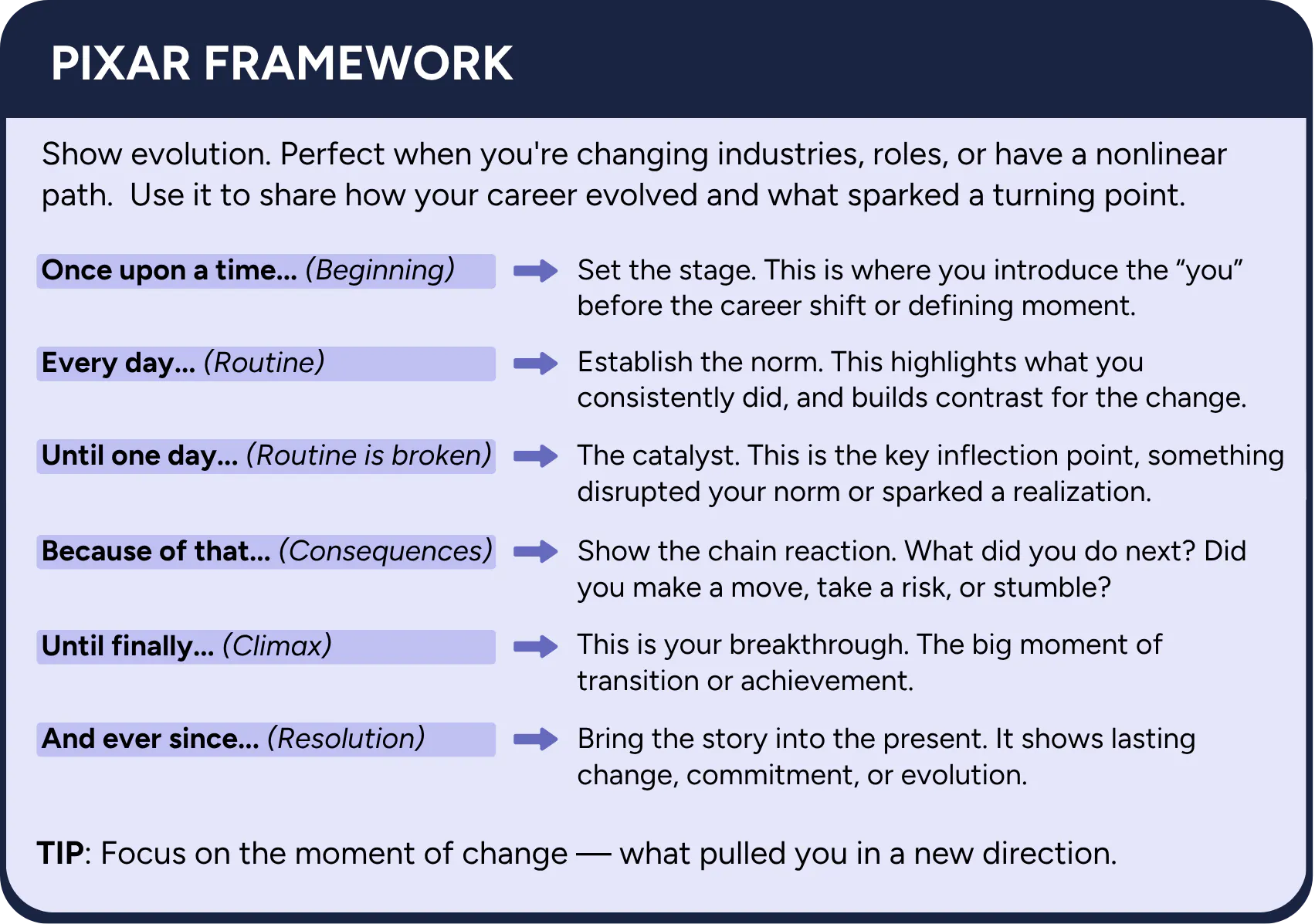
Structure: "Once upon a time... Every day... Until one day... Because of that... Until finally... And ever since..."
Show evolution over time. This framework is perfect when you're changing industries, roles, or have a non-linear career path.
The progression:
- Once upon a time: Set the stage - introduce the "you" before the career shift or defining moment
- Every day (Routine): Establish the norm - highlight what you consistently did and built contrast for the change
- Until one day (Routine is broken): The catalyst - something that disrupted your perspective or sparked change
- Because of that (Consequences): Show the chain reaction - what did you do next? Did you make a move, take a risk, or stumble?
- Until finally (Climax): The breakthrough - the big moment of transition or achievement
- And ever since (Resolution): Bring the story into the present - show lasting change, commitment, or evolution
Focus on the moment of change and what pulled you in a new direction.
Why Stories Matter More Than Facts
Anyone can recite their job history. The candidates who land offers are the ones who make interviewers feel something when they speak.
Facts get forgotten. Stories get remembered.
Your resume got you in the door, but your stories will get you the job. They demonstrate not just what you've done, but how you think, how you handle challenges, and what kind of colleague you'll be.
Before your next interview, ask yourself: Am I just answering questions, or am I telling stories worth hiring?
Putting It All Together
Choose the framework that best fits each story you want to tell:
- Use S.T.A.R. for straightforward behavioral questions
- Use 5 C's when you want to show your interpersonal skills
- Use Golden Circle to explain your motivations and career choices
- Use Freytag's Pyramid for major project accomplishments
- Use Hero's Journey for overcoming significant challenges
- Use Pixar Framework for career transitions and growth over time
Practice these frameworks with your key professional stories. The goal isn't to sound rehearsed, but to have a clear structure that helps you communicate your value effectively.
Remember: the best stories don't just describe what happened. They show who you are and what you'll bring to the role.

Was this content useful?