 cord
cordWhat Never to "Tell Me About Yourself"
And What to Say Instead

Most candidates trip up on the first question, not because they lack experience but because they don't know what not to say. The "Tell me about yourself" question is one of the most confusing interview questions, yet it's almost guaranteed to come up.
Understandably, most people either recite their entire background, start from school, or give a vague personal life story. It's well-meaning, but it misses the point entirely.
What hiring managers actually want to hear is a concise, relevant story that connects the dots between your experience and why you're a great fit for this role.
The Do's and Don'ts Framework
What Most People Say vs. What Hiring Managers Want to Hear
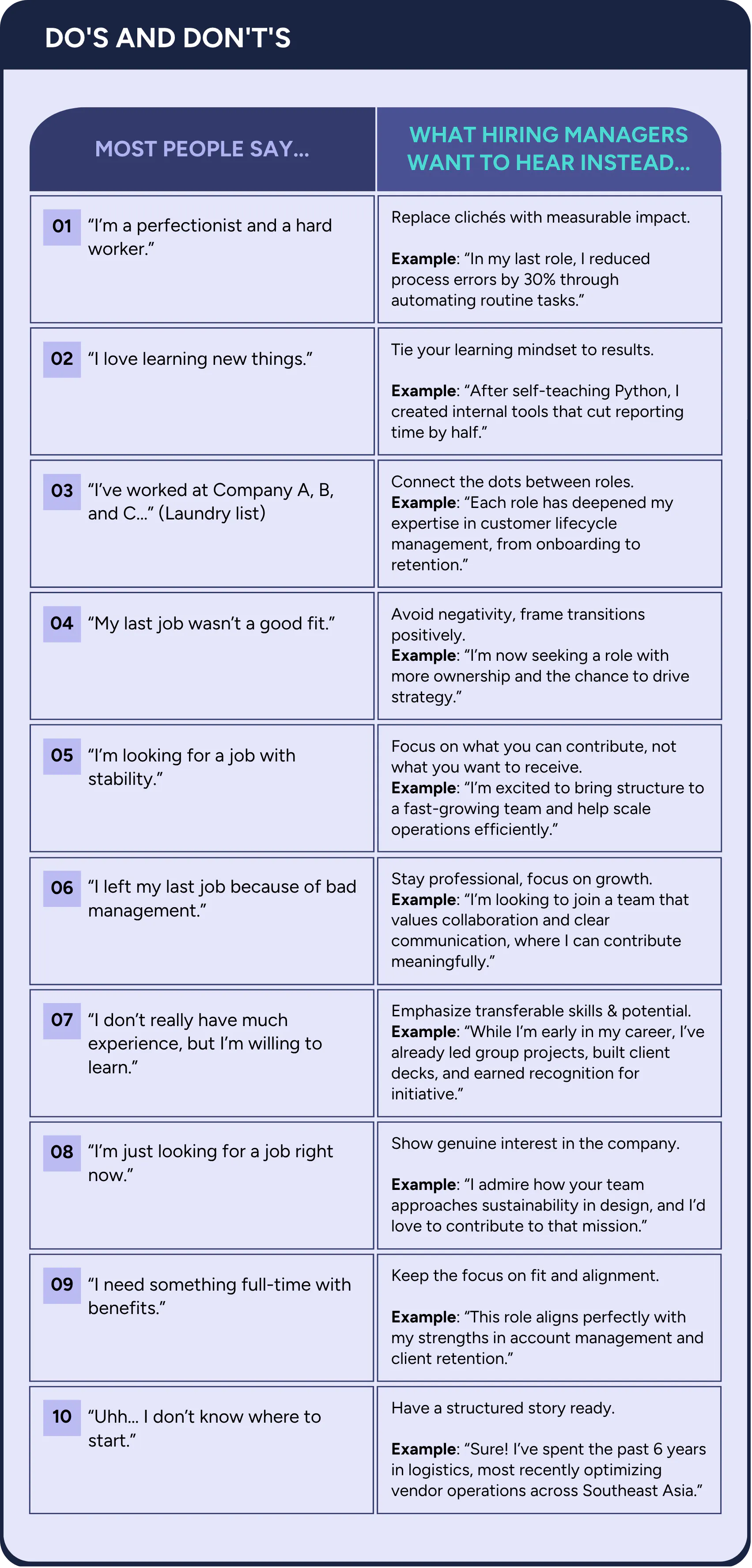
1. "I'm a perfectionist and a hard worker."
- Why it doesn't work: Replace clichés with measurable impact
- What to say instead: "In my last role, I reduced process errors by 30% through automating routine tasks."
2. "I love learning new things."
- Why it doesn't work: Tie your learning mindset to results
- What to say instead: "After self-teaching Python, I created internal tools that cut reporting time by half."
3. "I've worked at Company A, B, and C..." (Laundry list)
- Why it doesn't work: Connect the dots between roles
- What to say instead: "Each role has deepened my expertise in customer lifecycle management, from onboarding to retention."
4. "My last job wasn't a good fit."
- Why it doesn't work: Avoid negativity, frame transitions positively
- What to say instead: "I'm now seeking a role with more ownership and the chance to drive strategy."
5. "I'm looking for a job with stability."
- Why it doesn't work: Focus on what you can contribute, not what you want
- What to say instead: "I'm excited to bring structure to a fast-growing team and help scale operations efficiently."
6. "I left my last job because of bad management."
- Why it doesn't work: Stay professional, focus on growth
- What to say instead: "I'm looking to join a team that values collaboration and clear communication, where I can contribute meaningfully."
7. "I don't really have much experience, but I'm willing to learn."
- Why it doesn't work: Emphasize transferable skills and potential
- What to say instead: "While I'm early in my career, I've already led client decks and earned recognition for initiative."
8. "I'm just looking for a job right now."
- Why it doesn't work: Show genuine interest in the company
- What to say instead: "I admire how your team approaches sustainability in design, and I'd love to contribute to that mission."
9. "I need something full-time with benefits."
- Why it doesn't work: Keep the focus on fit and alignment
- What to say instead: "This role aligns perfectly with my interest in vendor management and client retention."
10. "Uhh... I don't know where to start."
- Why it doesn't work: Have a structured story ready
- What to say instead: "Sure! I've spent the past 6 years in logistics, most recently optimizing vendor operations across Southeast Asia."
Additional Common Mistakes to Avoid
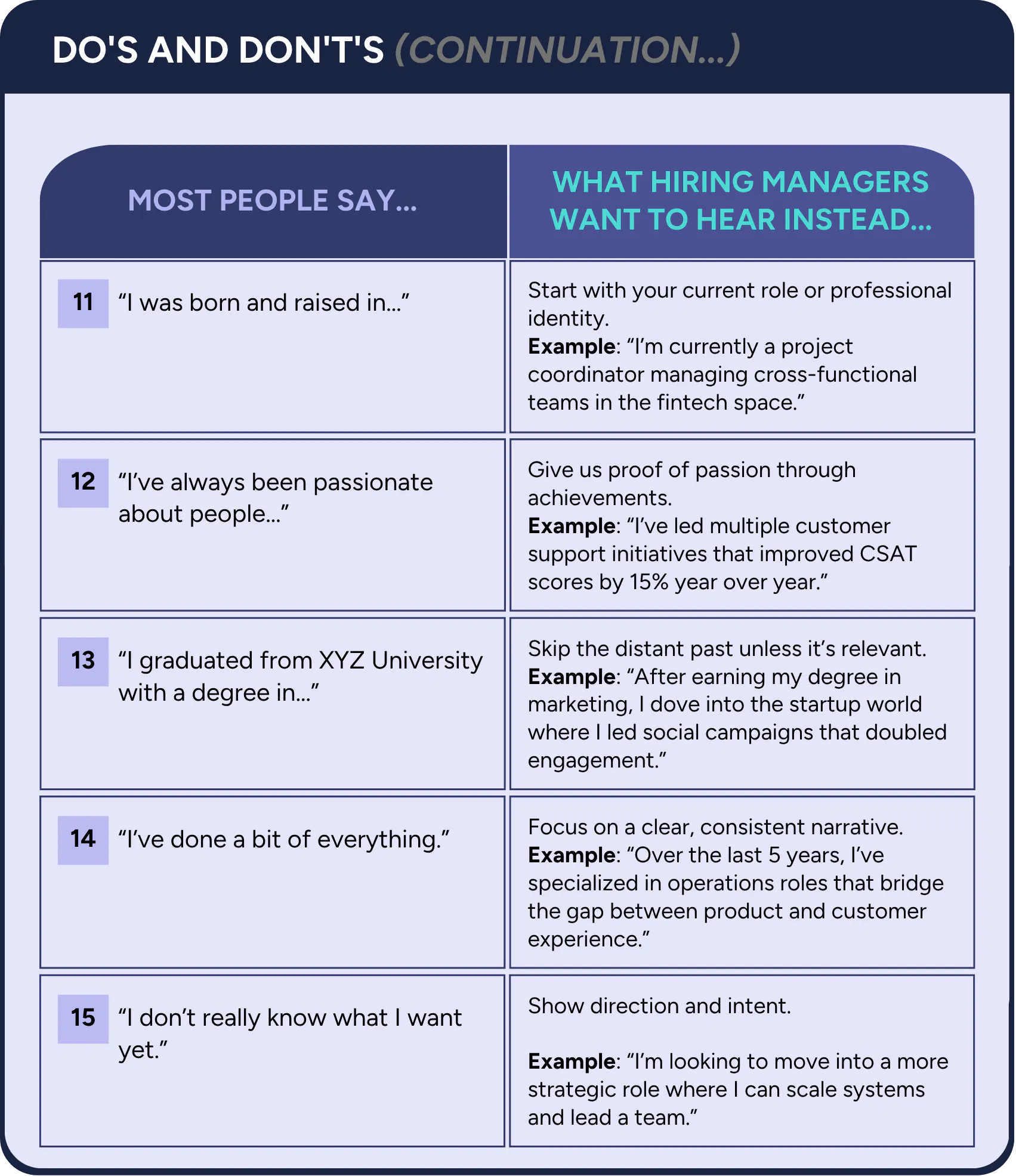
11. "I was born and raised in..."
- What to say instead: Start with your current role or professional identity. Example: "I'm currently a project coordinator managing cross-functional teams in the fintech space."
12. "I've always been passionate about people..."
- What to say instead: Give us proof of passion through achievements. Example: "I've led multiple customer support initiatives that improved CSAT scores by 15% over two years."
13. "I graduated from XYZ University with a degree in..."
- What to say instead: Skip the distant past unless it's relevant. Example: "After earning my degree in marketing, I dove into the startup world where I led social campaigns that doubled engagement."
14. "I've done a bit of everything."
- What to say instead: Focus on a clear, consistent narrative. Example: "Over the last 5 years, I've specialized in operations roles that bridge the gap between product and customer experience."
15. "I don't really know what I want yet."
- What to say instead: Show direction and intent. Example: "I'm looking to move into a more strategic role where I can scale systems and lead a team."
The Framework: Keep It Concise
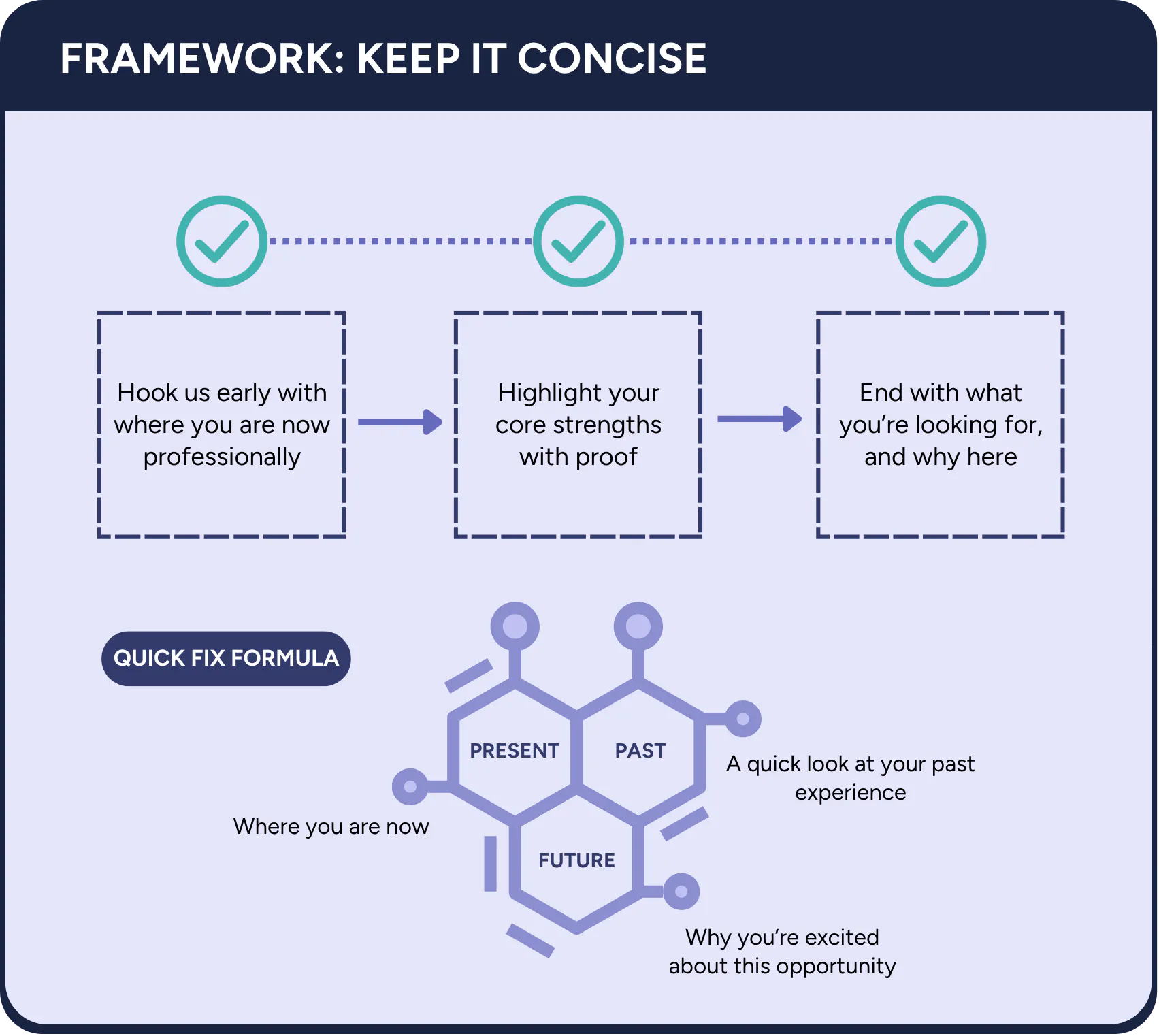
Follow this three-step structure:
- Hook us early with where you are now professionally
- Highlight your core strengths with proof
- End with what you're looking for, and why here
Quick Fix Formula: Present → Past → Future
- Present: Where you are now
- Past: A quick look at your past experience
- Future: Why you're excited about this opportunity
Examples of Strong Answers
Instead of starting with personal details or your entire work history, try these approaches:
For the project coordinator role: "I'm currently a project coordinator managing cross-functional teams in the fintech space. Over the past three years, I've consistently delivered projects on time by implementing agile methodologies that improved team efficiency by 25%. I'm excited about this opportunity because I want to scale these systems in a larger organization."
For the logistics professional: "I've spent the past 6 years in logistics, most recently optimizing vendor operations across Southeast Asia. Each role has deepened my expertise in supply chain management, and I've reduced costs by 20% while improving delivery times. I'm looking to bring this operational excellence to a company that's expanding into new markets."
Pro Tips to Remember
- They are not hiring your past. They are hiring your potential to solve their current problems.
- Use your intro to show them you understand this distinction.
- The right answer won't just introduce you—it will position you as the solution they need.
Remember, saying the right thing matters, but knowing what to avoid is equally important. Your response to "Tell me about yourself" sets the tone for the entire interview, so make it count.
This framework helps you craft a compelling introduction that focuses on what matters most to hiring managers: your ability to add value to their team and organization.

Was this content useful?