 cord
cordTechnology's Gender Pay Gap
Analysis of data on cord reveals women in technology earn, on average, £10k less than men

Data updated May 2022.
Contextual data
The average male engineer expects a salary of £67,137, while the average female engineer expects a salary of £57,878. Expected salary is here taken as a proxy for actual salary (cord asks engineers how much they expect to earn, not how much they currently earn) but, if accurate, this represents a pay gap of nearly £10,000 between the average male and female engineer - or 16%.
The average engineer identifying on cord as genderqueer/non-binary/other ("non-binary") expects a salary of £63,571.
Below, the data is explored by function, job title (among developers), seniority and years' experience, in order to compare the difference between the salaries of male, female and non-binary engineers of comparable ability and experience.
Unless clarified by context, "engineer" is used to refer to any professional who has created a profile for job-seeking purposes on cord. Engineers are carefully selected to be eligible to create profiles on cord. They require professional experience in Tech and Product-related roles, and are therefore specifically represent people working in these roles rather than, as many other statistics sometimes cover, the "Technology industry" as a whole. It is therefore felt that the data discussed here gives a unique insight into gender pay differentials among people working in Tech and Product-specific roles.
Salaries by gender and function
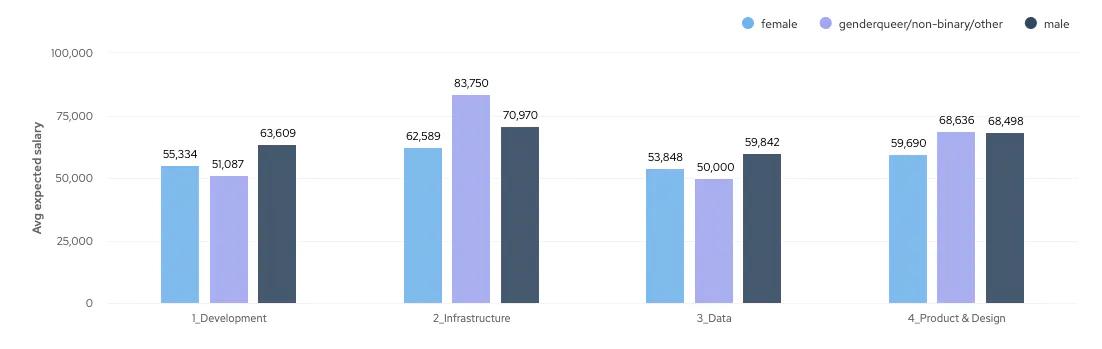
Men have higher salary expectations than women in all functions, and the highest of all genders in Development and Data. The difference is greatest in Development, where the average male salary is 14.95% higher than the average female salary, and lowest in Data, where the average male salary is still 11.13% higher than the average female salary.
Among Infrastructure engineers, non-binary engineers have the highest salary expectations, though only 4 non-binary engineers were included in the sample, so the data may be skewed. Conversely, non-binary engineers had the lowest salary expectations among Developers and Data engineers (with 23 and 7 non-binary engineers, respectively, included in the functions’ samples).
Developer salaries by gender and job title
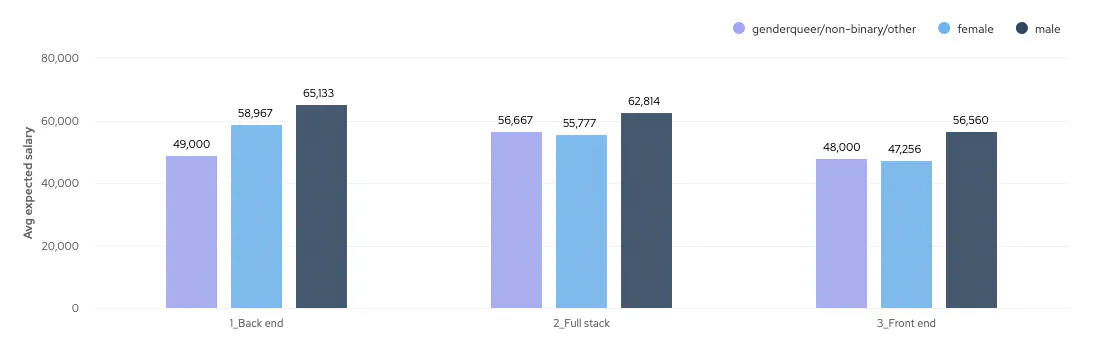
Male developers are the highest earners in every job title within Development, while female developers are the lowest earners among Full Stack and Front End developers.
The differential is greatest in Front End, where the average male salary is 19.69% higher than the average female salary, and smallest in Back End. In Back End, the average male salary is still 10.46% above that of the average female.
Salaries by gender and seniority
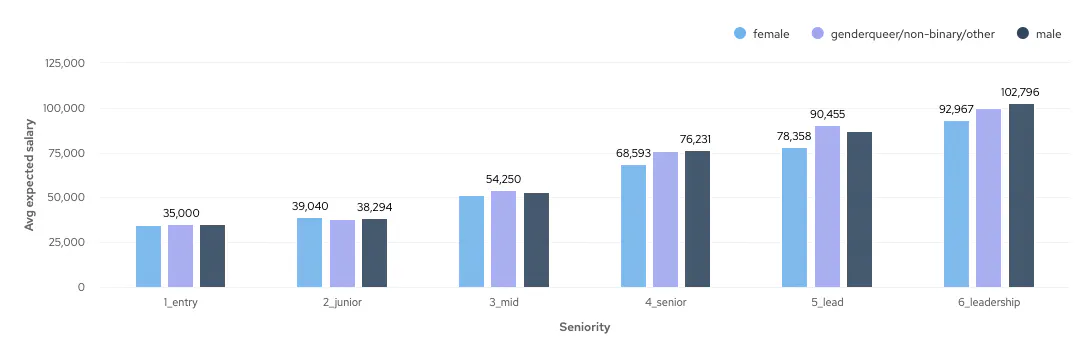
Not all of this differential is thanks to discrimination. Some of it is a result of seniority dynamics among engineers on cord. Data on gender representation shows that women on cord are disproportionately junior compared to men, so the average female engineer on cord is more junior than the average male.
When compared by seniority, expected salaries are closer from entry to mid level. At junior level, female salaries exceed those of male engineers on average.
However, from senior level upwards male salaries exceed those of females by at least 10% on average.
Non-binary engineers tend to out-earn women at all experience levels, and earn the most of all genders at entry, mid and lead level.
Key Insights
- The average male engineer expects a salary nearly £10,000 higher than the average female engineer
- Men earn more than women in every function, and in every job within Development
- From senior level upwards, male salaries outweigh females’ by at least 10% on average.
Data Disclaimer
Data refers to 46,793 engineers based in the UK looking for work on cord.
Gender is determined by one of two methods. All engineers are given the opportunity to self-ID. Roughly one quarter of engineers do so. The remainder have been assigned a gender (male or female) by a third-party predictive API (https://namsor.app/) based on their name. The API makes mistakes, but is accurate in 90-95% of cases.
All salary data is based on engineers' expected salaries on cord, which is used as a proxy for actual salary.

Was this content useful?
Table of contents
Highlights
- The average male engineer expects a salary nearly £10,000 higher than the average female engineer
- Men earn more than women in every function, and in every job within Development
- From senior level upwards, male salaries outweigh females’ by at least 10% on average.
Discussions you may like
Calculating my value
Discussion started over 6 months ago.



Evaluating working environments
Discussion started over 6 months ago.







You might also like

Working culture
Gender representation among engineers
cord data examined to reveal how well-represented different genders are in the Tech industry

Understanding compensation
How much do PHP developers earn?
PHP developer salaries broken down by experience, seniority, framework, and job salary listings

Working culture
How do gender and ethnic background affect pay in tech?
cord data from tens of thousands of engineers analysed to understand how gender and ethnic background impact salary