 cord
cordApplications per hire: cord vs job boards
October 6, 2026
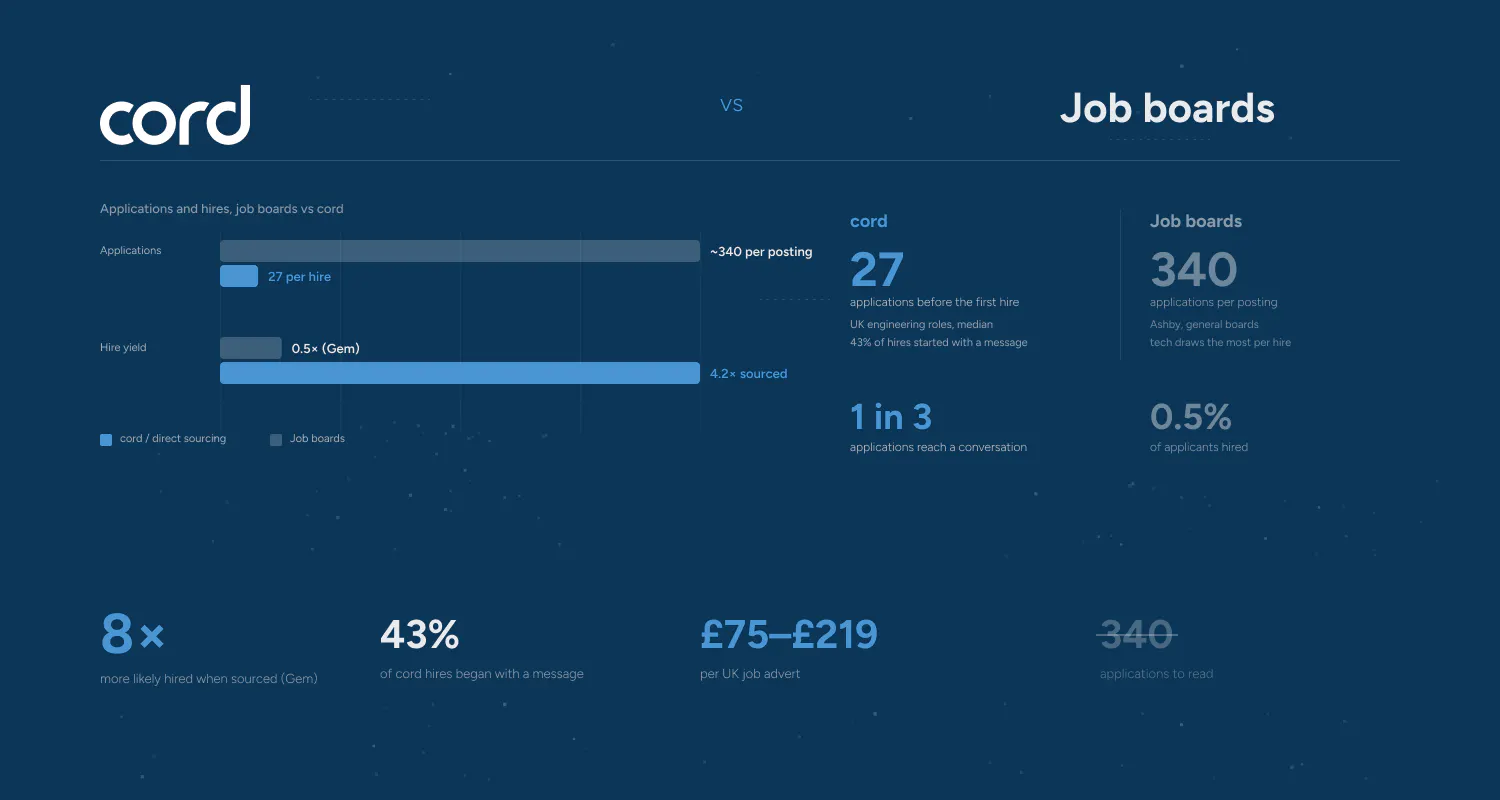
Job boards advertise a role publicly and wait for active job seekers to apply, while direct sourcing means approaching people who already fit and hiring from a pool you can reach yourself. For engineering roles the difference shows up in the numbers: a single tech posting on a general board draws around 340 applications, while UK engineering roles filled through cord took a median of 27 applications before the first hire. Volume is what job boards are built for. Fit is what hiring an engineer actually needs.
Job boards vs direct sourcing: what's the difference?
A job board is a noticeboard. You pay to post the role, people who happen to be looking find it, and your team sorts through whoever applies. Direct sourcing turns that round: the hiring team searches for people who fit, messages them, and starts a conversation before anyone has applied.
Much of what's written about direct sourcing describes something narrower. Staffing firms such as Hays and Kelly Services use the term for contingent workforce programmes, where a company builds its own bench of contractors and temporary workers instead of paying an agency markup each time. For permanent engineering hires it means something simpler: finding engineers who match the role and contacting them directly, rather than advertising and waiting.
How job boards and direct sourcing compare
- Approach
Job boards: post and wait.
Direct sourcing: search and message.
- Who you reach
Job boards: people actively looking right now.
Direct sourcing: people who fit, including those open to a move who aren't scrolling job ads.
- Volume
Job boards: high, often hundreds of applications per tech role.
Direct sourcing: low, a few dozen conversations.
- Conversion
Job boards: low, around 0.5% of applicants hired.
Direct sourcing: much higher per person contacted.
- Cost
Job boards: a fee per advert or per application, paid again for every role.
Direct sourcing: the time to search and message, or a subscription to a platform where engineers are already listed.
- Upfront effort
Job boards: almost none.
Direct sourcing: more, because someone has to find the right people and write to them.
Which one actually produces hires?
The clearest data comes from Gem's 2026 Recruiting Benchmarks Report, which covers 165 million applications and 1.2 million hires between 2021 and 2025. Job boards and company marketing channels generated roughly 90% of all applications but only about half of hires. Direct sourcing produced 11% of hires from 2.6% of applications, and sourced people were nearly eight times more likely to be hired than inbound applicants.
Looked at from the job board's side, the yield is low. Happydance's reading of the same Gem data puts job boards at 50% of applications but 27% of hires, with roughly 0.5% of applicants converting to a hire. A board's job is to maximise reach, so most of what arrives was never going to fit the role.
What UK job boards cost and who they reach
Prices change often and most boards run new-customer offers, so treat these as a guide and check each board's own pricing page.
- Indeed. Free to post, with Sponsored Jobs charged per application. For professional roles such as engineering, third-party guides put the typical cost at around $15 to $50 per application once a budget plays out.
- LinkedIn Jobs. Free to post one role at a time, with promoted posts charged per click. A UK software engineer role averages about $1.52 per applicant (Pin, 2026).
- Reed. A premium advert costs £89 + VAT and runs for up to six weeks, or you can post free and pay per application. Reed says it receives over 80,000 applications a day.
- Totaljobs and CWJobs. Both are owned by StepStone. A single Totaljobs advert costs around £149 to £219, with bundles bringing it nearer £95 a job, and adverts are cross-posted to CWJobs, the group's tech board.
- CV-Library. £149 + VAT for a 28-day advert, with a new-customer offer at £75, plus a separately priced CV database.
- Welcome to the Jungle (formerly Otta). Built for startups and scaleups, at £199 per post per month on its Starter plan.
None of these is expensive per advert. The cost sits in what comes after: the hours spent reading applications, and the reposts when the first round produces nobody worth interviewing.
How many applications does it take to hire an engineer?
On a general board, a lot. Ashby's data puts the average job posting at around 340 applicants, and tech roles draw the most applications per hire of any function. Most of that pile is filtered out on a skim, because a general board brings in whoever is looking rather than whoever fits.
Part of the reason is who's looking. In the 2025 Stack Overflow Developer Survey, 46% of developers said they weren't looking for a new role and only 15% were strongly considering one. A job ad reaches that 15%. A direct message can reach the larger group who would move for the right role but aren't checking job boards.
cord's data shows what a smaller, better-matched pool looks like. On UK engineering roles filled through cord between October 2024 and August 2026, the median role had 27 applications before its first hire, and more than a third of those applications turned into a conversation with the company. Of the engineers hired, 43% started with a message from the company and 57% with an application, and the applications were from engineers who had already said they were open to moving. Hiring was quick either way: a median of 30 days from application to hire, and 35 days from a company's first message.
Where job boards genuinely win
Job boards are the right tool when applicants are plentiful and the role is easy to assess. High-volume, local, entry-level or non-technical hiring suits them, and so does any role where you want the widest possible reach for little effort. They also cost almost nothing to try, which makes them a reasonable first step for a one-off role. Where they struggle is scarce, specialised work like engineering, where the people you want are mostly employed and not reading job ads.
cord vs job boards
- Who applies. Job boards: anyone looking for work who sees the advert. cord: engineers who have said they're open to moving.
- Applications per hire. Job boards: around 340 applications per posting on general boards. cord: a median of 27 applications before the first hire on engineering roles.
- Conversion. Job boards: around 0.5% of applicants hired. cord: more than a third of applications reach a conversation.
- Can you go to them first? Job boards: no, you wait for applications. cord: yes, 43% of hires on cord started with a message from the company.
- Cost. Job boards: £75 to £219 per advert in the UK, or pay per application, paid again each time you hire. cord: a flat subscription, around £940 a hire (Cost per hire: cord vs recruitment agencies).
- Best for. Job boards: volume, generalist and local roles. cord: engineering roles, where a small pool of the right people beats a large pile of the wrong ones.
Frequently asked questions
What is direct sourcing in recruitment?
Direct sourcing means finding and approaching people who fit a role yourself, instead of advertising and waiting or paying an agency. Staffing firms also use the term for contingent workforce programmes; for permanent engineering hires it means messaging engineers who match the role.
Is direct sourcing better than job boards?
For engineering and other specialised roles, usually. Gem's 2026 data shows sourced people are nearly eight times more likely to be hired than inbound applicants. For high-volume or generalist roles, job boards give more reach for less effort.
How many applications does it take to hire a software engineer?
On a general job board, the average posting draws around 340 applications (Ashby). On UK engineering roles filled through cord, the median was 27 applications before the first hire.
Which UK job boards are best for hiring developers?
General boards such as Indeed, Reed and Totaljobs reach the most people. CWJobs focuses on tech, Welcome to the Jungle on startups and scaleups, and LinkedIn Jobs reaches professionals. For senior or specialised engineers, direct sourcing tends to reach people the boards don't.
Is direct sourcing only for contractors and temporary workers?
No. Workforce firms such as Hays and Kelly Services use the term for contingent talent pools, but the same approach of finding and contacting people who fit works for permanent hires, and it's how a large share of engineers are hired.
A job board measures its success in applications, and on a general board a tech role gets plenty of them. The number that matters is how many of those people you'd hire, and for engineers that number is small. Start with people who fit, and you read 27 applications instead of 340.