 cord
cordTime to hire: cord vs LinkedIn Recruiter
October 6, 2026
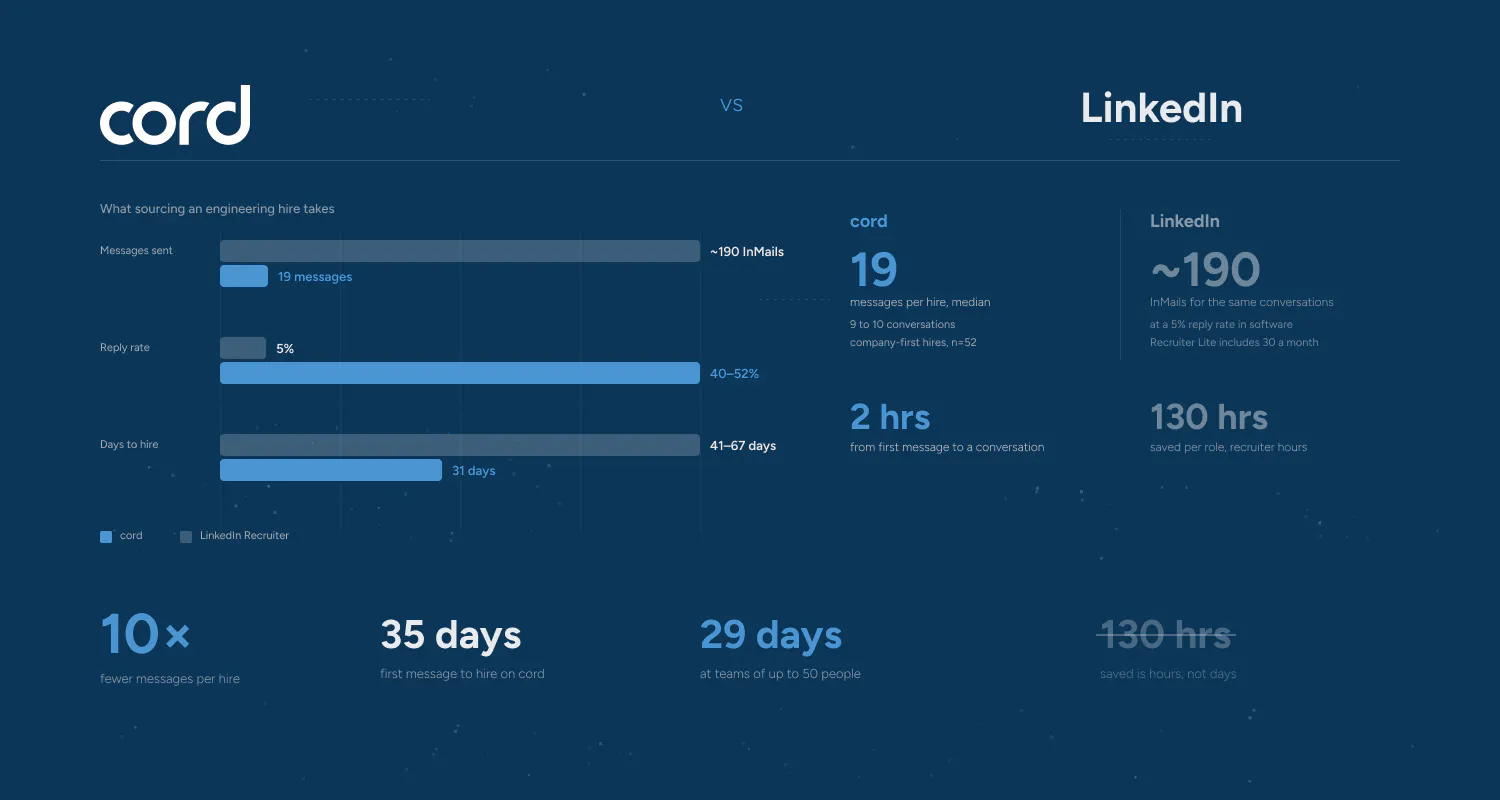
Hiring a software engineer through LinkedIn typically takes 41 to 67 days from posting the role to an accepted offer, and senior or specialist roles can run past 70. Across UK engineering hires on cord, the median was 31 days from first contact to hire, and 35 days when the company sent the first message. The interviews take about as long on any channel. The part that changes is how long it takes to get people talking to you, and on LinkedIn that's set by how few engineers reply.
How long does it take to hire through LinkedIn?
There's no published figure for hiring through LinkedIn Recruiter specifically. The numbers usually quoted measure different things, so it's worth knowing what each one counts.
Commonly quoted time-to-hire figures:
- 41 days, all roles. LinkedIn's own average for 2021, measured from search to accepted offer.
- 49 days, engineering. LinkedIn Economic Graph data reported by CNBC in 2021. This runs from application to the person's first day, so it includes the notice period.
- 67 days, software engineers. CRB Workforce's median for the first quarter of 2026. It doesn't say how the figure was measured.
For a standard software engineer role, that puts posting to accepted offer at roughly six to ten weeks. In the UK, a notice period of one to three months comes on top.
Where the time goes
The stage breakdown that comes up most often for engineering roles, drawn from daily.dev and recruiter benchmarks, looks like this:
- Sourcing and screening, 1 to 3 weeks: building a pipeline, sending messages, running first calls. This is the stage the tool affects.
- Technical interviews, 2 to 3 weeks: coding exercises and technical screens. The hiring team runs these.
- Final rounds, 1 to 3 weeks: usually the biggest bottleneck, because several people's calendars have to line up.
- Offer and negotiation, 1 to 2 weeks: approvals and back and forth on the package.
- Notice period: two to four weeks in the US, and often one to three months in the UK.
Only the first stage depends on which sourcing tool you use. Everything after it depends on how the company runs its process.
Does LinkedIn Recruiter speed up hiring?
It speeds up searching. LinkedIn says its hiring tools can save up to 130 hours per role, mostly through Recruiter's search filters, Talent Insights and InMail templates. That's 130 hours of recruiter work, though, not 130 hours off the calendar. Finding the right profiles faster doesn't help if the people behind them don't reply.
Replies are where LinkedIn sourcing gets slow. InMail averages an 18 to 25% response rate across recruiting, and around 5% in software and SaaS, the lowest-responding sector (LinkedIn, industry benchmarks). Engineers get more recruiter messages than almost anyone, and most of them go unanswered.
cord's data shows how many conversations a hire actually takes. On UK engineering roles where the company messaged first, the median hire came after 19 messages and nine or ten conversations, with replies in line with the 40 to 52% positive rate cord has published, and the conversation with the eventual hire started a median of about two hours after the first message. Getting nine or ten conversations at a 5% reply rate would take around 190 InMails. Recruiter Lite includes 30 a month.
That's the real time cost of sourcing on LinkedIn: the number of weeks it takes to send enough messages for enough people to answer. Once the right engineer is talking to you, the remaining steps take about as long on any channel. On cord, the median from first message to hire was 35 days, and most of that was interviews, feedback and an offer.
Does company size affect time to hire?
Yes, and mostly through the interview loop. Paraform's data, shared on LinkedIn, puts a full-stack hire at 22 days for a pre-seed startup and 48 days at Series D or later, with the gap between mid-round and final interviews growing from 8 days to more than 20.
Time to hire on cord by company size, first contact to hire:
- Up to 50 people: a median of 29 days, with 55% hired inside 30 days.
- 51 to 500 people: a median of 32 days, 42% inside 30 days.
- More than 500 people: a median of 39 days, 36% inside 30 days, from a smaller sample.
Bigger companies are slower on cord too, though the gap is closer to ten days than Paraform's 26. More people have to sign off, and more calendars have to line up before the final round.
What actually shortens time to hire
Most of the fixes sit with the hiring team, and they work whatever tool you source with. The guide to reducing time to hire goes into more detail.
- Message people likely to reply. A short message from the hiring manager to someone who has said they're open beats a template sent to a hundred profiles. LinkedIn's own data credits "Open to Work" targeting with response rates up to 35 to 37% higher.
- Close the gap before the final round. That's where Paraform found the days pile up as companies grow. Book the final round when you book the mid-round.
- Give feedback within two days. Every day of silence between rounds is a day for a competing offer to land.
- Plan for the notice period. A senior engineer on three months' notice who accepts in week seven starts in week twenty.
cord vs LinkedIn Recruiter
They're built for different jobs, and on time to hire the difference sits almost entirely in sourcing.
- Who you reach. LinkedIn Recruiter: LinkedIn's whole network, across every industry. cord: engineers who have said they're open to moving.
- Reply rate. LinkedIn Recruiter: 18 to 25% for recruiting InMail, around 5% in software. cord: 40 to 52% positive replies to direct messages (Response rates: cord vs LinkedIn Recruiter).
- Messages per hire. LinkedIn Recruiter: around 190 InMails to reach nine or ten conversations at a 5% reply rate. cord: a median of 19 messages per hire.
- Time to hire. LinkedIn Recruiter: 41 to 67 days posting to accepted offer for software engineers, across published benchmarks. cord: a median of 31 days from first contact, 35 when the company messaged first.
- Cost. LinkedIn Recruiter: Recruiter Lite is £170 a month with 30 InMails, and a full Recruiter seat is around $10,000 a year. cord: a flat subscription with no per-message credits.
- Best for. LinkedIn Recruiter: any role in any industry, and passive people who aren't on a specialist platform. cord: engineering roles, where reply rate decides how fast the pipeline fills.
Where LinkedIn genuinely wins
LinkedIn's reach is unmatched. If you're hiring across many roles and industries, or for someone senior who isn't looking and won't be on a specialist platform, Recruiter can find them, and its search is good. It also does a job cord doesn't try to do for non-technical roles. For engineering hires, the search was rarely the slow part. The slow part was waiting for replies.
Frequently asked questions
How long does it take to hire through LinkedIn?
Hiring a software engineer through LinkedIn typically takes 41 to 67 days from posting to accepted offer, with senior roles taking longer. LinkedIn's own average across all roles was 41 days in 2021.
Does LinkedIn Recruiter reduce time to hire?
It reduces search time; LinkedIn says its tools save up to 130 hours of recruiter work per role. It doesn't change how many engineers reply, and at around 5% in software, reply rate is what decides how long sourcing takes.
What is the median time to hire for a software engineer?
Published figures range from about 41 to 67 days from posting to accepted offer. Across UK engineering hires on cord, the median was 31 days from first contact to hire.
What's the difference between time to hire and time to fill?
Time to fill runs from publishing the job to an accepted offer. Time to hire runs from first engaging the person to an accepted offer. Workable's UK and Ireland figures for tech roles are 56 and 28 days, which is why the same hire can be described as taking four weeks or eight.
Does company size affect time to hire?
Yes. On cord, engineering hires took a median of 29 days at companies of up to 50 people and 39 days at companies of more than 500, and Paraform's data shows a similar pattern by funding stage.
LinkedIn Recruiter is very good at finding engineers. What it can't do is make them answer, and at a 5% reply rate the weeks go on sending messages rather than interviewing anyone. Send fewer messages to people who want to hear from you, keep the gap before the final round short, and the rest of the timeline is the same on any channel.