 cord
cordTime to hire: cord vs recruitment agencies
October 6, 2026
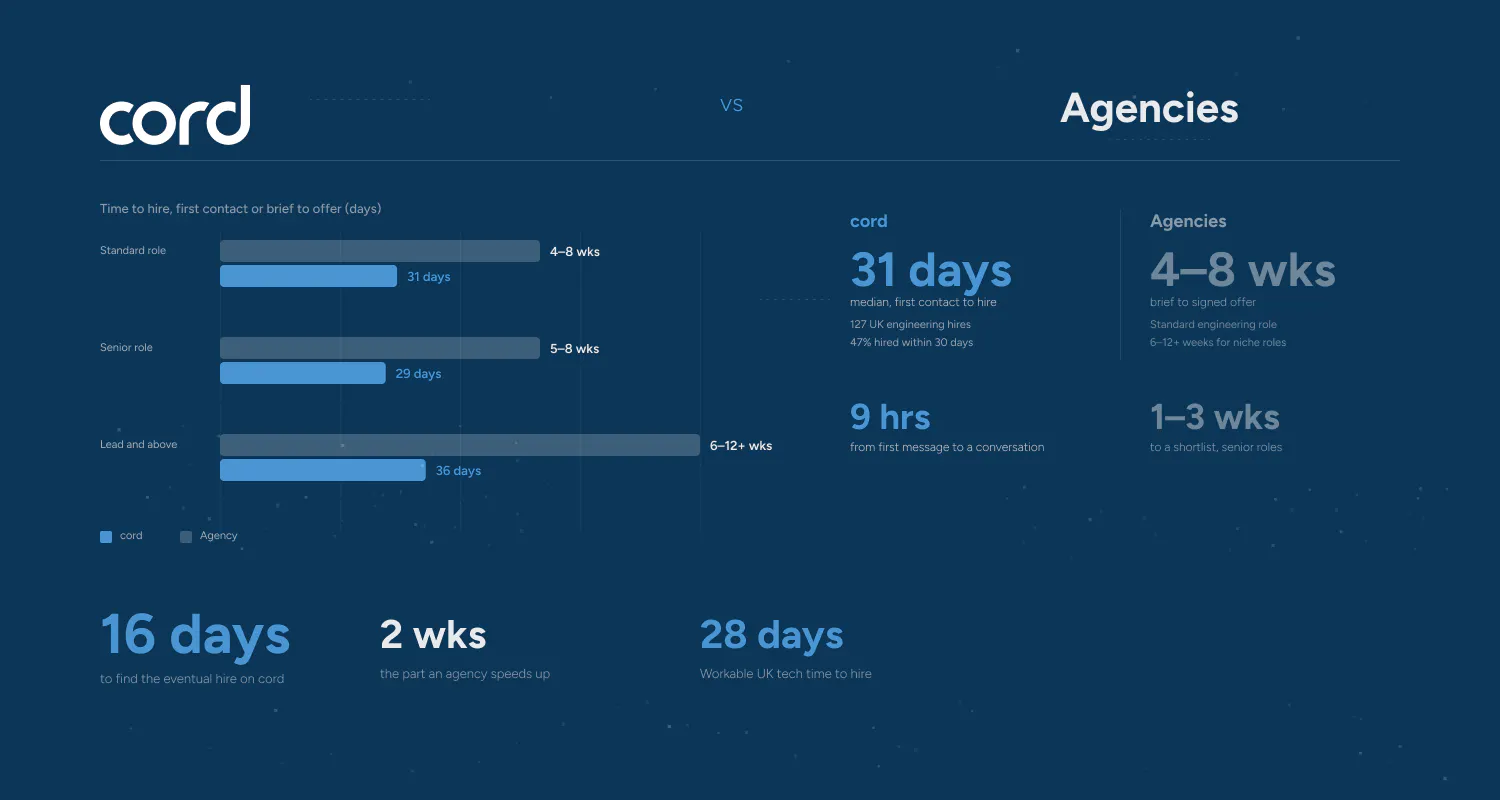
A recruitment agency typically takes 4 to 8 weeks to fill a standard software engineer role, measured from the job brief to a signed offer, and senior or niche roles run to 12 weeks or more. Hiring directly isn't dramatically quicker: across 127 UK engineering hires on cord, the median was 31 days from first contact to hire. The weeks sit in the same place either way, in the interviews, feedback and offer that the hiring team runs itself.
How long does a recruitment agency take to fill a role?
Agency timelines depend on how senior the role is and how scarce the skills are. The Maine Group, a UK agency, publishes one of the clearest breakdowns, splitting each tier into time to a shortlist and time to an accepted offer.
Typical agency timelines by role type:
- Temporary or interim roles: a shortlist in 24 to 72 hours, placed in 2 to 7 days.
- Junior to mid-level permanent roles: a shortlist in 5 to 10 working days, an accepted offer in 3 to 5 weeks.
- Senior or specialist permanent roles: a shortlist in 1 to 3 weeks, an accepted offer in 5 to 8 weeks.
- Executive or hard-to-fill roles: a shortlist in 2 to 4 weeks, an accepted offer in 6 to 12 weeks.
For software engineers, tech recruiters quote the same range. open-source.io and Halian both put a standard role at four to eight weeks, and Adria Solutions puts a mid-level tech hire at 28 to 45 days. Staff engineers, cloud architects and machine learning roles take longer. None of these figures include the notice period, which in the UK is usually one to three months on top.
Where the weeks go
open-source.io's week-by-week breakdown for a mid-level engineer is the one most often quoted, and it's useful because it shows who controls each stage.
- Week 1, scoping: writing the brief and agreeing the must-haves. Both sides.
- Weeks 2 to 3, sourcing and screening: finding people and checking they fit. This is the agency's work.
- Weeks 3 to 5, interviews: usually two or three stages, such as a technical screen and a pairing round. The hiring team runs these.
- Weeks 5 to 6, offer: salary negotiation and acceptance. The hiring team again.
- Weeks 6 to 10 and beyond, notice: the engineer works out their notice period. Nobody controls this.
Of a 4 to 8 week process, roughly two weeks are the part an agency does. The rest belongs to the company doing the hiring.
Is an agency faster than hiring directly?
Not meaningfully, because the stage an agency speeds up is the shortest one. An agency can hand you a shortlist sooner than you'd build one alone, but it can't sit your interviews or shorten anyone's notice period. Once the right engineer is in the process, the timeline belongs to the hiring team, whoever found them.
The independent benchmarks point the same way. Workable's data for IT and development roles in the UK and Ireland puts time to hire, from first engaging someone to an accepted offer, at 28 days, and time to fill, from publishing the job to an accepted offer, at 56 days (Workable, 2023). That's the agency range with a definition attached.
cord's own data lands in the same place. Across 127 engineering hires on UK roles between October 2024 and August 2026, the median time from first contact to hire was 31 days, with 47% hired inside 30 days and 83% inside eight weeks. Finding the eventual hire took a median of 16 days from the role going live, about the length of an agency's sourcing weeks, and once the first message was sent, the conversation started a median of nine hours later. What followed was interviews, feedback and an offer.
One caveat on comparing these figures: agency timelines are what agencies publish about their own process, while cord's are measured from first contact to the date the hire was recorded. They describe the same stretch of the process, not an identical one.
Time to hire by seniority: agency vs direct
Time to hire by seniority, agency against hiring directly on cord:
- Junior to mid-level. Agency: 3 to 5 weeks to an accepted offer. cord: too few hires in this group to give a reliable median.
- Senior. Agency: 5 to 8 weeks. cord: a median of 29 days from first contact.
- Lead and above. Agency: 6 to 12 weeks or more. cord: a median of 36 days from first contact.
Seniority adds about a week on cord. Agencies put the extra time at senior level down to scarcer skills and longer interview loops (Four Squared Recruitment, Adria Solutions), and neither of those changes depending on who runs the search.
What actually shortens time to hire
Since most of the timeline is the hiring team's, that's where the weeks come back. None of this depends on who does the sourcing, and the full guide to reducing time to hire goes further.
- Cap interviews at three stages. Adria Solutions recommends three at most, because every extra round is another week for a competing offer to land.
- Give feedback within two days. noxx found that a four-person hiring committee commonly stretches a 72-hour feedback loop to 7 to 10 days.
- Keep take-home tests short. Tasks that take five or ten hours shrink the pool straight away (Adria Solutions).
- Put the salary on the advert. A package below the market rate is one of the slowdowns The Maine Group lists, and publishing the band settles it before the first call.
- Name one decision-maker. The Maine Group lists a single, empowered decision-maker as a speed-up and multiple sign-offs as a slowdown.
The notice period is the one stage nobody can compress, so plan around it from the start. A senior engineer on three months' notice who accepts in week six starts in week nineteen.
cord vs a recruitment agency
They solve different problems, and on speed they end up closer than either side's marketing suggests.
- Who finds the people. Agency: a recruiter sources and screens, then sends a shortlist. cord: the hiring team messages engineers who have said they're open to moving.
- Time to a first conversation. Agency: a shortlist in 1 to 3 weeks for a senior role. cord: a median of nine hours after the first message.
- Time to hire. Agency: 4 to 8 weeks from brief to signed offer for a standard engineering role. cord: a median of 31 days from first contact.
- Cost. Agency: 15 to 25% of first-year salary, around £15,000 on a £75,000 engineer. cord: around £940 a hire (Cost per hire: cord vs recruitment agencies).
- Best for. Agency: temporary cover, executive and confidential searches, and teams with no time to run a process. cord: engineering roles where the hiring team wants to run the process itself.
Where an agency genuinely wins on speed
Temporary and contract roles are the clear case. A 24 to 72 hour shortlist is real speed, because the agency already holds a bench of people who are available now. Agencies also earn their time on executive and confidential searches, and on roles where nobody internally has the hours to screen. For a permanent engineering hire with an engaged hiring manager, the weeks an agency can save are the ones that were already short.
Frequently asked questions
How long does a recruitment agency take to fill a role?
Around 4 to 8 weeks from brief to signed offer for a standard permanent role, 2 to 7 days for temporary roles, and 6 to 12 weeks or more for executive or hard-to-fill roles. The notice period comes on top.
Does using a recruiter speed up hiring?
It speeds up sourcing and screening, usually weeks two and three of the process. Interviews, feedback and the offer take as long as the hiring team makes them, whoever found the person, and the notice period doesn't move at all.
How long does it take to hire a software engineer in the UK?
Usually 4 to 8 weeks from brief to signed offer. Workable puts UK and Ireland tech roles at 28 days time to hire and 56 days time to fill, and engineering roles on cord are filled a median of 31 days after first contact.
How long does it take to hire a senior software engineer?
Agencies quote 5 to 8 weeks for senior roles and 6 to 12 weeks or more for lead or niche roles. On cord, senior engineering hires took a median of 29 days from first contact and lead roles took 36 days.
What's the difference between time to hire and time to fill?
Time to fill runs from publishing the job to an accepted offer. Time to hire runs from first engaging the person to an accepted offer. Workable's UK tech figures are 56 and 28 days, which is why the same role can be described as taking four weeks or eight.
An agency can find people faster than a team that isn't looking. It can't make the rest of the process move, and the rest is where the weeks are. If hiring an engineer takes you two months, the time comes back from fewer interview stages and faster feedback, and that's true whether the shortlist came from a recruiter or from a message you sent yourself.