 cord
cordProgramming's LGBTQ+ Pioneers
Exploring how Christopher Strachey and Peter Landin left their mark on programming and LGBTQ+ rights
In the embers of World War II, the spark of a new age of technology lay quietly glowing. The team of codebreakers assembled at Bletchley Park, most notably Alan Turing, had in the process of cracking the Nazis’ Enigma code all but invented the field of Computer Science.
Turing, famously, was charged with “gross indecency” in 1952 for admitting to being in a homosexual relationship, and died two years later as a result of cyanide poisoning. The coroner’s report concluded that this was an act of suicide. In 2009, Prime Minister Gordon Brown issued an apology on behalf of the British Government for “the appalling way [Turing] was treated.”
Turing’s story is now well-known, especially thanks to the 2014 film The Imitation Game. This year, cord is using Pride Month to highlight some less well-known LGBTQ+ figures in the formative years and the future of Computer Science and technology.
We will celebrate the three transgender women who changed technology, as well as profiling the LGBTQ+ leaders who continue to lead the field today. Here, however, we will pick up soon after Turing’s tale left off, and tell the story of two men who had a profound impact on computer programming as we know it today, as well as on the LGBTQ+ rights movement in general: Christopher Strachey, and Peter Landin.
Christopher Strachey (1916-1975)
Working alongside Turing at Bletchley Park was a cryptographer named Oliver Strachey. Hailing from a family of distinguished scientists and thinkers, Oliver’s son Christopher had already crossed paths with Turing - the latter having become a fellow of King’s College Cambridge, at the age of 22, in 1935, the same year that Christopher joined as an undergraduate. The two reportedly knew each other socially, but it’s thought unlikely that either would have discussed Turing’s nascent research into computability.
During the third year of his studies, Strachey suffered a mental breakdown which, according to his sister, may have resulted from his coming to terms with his homosexuality. He recovered following a year spent in his uncle’s psychotherapeutic home and vacationing in the USA, and graduated with a lower-second class degree after resuming his studies. He would go on to hold a position with Cambridge University, before founding Oxford University’s Programming Research Group.
Strachey is credited with a string of firsts in computing. He built what is widely believed to be the first ever computer game - named M.U.C. Draughts (by Noah Wardrip-Fruin, the M.U.C standing for Manchester University Computing) - a checkers game that ran first (unsuccessfully) on NPL’s Pilot ACE, then later (successfully) on the Ferranti Mark 1 computer at Manchester University. He was given access to the Mark 1 by the university computer laboratory’s director; Strachey’s old acquaintance, and his father’s former colleague, Alan Turing.
He is also considered by some to have developed the world’s first computer-generated art, in the form of a musical rendition of God Save the Queen that ran on the Mark II Manchester Electronic Computer. In 1953, Strachey used a generative algorithm to produce a series of “love letters” which were enigmatically posted to the computing department’s notice board, signed off “M.U.C.”
Strachey also pioneered the concept of time-sharing, allowing multiple users to share computing resource, but perhaps his most enduring contribution to technology lies in his work on programming itself. Strachey developed the Combined Programming Language (CPL, which was an early precursor of C (via BCPL, then B)). His series of Lecture Notes Fundamental Concepts in Programming Languages also directly influenced C’s development by formalising the distinction between L- and R- values.
It’s hard to imagine modern programming without C, and ergo without the contribution that Strachey made to its early precursors. Along with the assistant he worked with while consulting in the early 1960s, Strachey played a pivotal role in the evolution of modern programming.
Peter Landin (1930-2009)
That assistant was one Peter Landin. After working as Strachey’s assistant from 1960-1964, Landin later worked for Univac and MIT, before founding the Queen Mary University computer science department.
His most profound and enduring contribution to computer science, however, was his observation that the meaning of programming languages could be expressed using mathematical logic.
In 1964, Landin published The Mechanical Evaluation of Expressions, based on four years’ research into programming languages conducted alongside his work for Strachey. This showed how to translate programs into lambda calculus, meaning that individual programming languages could potentially be universally understood from machine to machine, rather than being dependent on any individual computer’s manufacturer. It was also a fundamental concept in functional programming.
As well as this, Landin built the SECD machine, the world’s first abstract process virtual machine, and developed the ISWIM language which defined the Landin off-side rule. According to Landin's obituary in the Guardian, ISWIM also laid the groundwork for Java and Javascript.
It should be noted that, later in life, Landin regretted his contribution to computer science, viewing the field as dominated by exploitative corporate interests and facilitating surveillance states. In 1970 he effectively stepped down from active work as a professor at Queen Mary University, gaining emeritus status and continuing only in a limited role from then on, beginning to feel disillusioned at the overtly theoretical direction the field appeared to be travelling in.
From here, Landin’s efforts were directed towards social rather than technical issues. Landin was bisexual, and in the early 1970s became actively engaged with the Gay Liberation Front (GLF) and separated amicably from his wife Hanne in 1973. He was arrested during a demonstration for the Committee of 100, an anti-war group founded by Bertrand Russell, and his house in Camden became a haven for the gay community. The dinner parties he hosted there are said to have given rise to Aids: the Musical!, as well as the rebirth of Gay Pride marches during the 1980s, in the build-up to the confrontation over Section 28.
Not until 2003 - just six years before Landin’s death - would Section 28 be repealed across the UK, finally allowing LGBTQ+ workers across the country (particularly teachers, who were prohibited by the law from portraying settled LGBTQ+ relationships as an acceptable “pretended family relationship”) the right to portray their true selves at work.
A new era
Landin serves as a bridge between the foundational role that Turing and Strachey’s generation played in the evolution of Computer Science, and its crystallisation into something like the discipline we recognise today. Between CPL and ISWIM, as well as The Mechanical Evaluation of Expressions, he and Strachey laid the groundwork for programming as we know it.
Landin also, however, represents a bridge between an era during which Turing, Strachey and countless others had to keep their LGBTQ+ identities hidden from all but their closest associates, to one in which these began to form a more outwardly visible part of people's identity and work.
In the next article in this series, we will introduce three trans women who played an integral part in the development of modern computing, but who also faced cruel discrimination for their identity in the process.
References and further reading

Was this content useful?
Table of contents
Highlights
- Christopher Strachey created the world’s first computer game and computer-generated art, as well as CPL, a precursor of C
- Peter Landin, Strachey’s assistant for four years, created ISWIM and was the first to realise that programming languages can be expressed as mathematical functions
- Between them, they helped lay the foundations of modern programming
Discussions you may like
Evaluating working environments
Discussion started over 6 months ago.



Finding courage at work
Discussion started over 6 months ago.







You might also like

Working culture
Technology's Gender Pay Gap
Analysis of data on cord reveals women in technology earn, on average, £10k less than men

Professional knowledge
Leader Bio - Alla Babkina
Partner, Europe at TheoremOne

Working culture
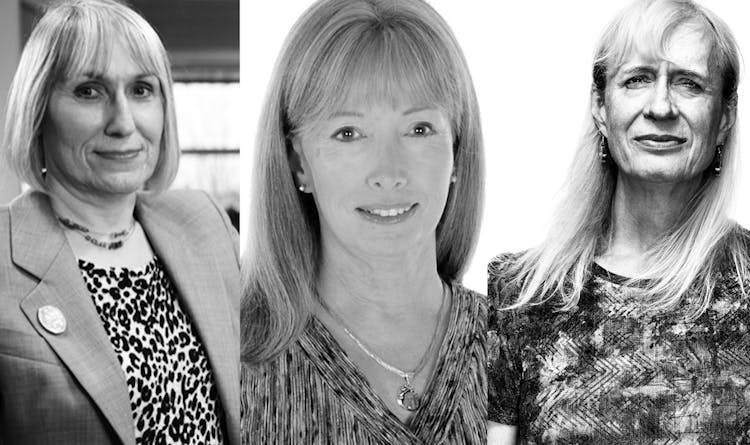
Three Transgender Women Who Changed Technology
Celebrating the contributions of Lynn Conway, Sophie Wilson and Mary Ann Horton to technology and transgender rights